


There’s a peculiar thing that happens in a quiet house on a Tuesday morning when no one is expecting anything from you. The coffee is warm. The phone is silent. And instead of feeling peaceful, you feel a low hum of guilt — like you’re supposed to be somewhere, doing something, connecting with someone.
We’ve been so thoroughly trained to equate being alone with being lonely that most of us can’t tell the difference anymore. The cultural message is relentless: stay busy, stay social, stay relevant. And so when you find yourself with an open afternoon and no plans, the instinct isn’t to savour it. It’s to fill it.
But neuroscience tells a very different story about what happens in your brain when you’re alone — voluntarily, intentionally, without apology. And that story is worth hearing, especially if you’re in a season of life where the shape of your days is changing.
The neuroscience behind solitude (it’s not what the loneliness headlines suggest)
The public conversation about loneliness has been important. The Surgeon General’s advisory, the research on social isolation and mortality — all of it matters. But somewhere along the way, solitude got caught in the crossfire.
Loneliness is the distressed feeling of insufficient connection. Solitude is the chosen experience of being with yourself. They share a surface appearance and almost nothing else.
Research by Thuy-vy Nguyen and colleagues at Durham University has demonstrated that solitude — when chosen — consistently reduces high-arousal emotional states (both positive and negative) and increases feelings of calm, peace, and relaxation. The key variable isn’t being alone. It’s whether you chose to be alone.
That distinction changes everything. And when you start making that choice deliberately, a cascade of neurological and psychological shifts begins. Here are seven of the most significant.
1. Your default mode network finally gets to do its job
Your brain has a network of regions — the medial prefrontal cortex, posterior cingulate cortex, and angular gyrus among them — that activate when you’re not focused on external tasks. Neuroscientists call it the default mode network (DMN), and it’s responsible for some of the most important cognitive work you do: self-reflection, autobiographical memory, moral reasoning, imagining future scenarios.
The DMN can’t fully engage when you’re scrolling, responding, multitasking, or performing for others. It needs quiet. It needs space. It needs you to stop doing and just be for a while.
When you treat solitude as restorative rather than something to escape, you give this network the runway it requires. That nagging feeling that you can’t think straight? It often isn’t a cognitive problem. It’s a noise problem.
2. Your emotional regulation improves — measurably
Nguyen’s research also found that solitude helps deactivate high-arousal states. That includes anxiety, irritability, and that particular brand of overstimulation that comes from too many social demands in too short a period.
This doesn’t mean solitude numbs you. It means it brings your emotional thermostat back to baseline. Your prefrontal cortex — the part responsible for regulating emotional responses — functions more effectively when it isn’t constantly managing social inputs.
If you’ve noticed that you’re more reactive lately, quicker to snap or withdraw, it might not be that something’s wrong with you. It might be that your brain hasn’t had enough time without an audience. For many people navigating the conflicting emotions that come with major transitions, regular solitude becomes the space where those emotions can finally settle.

3. You start hearing your own preferences again
This is one of the shifts, but it might be the most profound. After decades of calibrating yourself to other people’s needs — children, partners, colleagues, ageing parents — many of us lose contact with our own preferences. Not our opinions (those tend to stay sharp), but our genuine desires. What we actually want to do with a free Saturday. What kind of work still energises us. What we’d choose if no one were watching.
Solitude creates the conditions for what psychologist Donald Winnicott called the capacity to be alone — a state he considered essential for discovering authentic selfhood. When you’re always in relation to someone else, you’re always performing some version of yourself. Alone, you can stop performing.
If you recognise yourself in the pattern of being the person everyone likes but nobody truly knows, this is where that pattern starts to loosen.
4. Creativity surfaces in unexpected ways
There’s a reason so many breakthroughs — artistic, scientific, personal — happen in the shower, on a walk, or in the middle of the night. They happen when the brain’s executive control network steps back and the default mode network steps forward.
Neuroscientist Marcus Raichle, who originally characterised the default mode network, noted that this resting-state activity isn’t idle. It’s generative. The brain is making connections, testing associations, integrating experiences — all below the threshold of conscious effort.
You can’t force this process. But you can create the conditions for it. And those conditions look remarkably like a person sitting quietly in a garden, doing nothing in particular.
This is why curiosity becomes such a powerful force when paired with solitude. The space to be alone and the willingness to follow an interesting thread — that combination generates more ideas than any brainstorming session ever could.
5. Your relationships actually get better
This sounds counterintuitive, but it’s one of the most consistent findings. People who practice intentional solitude report higher relationship satisfaction, not lower.
Matthew Lieberman’s work at UCLA — detailed in his book Social: Why Our Brains Are Wired to Connect — makes the case that our social brains need rest just as much as they need connection. The same neural circuits that help you empathise with your partner, read your grandchild’s mood, or navigate a tricky conversation with a friend are the circuits that get depleted by constant social engagement.
When you recharge in solitude, you come back to your people with more presence. More patience. More of the warmth that actually matters in close relationships. Many couples discover this is especially important during retirement transitions, when suddenly being together 24/7 creates friction that neither person expected.
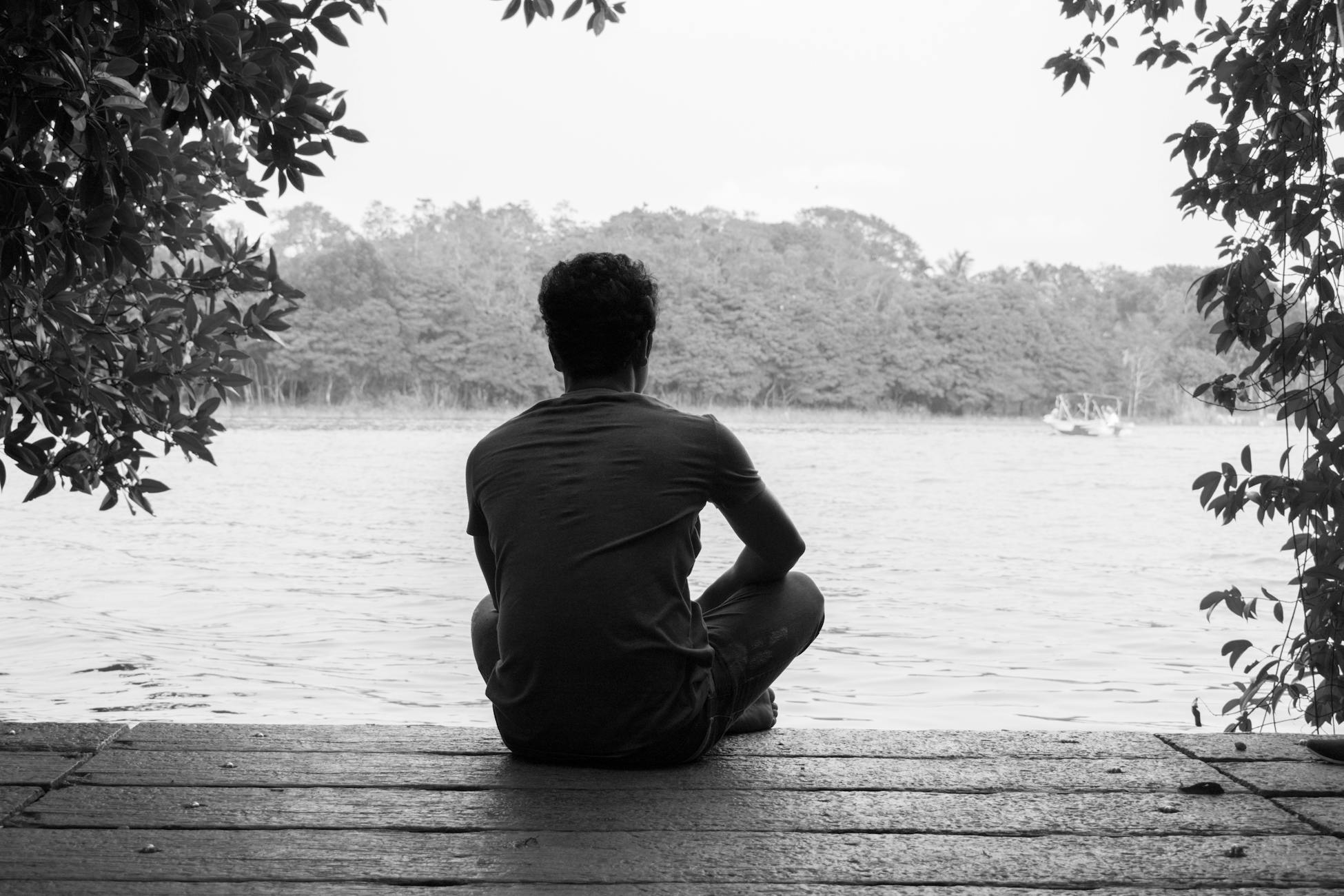
6. You develop a more honest relationship with time
Busyness distorts time. When every hour is accounted for, the days blur together and the years vanish. Solitude slows time down — not literally, but experientially. An hour spent sitting with your own thoughts, journaling, walking without a destination, or simply watching the light change across a room feels longer than an hour of back-to-back appointments.
And that recalibration matters. It’s part of what makes the difference between arriving at the end of a year feeling like it evaporated and arriving with a sense that you actually lived it. There’s a reason ending a year well requires reflection, and reflection requires time alone.
This is also where practices like journaling come alive. What feels like a waste of time in the abstract becomes, in solitude, a surprisingly powerful way to process experience and reclaim your sense of agency over your own story.
7. You stop outsourcing your sense of peace
Perhaps the deepest shift of all. When solitude becomes a practice rather than a punishment, you gradually stop needing external validation to feel okay. You stop reaching for the phone the moment discomfort arises. You stop filling silence with noise because silence feels threatening.
A well-known study by Timothy Wilson and colleagues at the University of Virginia found that many people preferred administering electric shocks to themselves rather than sitting alone with their thoughts for 15 minutes. That finding says something important — not about weakness, but about how thoroughly we’ve been conditioned to avoid our own inner experience.
Learning to sit with yourself, comfortably, without distraction — that’s a skill. It’s one the contemplative traditions have taught for thousands of years, and it’s one neuroscience is now confirming has measurable effects on wellbeing, cognitive clarity, and emotional resilience.
Making solitude a practice, not an accident
None of this means you need to become a hermit. Connection remains essential to human flourishing. What changes is the quality of your connection — and that quality improves dramatically when you’re not running from yourself into every available social interaction.
A few things that tend to help: choosing a regular time for solitude (morning works for many people, though it’s personal), protecting that time from interruption, and resisting the urge to make it productive. Solitude isn’t a more efficient way to get things done. It’s a way to remember who’s doing them.
If you’re in a season where your daily rhythms are shifting — retirement, empty nest, a career transition — this practice becomes especially valuable. The emotional complexity of retirement often catches people off guard, and solitude is one of the most reliable ways to process that complexity without being overwhelmed by it.
The invitation underneath
At its core, treating solitude as restorative is an act of trust — trust that who you are, without performance or productivity, is enough. That your company, offered to yourself, has value. That the quiet hours aren’t empty. They’re full of something your overstimulated brain has been asking for.
The ancient traditions knew this. The neuroscience confirms it. And your own experience, if you give it room, will likely tell you the same thing.
You don’t have to earn your solitude. You just have to stop apologising for it.
