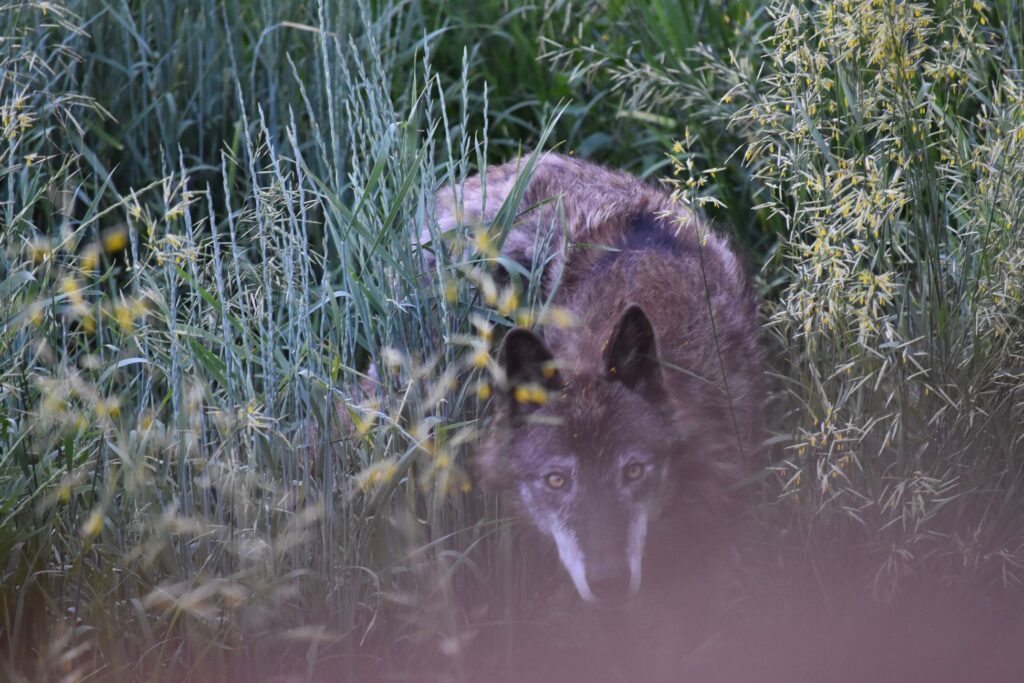
There is a story the culture keeps telling about the wolf who leaves. He walks off the ridgeline at dusk, silhouetted against a bruised sky, and the pack watches him go. The story is clean because it ends. He is either lonely or free, depending on who is telling it, and both endings are marketable.
But there is another wolf. The one who stays. The one who eats from the same kill, sleeps in the same den, answers the same howl at moonrise — and carries, all the while, a knowing the pack cannot bless. She has not left. She may never leave. And still, some quiet interior of her has already walked out past the treeline and does not intend to come back.
This is the animal worth sitting with. Not the exile. The one who belongs to two things at once.
The pack is older than your opinion of it
Wolves are not metaphors first. They are mammals, cooperative hunters, keepers of a social contract older than any language you were raised in. Field ecologists have spent decades revising the old alpha mythology; what they find, again and again, is family. A breeding pair, their young, the grown pups who stayed on to help raise the next litter. Loyalty is not sentiment in a wolf pack. It is metabolism. It is how the body eats through winter.
Your own pack works the same way, whether you call it family, culture, faith, marriage, hometown, or the small nation of people who taught you how to be a person. It fed you. It taught your nervous system what safety sounds like. When it howls, some ancient part of your chest still answers before your mind has been consulted.
So when something inside you begins to move in a direction the pack cannot follow, do not mistake this for a small problem. You are not being difficult. You are being pulled by two legitimate gravities. The pack is real. The path is real. And the tension between them is not a flaw in your character — it is the shape of a certain kind of life.
The knowing that arrives without paperwork
It rarely announces itself as rebellion. More often it comes as a small refusal that surprises you. A prayer you cannot say anymore with the old sincerity. A career your family understands that has begun to taste like tin. A god who used to answer and now, honestly, does not. A love that is kind and correct and somehow not the love you are here for. A politics your people wear like a second skin that no longer fits over your ribs.
You did not choose this knowing. It chose you, the way weather chooses a valley. And now you have to decide what to do with an inner life that has outgrown its permissions.
The temptation, at this point, is to reach for one of two clean stories. Either you swallow the knowing and go back to sleep, telling yourself it was a phase, a tantrum, a spiritual indigestion. Or you burn the whole village down in the name of authenticity, pack a bag, and become the lone wolf the internet keeps congratulating.
Both are shortcuts. Both are the pack’s story in disguise — one written by the pack that raised you, one written by the pack of the newly-departed, who need you to leave in order to feel less alone in their leaving.
There is a third animal. The one who stays in the den and refuses to lie about what she has seen.
Loyalty is not the opposite of truth
Somewhere along the way, the modern self-story taught you that honesty requires exit. That if you have grown past the people who raised you, the mature thing is to cut them off, to protect your peace, to build a new tribe of the like-minded and never look back. This is sold as liberation. Often it is just a different cage with better lighting.
The wolf who stays is doing something harder. She is holding, in one body, two loyalties that do not resolve. Loyalty to the people who fed her. Loyalty to the truth that has begun to move in her. She is not pretending the tension away. She is not pretending it is comfortable. She has simply refused to let either loyalty devour the other.
Anthropologists who study initiation cultures — the ones that still remember how to walk a young person from one life into the next — describe a threshold state, a liminal season where the initiate belongs to neither the old identity nor the new one. Traditionally, this was held by ritual, by elders, by fire. Modern life has abolished the ritual and left the threshold intact. Millions of people are standing in a doorway their culture no longer has a name for, wondering why they feel so unhoused.
You are not broken. You are on the threshold. The pack cannot bless the threshold, because the pack lives inside the house.
What the pack cannot bless, the land sometimes can
There is a version of belonging that does not require permission. It is older than the pack, and it is what the pack is a small local dialect of. Call it the land. Call it the living world. Call it the deep pattern that grew wolves in the first place, and then grew the moon they sing to.
When the human circle cannot bless what is moving in you, this larger circle sometimes can. Not as consolation prize. As correction of scale. Sit long enough beside a river and the river will not agree with you, exactly, but it will stop requiring you to justify yourself. Walk into a forest carrying a decision your family cannot understand, and the forest will neither approve nor disapprove. It will simply keep breathing, and invite you to remember that you are also a breathing thing, and that not every question you carry has to be answered by the people whose approval you were born needing.
This is not an instruction to flee into nature and skip the harder conversations. It is a reminder that the pack is not the ceiling of belonging. It is a floor. There is sky above it. Writers on this site have circled this same fire from other angles — the burning that dismantles the old self, the standing ground that refuses to flinch, the old fire that will not be domesticated. Different animals, same threshold.
The howl that does not ask for permission
Wolves howl to find each other across distance. It is a technology of location — I am here, are you there — refined over evolutionary time into something that also functions as grief, as celebration, as territory, as reunion. The howl is not a request. It is an announcement.
The wolf who stays learns, eventually, to howl her real coordinates. Not the coordinates the pack expects. Not the coordinates that would make her easier to love. The actual ones. Where she actually is. What she actually sees from that ridge.
Sometimes the pack answers. Sometimes a wolf you did not know was there answers from three valleys over, and you realize you were never as alone in this as you thought. Sometimes there is only silence, and you learn that silence is not the same as rejection. Sometimes it is just distance, and distance is workable.
What breaks people is not the honest howl. What breaks people is the years of pretending they are located somewhere they are not, so that the pack will keep answering a signal that is no longer theirs.
Staying without lying, leaving without burning
So what does the wolf who stays actually do?
She stops asking the pack to bless what the pack was never built to bless. This is not bitterness. It is accurate expectation. You do not ask a river to be a mountain. You do not ask the people who taught you the first language to also teach you the second one. They gave you what they had. The rest is your walk.
She stops confusing dissent with betrayal — her own or theirs. She can disagree with her mother and still love her mother. She can outgrow the theology and still respect the people still inside it. She can vote differently, believe differently, love differently, and still show up when someone is sick. Belonging is not agreement. It never was. Agreement is a much smaller thing that recent centuries have tried to sell as the whole meal.
She lets the threshold be long. She stops demanding that this season resolve itself into a clean identity by next Tuesday. Initiations take as long as they take. The body knows. The land knows. The rush is almost always the pack — either the old one wanting you back, or the new one wanting you to hurry up and arrive so they can count you.
She finds, slowly, the other threshold-dwellers. Not a new pack to replace the old one. A quieter constellation. People who also carry a knowing their circle cannot bless, and who have decided not to lie about it, and also not to weaponize it. You recognize each other by a certain unhurried honesty. This site has sat with that recognition before, in the piece on trusting your instinct without losing your pack. The animal keeps coming back because the question keeps coming back.
What are you actually loyal to?
Here is the question the wolf who stays eventually has to answer, and it is not the question the culture is asking her.
The culture is asking: are you loyal to the pack, or are you loyal to yourself? As if those were the only two options. As if authenticity were a solo sport. As if the self that would abandon everyone who ever loved it in the name of its own becoming were a self worth becoming.
The older question is quieter. What are you actually loyal to? Not who. What. What life, what truth, what pattern of being, what quality of attention, what kind of world are you here to keep faith with? Once you can answer that — not in a slogan, in the marrow — the pack question rearranges itself. Some people from the old circle will belong to that same deeper loyalty and will walk with you. Some will not, and you will love them anyway, from wherever you actually are.
You will not be the lone wolf of the poster. You will not be the obedient wolf of the family album. You will be the third animal. The one who stayed close enough to be reached, and honest enough to be real, and rooted enough in something larger than the pack that the pack’s blessing was no longer the weather your soul lived or died by.
The ridge is quiet tonight. The pack is asleep in the den. Somewhere in your chest, an animal is awake. What is she listening for?