

When You Can Feel What No One Is Saying
There are seasons when your biggest challenge isn’t what’s happening on the surface.
It’s everything underneath.
You walk into a room and immediately feel the tension that nobody’s naming.
You sense a shift in a relationship long before there are words for it.
You know when someone is lying to themselves—even while they’re convincing everyone else.
You might wish you could just “not notice so much.”
But your nervous system picks things up anyway.
So you adapt. You learn to stand at the edge of conversations, observing. You listen more than you speak. You hold other people’s secrets. You become the friend, partner, or guide people come to when they’re ready to be honest.
From the outside, you might look mysterious, quiet, private.
From the inside, you often feel like you’re walking a ridge between worlds:
between solitude and belonging,
between wild instinct and human agreements,
between what people say and what you can feel they really mean.
We don’t have much language for this way of being. We talk about “empaths,” “introverts,” “old souls,” but these labels can feel too neat. There’s an older image that speaks to this path more deeply:
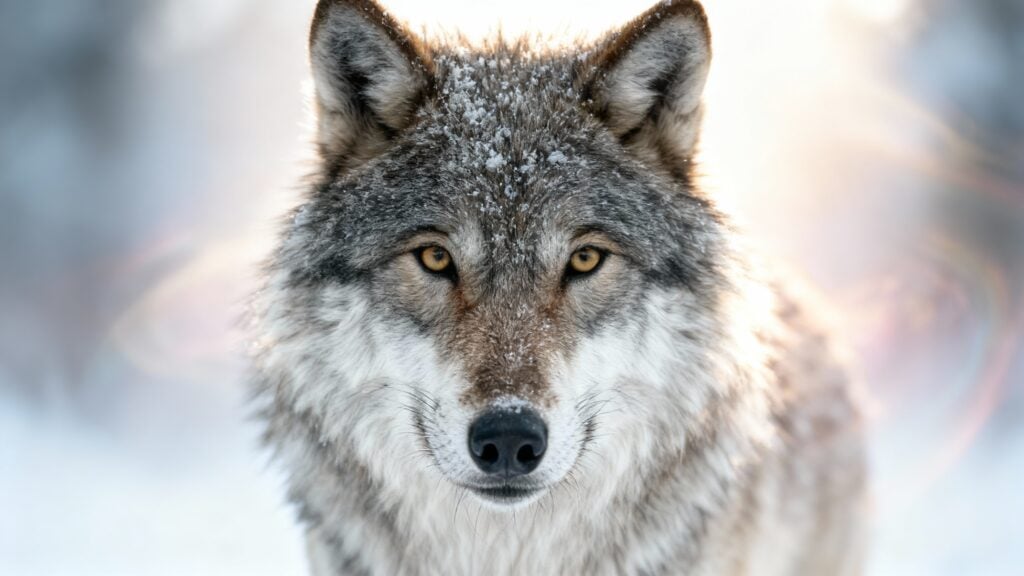
the Wolf.
The Animal at the Edge of the Firelight
For as long as we’ve told stories, the Wolf has been there in the shadows.
In some traditions, it’s feared—a symbol of danger, appetite, the wild that civilized people are trying to keep out. Think of the fairy tales where the Wolf is the predator at the edge of the village. In others, it’s revered: a teacher of loyalty, a pathfinder, a companion to gods and heroes.
Wolves live in a tension that humans recognize instinctively. They are pack animals, but not domestic. They belong together, but not inside our fences. They roam wide territory, moving through forest, mountain, and snow with a kind of silent confidence.
They survive by sensing:
the wind, the tracks, the mood of the pack.
They know when to move as one, when to split, when to rest.
This is why the Wolf persists so strongly in our imagination. It carries the archetype of the Intuitive Wanderer: part of the group but never fully swallowed by it, guided as much by instinct as by rules. It mirrors the part of us that feels more at home on the edge than in the middle—close enough to love, far enough to still hear our own inner voice.
When Instinct Turns Into Isolation
Our culture doesn’t make it easy to live as a Wolf.
We’re taught to fit in, be agreeable, follow the script. Constant noise and distraction numb the very sensitivity that keeps the Wolf alive. At the same time, we romanticize “lone wolves” as hyper-independent rebels who don’t need anyone. Both extremes miss the point.
Healthy Wolf energy is intuitive, loyal, and discerning. It knows how to move alone and how to move with its pack. It values depth over noise, truth over comfort, presence over performance.
But when this archetype is out of balance, it can become painful. You start to feel like an outsider everywhere. You sense so much that you stop trusting your perceptions. You feel responsible for everyone’s unspoken emotions, while your own needs go underground.
You withdraw to protect yourself.
You stop sharing what you really see.
You convince yourself that no one could truly understand you.
The task is not to silence the Wolf in you.
It’s to let it guide you—without letting old wounds turn instinct into chronic isolation.
3 Signs You’re Already Aligned With the Wolf in You
We all have Wolf energy inside us—the capacity to sense, to track, to move between solitude and connection. You may be naturally close to it if:
- You read the room before anyone speaks.
You notice tone, body language, small shifts. You often know when something is off long before it’s named. People sometimes say, “How did you pick up on that?” - You prefer a few deep bonds over many shallow ones.
You’re not interested in being liked by everyone. You feel most yourself with a small circle of people you trust completely, or even alone in nature or in your own space. - People open up to you quickly.
Strangers or acquaintances end up telling you things they “never tell anyone.” Your presence feels safe enough that others drop the mask without quite knowing why.
If this feels familiar, your inner Wolf is alive and walking. The invitation is to trust that sensitivity instead of treating it as a flaw.
3 Signs Your Wolf Is Wounded or Hiding
For others, Wolf energy has been pushed into the shadows. Instead of a clear instinct and loyal heart, you’re left with confusion, hyper-vigilance, or loneliness. You may need to reconnect with your Wolf if:
- You feel like an outsider almost everywhere.
In groups, you hover at the edge. You rarely feel fully “in.” You’re always half-watching, half-wondering if you belong here at all. - You doubt your inner signals—and override them.
You often have a strong gut feeling, but you talk yourself out of it. You stay in situations that don’t feel right, telling yourself you’re “overreacting” or “too sensitive.” - You disappear when things get too intense.
When conflict or emotional honesty approaches, you shut down or withdraw completely. Instead of using your instincts to navigate, you vanish to avoid being overwhelmed.
If you see yourself here, nothing is wrong with you. It simply means your Wolf has learned to survive by hiding. It’s still there—waiting for you to listen and let it come closer to the fire again.
Final Notes and My Relationship With the Wolf as a Shaman
On my own path, the Wolf has been with me for a long time.
I’ve spent years at the edge of different worlds: between the forest and the city, between Indigenous traditions and modern life, between being a guide and being a man with very human doubts. A lot of my work has been shaped by sensing what’s underneath people’s words—the unspoken grief, the quiet longing, the hidden rage.
There have been times when this sensitivity felt like too much. I isolated myself, disappeared into the forest or into my own mind, convinced that no one could truly walk with me there. I played the strong guide in groups, then retreated to deal with my own shadows alone.
Over time, something shifted. I began to see that the Wolf in me didn’t just want solitude. It also wanted a real pack—people with whom I didn’t have to perform, where my intuition wasn’t a job but a way of being.
Learning to trust my instincts without abandoning connection has been one of the deepest lessons of my life. It’s also woven through my book Laughing in the Face of Chaos: the tension between wandering and belonging, between seeing too much and still choosing to love, between standing at the edge and still saying yes to relationship, to community, to life.
If the Wolf speaks to you—if you recognize yourself as the one who feels too much, stands a little outside, sees through masks—my book is an invitation:
- To stop apologizing for your perceptions.
- To honor your need for space without exiling yourself.
- To let your instinct lead you not away from life, but deeper into the relationships and paths that can truly hold you.
