She lived alone in a terrarium for eight months, the last female of her kind anyone would ever see.
Biologist Hugh Yorkston caught grasshoppers to feed her, watching as she scurried through the fallen birds’ nest fern he’d provided for shelter. Three weeks earlier, a male shrew had been found—extraordinarily, miraculously—giving her species one final chance. But the male was aggressive, possibly ill. They kept the pair in separate containers.
The male died. The female lived on, waiting for a mate that would never come.
When she died sometime in late 1985 or early 1986, Australia’s only shrew species died with her.
This October, forty years later, the International Union for Conservation of Nature made it official: the Christmas Island shrew is extinct.
The news barely registered. Most Australians don’t know what a shrew is, much less that one counted among our native fauna. But this quiet erasure carries weight—it brings Australia’s tally of extinct mammals since European settlement to 39 species. More than any other country in the world. These losses represent 10% of all land mammals before colonization.
North America, by comparison, has lost exactly one native land mammal since European settlement.
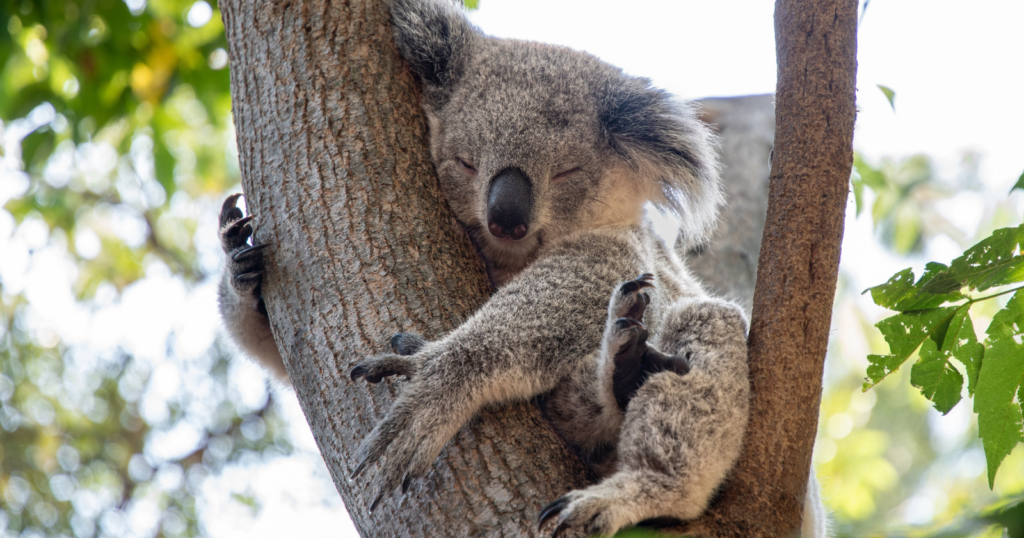
What the official announcement doesn’t mention: the pattern that killed the shrew is already at work on koalas.
The improbable survivors
The Christmas Island shrew’s story began tens of thousands of years ago with an impossible journey. A small family of shrews—or perhaps a single pregnant female—rafted on floating vegetation from what is now Indonesia. Against oceanic odds, they landed on uninhabited Christmas Island, an Australian territory about 1,500 kilometers west of the mainland.
These unlikely survivors became Australia’s only shrew species.
For millennia, they thrived. When European naturalists first visited Christmas Island in the 1890s, they remarked that “this little animal is extremely common all over the island, and at night its shrill shriek, like the cry of a bat, can be heard on all sides.” At 4.5 to 6 grams—lighter than two pennies—these tiny hunters filled the ecological niche that dunnarts and planigales occupy on the Australian mainland. Their high-pitched squeaks became part of the island’s soundscape, unremarkable because they were everywhere.
Change came swiftly. In 1900, black rats arrived as stowaways on hay bales. Worse, these rats carried trypanosomes—a cellular parasite the island’s native mammals had no defense against. Within a year, residents began seeing dying rats stumbling across the forest floor.
By 1908, the two rat species and the Christmas Island shrew were thought extinct. From thriving abundance to presumed annihilation in less than a decade.
But the shrew lived on, somehow. After not being seen for more than 50 years, two survivors were caught in the 1950s as bulldozers cleared rainforest for mining. Then nothing for another three decades.
When Yorkston and colleague Jeff Tranter found that female in December 1984, they didn’t consider it a final conservation opportunity. They kept her comfortable, fed her insects, watched her with the curiosity of field biologists who’d stumbled upon something remarkable. When the male appeared in March 1985—another impossible survival—they housed him separately. The aggressive male, the docile female, never introduced, never given a chance to breed.
The lesson here isn’t about blame. It’s about what extinction actually requires: isolation, introduced threats, and missed opportunities compounding over time.
The shrew had all three. So do koalas.
Since 1985, no one has seen a Christmas Island shrew. Only four have been documented in over 120 years. Two recovery plans were compiled. Targeted searches conducted. The most telling evidence of extinction came from absence—no shrews found in the stomach contents of hundreds of feral cats culled over recent decades.
The pattern at work
In February 2022, koalas were officially uplisted from vulnerable to endangered across Queensland, New South Wales, and the Australian Capital Territory. The Australian government’s National Koala Monitoring Program estimates between 224,000 and 524,000 koalas remain across all of Australia. But the Australian Koala Foundation—which conducts extensive field research—suggests the actual number of viable, long-term sustainable populations may be less than 60,000.
The disagreement reveals something more troubling than uncertain numbers: we’re losing koalas faster than we can count them.
In 2025, the Australian government approved the destruction of almost 4,000 hectares of koala habitat—making it the worst year on record for federally permitted clearing. That’s an area equivalent to four Sydney Airports, bulldozed for projects including coal mines. Worse, 98% of koala habitat has been cleared without even being assessed under national environmental law, thanks to loopholes.
Land clearing in New South Wales increased by 1,300 percent after the government weakened native vegetation laws in 2016. What remains is a fragmented patchwork—isolated populations unable to reach each other, genetic diversity collapsing, immune systems weakening. Like shrews in separate terrariums, koalas live in habitat islands.
At Campbelltown’s Smiths Creek, a local resident named Les Shearim identifies individual koalas by the unique black and white pigmentation on their snouts. He knows Scratch, Milly, and dozens of others by sight. This small patch of woodland—820 feet wide, two miles long—holds one of New South Wales’ last disease-free koala populations.
It’s also directly in the path of proposed highway expansions. Development assessments are pending.
Then there’s chlamydia—a bacterial infection transmitted sexually and from mothers to joeys. It causes blindness, kidney failure, and infertility. In some colonies in southeast Queensland and New South Wales, infection rates reach 50 to 70 percent. A blind koala can’t navigate trees to find food or escape predators. An infertile population can’t recover its numbers. The disease doesn’t need to kill directly—it just needs to make survival impossible.
The disease works in tandem with Koala Retrovirus, which weakens immune systems. Koalas with high retrovirus levels are significantly more vulnerable to chlamydia, especially when stressed by habitat loss.
When sanctuary becomes trap
In southwest Victoria, another crisis has been unfolding for decades, mostly hidden from view.
In the 1990s, as farming yields declined, landowners turned to Tasmanian blue gum plantations. Fast-growing trees, profitable woodchip exports—about two million tonnes shipped annually to China and Japan. Since 1995, 170,000 hectares of blue gum plantations have been established in Victoria’s southwest.
Koalas moved into these plantations by the thousands. The blue gum saplings grew into tall trees that looked like sanctuary.
Every 14 years, when the trees reach maturity, harvest machines come through. Koalas—small grey balls of fur camouflaged against silver bark—are often crushed by machinery. Wildlife rehabilitators documented the aftermath: broken limbs, severed arms, dead mothers with living joeys in their pouches. Tracey Wilson from Mosswood Wildlife brought these injuries to national attention at a 2012 koala conference. When footage leaked in 2013, the government mandated “koala spotters” before harvests.
But spotted koalas still have nowhere to go. They flee into national parks like Budj Bim, creating unsustainable densities in areas without sufficient food.
In March 2025, lightning struck Budj Bim National Park. The fire burned through 2,200 hectares—about one-third of the park—destroying large stands of manna gums, the koalas’ main food source. The park held an estimated 2,000 to 3,000 koalas before the fire—many of them displaced from surrounding plantations.
Between March 15 and May 15, more than 1,000 koalas were shot by marksmen in helicopters—nearly half the population assessed. Victoria’s Department of Energy, Environment and Climate Action authorized the unprecedented aerial euthanasia, claiming it was the most humane way to prevent suffering from starvation and severe burns in inaccessible terrain.
The public wasn’t informed until wildlife carers were tipped off weeks into the operation. Global headlines followed. Animal welfare groups demanded answers: How were koalas assessed from helicopters 30 meters up? Were joeys checked? Why wasn’t supplementary feeding attempted?
The headlines focused on the shooting. Few mentioned the blue gum plantations that had created the crisis. Or that harvesting continues in plantations surrounding the park, displacing more koalas into an ecosystem that can’t support them.
The vaccine and the bulldozers
Climate change acts as the final multiplier. The 2019-2020 bushfires killed, injured, or affected an estimated 60,000 koalas. Some 12.6 million hectares of forest burned. Rising temperatures and changing rainfall patterns are reducing the nutritional quality of eucalyptus leaves—koalas’ only food source. During heat waves, koalas leave trees to seek water on the ground, where they’re vulnerable to vehicle strikes and dog attacks. Approximately 4,000 koalas die this way each year.
In September 2024, Australia approved a world-first vaccine to protect koalas against chlamydia. Ten years of development. The results were remarkable: 64 percent reduction in mortality from the disease. In one Queensland trial, a population headed for extinction rebounded.
The vaccine works.
In 2025, the year after it was approved, habitat destruction approvals hit record levels.
In 2022, Environment Minister Tanya Plibersek pledged that Australia would prevent any new extinctions. The Threatened Species Action Plan was launched with $224.5 million in funding: no new extinctions, 110 priority species protected, 30% of land mass conserved.
By 2025, federally approved koala habitat destruction had tripled. One coal mine alone—the Vulcan South project in Queensland—was approved to destroy 1,166 hectares of koala habitat, accounting for 30% of all koala clearing approved that year.
You can develop all the vaccines you want. But you can’t vaccinate a koala against a bulldozer.
The pattern perfected
The shrew’s extinction isn’t isolated. Christmas Island has lost three of its five endemic mammal species. Yellow crazy ants have killed an estimated 20 million land crabs—keystone species that turn soil and control vegetation. Their absence has allowed forest structure to fundamentally change. The Asian wolf snake that arrived on Christmas Island caused the extinction of the Christmas Island pipistrelle bat in 2009.
An ecosystem unraveling thread by thread.
Scale that to a continent. Australia has lost mammals at an average of one to two species per decade since 1788. In 2023 alone, 144 animals, plants, and ecological communities were added to the threatened species list—five times the yearly average.
Right now, across eastern Australia, koalas live in fragmented habitat patches—isolated populations unable to reach each other. Policy in New South Wales and Queensland requires that rescued koalas be returned to their capture sites, even when those sites are dangerous or depleted. The rule aims to prevent disease spread. In practice, it keeps them confined to patches too small to sustain them.
We have the tools. The vaccine works. Habitat corridor technology exists. Translocation programs have proven successful. Scientists have mapped which populations need connectivity most urgently.
The Christmas Island shrew was officially declared extinct in October 2025, roughly 40 years after the last one died in Yorkston’s terrarium. The delay is common—it takes years to prove a cryptic species is truly gone, to complete surveys, to rule out hidden survivors.
Koalas are projected to be functionally extinct on the east coast by 2050. But if habitat destruction continues at current rates—if we keep approving coal mines that destroy thousands of hectares, if we keep allowing 98% of clearing to happen without assessment, if we keep displacing koalas from plantations into parks too small to hold them—they’ll be gone well before that.
We’ll spend the 2040s the way we spent the last four decades with the shrew: searching for survivors that don’t exist, writing recovery plans for species already lost, debating whether hope remains while the evidence says it doesn’t.
Australia earned its title as the mammal extinction capital of the world one species at a time, through a consistent pattern: introduce threats, fragment habitat, deplete populations, recognize the crisis too late, pledge action, approve destruction anyway.
Perhaps somewhere on Christmas Island, in the densest rainforest, a small family of shrews are hanging on. Perhaps the koala will defy the trajectory, will adapt fast enough, will find refuges we haven’t destroyed yet.
But extinction doesn’t care about hope or miracles or last-minute discoveries. It doesn’t need dramatic collapse or sudden catastrophe.
It just needs isolation compounding into genetic weakness. Disease finding stressed populations. Habitat shrinking faster than adaptation. Government pledges meeting bulldozer approvals. Vaccines developed while food trees fall.
It needs us to keep koalas in separate patches too small to sustain them. To approve the habitat destruction while mourning the loss. To develop solutions while eliminating the conditions that would make those solutions work.
It needs us to keep doing what we’ve perfected: understanding the solutions, recognizing the crisis, and choosing the bulldozers anyway.
Did you like my article? Like me on Facebook to see more articles like this in your feed.