

Birthdays have always felt sacred to me.
I don’t know exactly when it started. But wishing people happy birthday, even strangers, even quietly in my mind, has always made me feel good.
I just like it. I like the idea that we all have one day per year when we feel truly special. At least to someone. Or to ourselves.
I like sending a message at midnight, imagining how people feel when they see it. I like the forced pause it creates in a day.
But not everyone thinks the same. Some people would rather skip birthdays altogether. They find it uncomfortable to be seen. They don’t like the pressure of responding. They say no gifts, no celebrations, please. And sometimes, those are the very people you love the most.
So for me, not saying happy birthday is never neutral. It’s a deliberate act.
And yet this year, I chose not to say happy birthday to the most important person in my life. The person who used to be the main character of my life.
He’s turning 27 without me. The last time we talked was on September 23. That’s the new streak for no contact.
Nice. Emotional distance unlocked.
67 days of silence
It’s been 67 days since we last spoke.
I counted. I always count.
I have a note on my phone that lists the exact number of times we met, each with some extra details. Where we were. What we talked about. What I wore. Even what we ate, sometimes. Numbers always give shape to things I can’t hold anymore. I can’t help but count everything around me. It makes things real, somehow.
It makes loss traceable.
He turns 27 this week. And I’m in Berlin. Just for a day. Just long enough to walk past Alexanderplatz and feel the strange ache of being somewhere he used to describe to me.
It’s odd, isn’t it? Standing in places someone once mapped out for you, only to find they’re not there. And never will be.
Berlin didn’t feel like a reunion. It felt like a ghost tour I paid for by accident.
Last year, I wrote him a fictional story for his birthday, set in Berlin. Now I’m the one here, and there’s no story, no midnight message, no reply. For the first time in five years.
I guess even rituals run out of time eventually. Sometimes. Rarely.
A letter I didn’t read
This year, I choose the old-school method: pen, paper, and nowhere to hide.
Not a message, not a story. A real, physical letter.
I sent it through German post, not even sure if it would reach him.
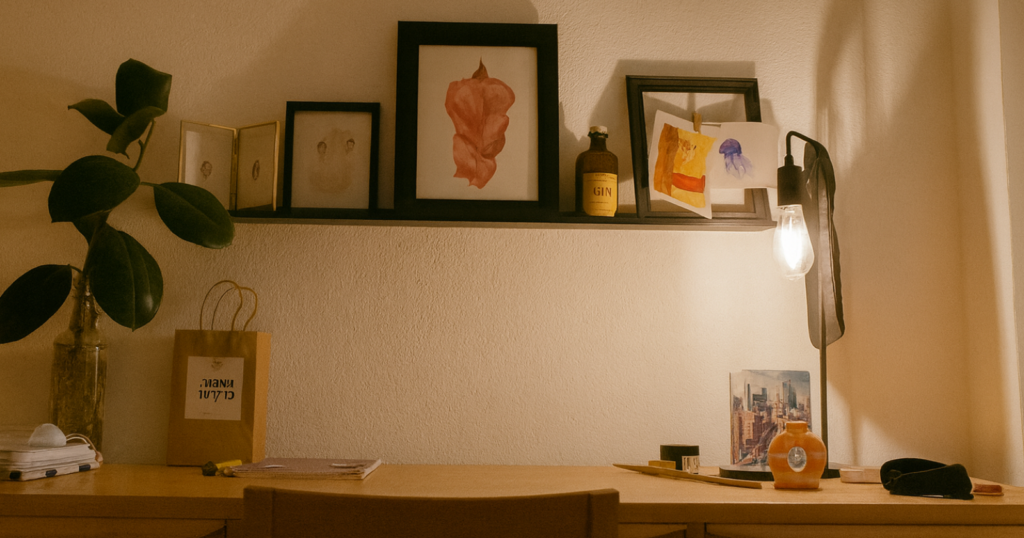
I sat in my half-lit room in Dresden, tea cooling beside me, already knowing the tears would come.
They did.
I wrote for over an hour. It was kind of writing that pulls words out from the lungs. And still, when I sealed the envelope, I felt it wasn’t enough. I hadn’t said what I really needed to say. I wasn’t ready.
I’m still not.
But I couldn’t stay silent either. So instead of sending another letter this year at midnight, I’m publishing this. Exactly at 00:00.
The grief of not knowing what happens next
It feels strange to send a letter you might never hear about again. You put so much of yourself into it, seal it, hand it to a stranger… and then it just disappears.
I don’t know if it will arrive.
I don’t know if he will be the one to find it.
I don’t know if he’ll open it immediately or throw it away.
I don’t know if it will mean something or nothing at all.
Maybe it will get lost somewhere between Dresden and Georgia. Maybe it will land in the right mailbox on the first try. Maybe a neighbor will get it and think, “Wow, this is not for me,” and quietly put it aside.
And here’s the strange part: I don’t even know what I want it to do.
I don’t know if I want it to move something in him.
I don’t know if I’d be relieved or terrified if it did.
And I don’t know what it will do to him, if anything.
That’s the part that hurts in a very quiet way. The grief isn’t just about what we’ve already lost. It’s about all the things I’ll never see: his face when he reads the first line, the way his eyes move across the page, the thoughts that show up in his mind afterwards.
Sending that letter meant accepting that the rest of the story, from that point on, lives entirely on his side.
No control.
No update.
No “and then this happened.”
Just… a blank space where “what happens next” should be.
Grief, in this form, isn’t loud. It’s not wailing or screaming or begging the universe to reverse time. It’s the quieter grief of living with questions you deliberately chose not to resolve.
There is a special kind of pain in doing something that matters deeply to you and having no idea what happened on the other side.
The unconscious knows before you do
The most absurd part?
I didn’t even know where to send it. Not the message. Not the pain. Not even the envelope.
Believe it or not, I didn’t even know where to send grief. Literally — just because I don’t know his exact address.
Well, I do know the area where he lives. But postal boxes and addresses in my country are tricky.
What I do have is a location he once marked with a heart on the map. He did that because I used to get off at the wrong train station almost every time I visited him. Finally, after 5-or-so years, he got tired and marked the right spot with a heart.
Luckily. Not that I learned how to get off at the right station, but…
So I sent the letter there. Not to him exactly. To a memory with coordinates.
The strangest thing is that I have no idea what I wrote, honestly, for one simple reason: I never read the letter.
In psychology, we call it repression. Pushing painful things out of awareness so we don’t have to deal with them every second. I’ve done it my whole life. Big emotions? Push. Awkward memories? Push. Entire three-page handwritten letter about a person I still love?
Apparently… also push.
Technically, Freud said repression is unconscious, which means you don’t know you’re doing it. I, on the other hand, am repressing with full awareness.
Because if I reread, I would start editing. And if I edited, I would start performing. And if I performed, the whole point of this letter — being as real as possible, even if it’s ugly, would die right there under a layer of nice, polite sentences.
I don’t need to be polite. Not with him.
All I know is that when I finally stopped, the pages were full, my face was wet, and the room felt slightly bigger.
Moving on isn’t linear. It’s a spiral
Psychology talks a lot about “moving on” as if it’s a direction. A clean step forward. But anyone who’s ever lost someone without a full goodbye knows: it doesn’t work like that.
It circles. It drags. It shows up in places you didn’t invite it.
Some days, you feel proud of yourself for not reaching out. Other days, you reread old messages in your head and wonder if you imagined the whole thing. If it ever really meant what you thought it did.
You might open Google Photos and see a memory from this day two years ago. Three. Four. And feel something sharp in your chest, something painful, unbearable.
At those moments, you feel physically sick.
You might wonder if you’ll ever be able to look at those pictures without flinching. Or closing the app completely. Yet, it’s all part of the same loop. The same quiet process of letting go without pretending it never mattered.
And maybe that’s why this hurts more than I expected. Because he was the one I always wrote to. Even when things were difficult, even when I was struggling. He didn’t always reply in the way I needed. But he read. He knew. He saw me in the folds of those birthday stories.
This year, I don’t know if he will see me at all.
Learning to greet myself at arrivals
There’s a difference between closure and distance. One is a decision. The other is just a fact of space.
I don’t know if I want the letter to mean something to him. I don’t know what kind of impact I want it to have. But I know I needed to write it.
I think about him often. Not constantly, but consistently. In small moments. In the way I now sip tea in silence, the way I overexplain myself to strangers, the way I walk faster at train stations.
And the hardest part of all this is that a week after sending the letter, I have to leave Dresden.
Thinking about going home without anyone waiting at the airport hits in a very specific way. My brain, being the dramatic thing it is, keeps playing a scene where he’s standing in arrivals. He spots me, I spot him, time slows down.
You know the scene, right?
But instead, I know I’ll be walking arrivals alone, dragging my huge suitcase all alone, while strangers run into hugs and long-awaited reunions.
At some point, it just lands in my mind with annoying clarity: There is no one whose job it is to wait for me at the airport. No one is officially assigned to meet me. No one gets a notification that I’ve landed and must now rush over and make my life look like a movie.
I was the one who decided to be my own main character. This is the part where the role comes with no supporting cast.
So I adjust the script a little.
If nobody is waiting for me, maybe my job is to be the one who metaphorically is. The person who knows what I’ve just gone through, who tells me, even silently, “You made it. I’m glad you’re here.”
Is it cheesy? Yes.
Is it better than emotionally abandoning myself at baggage claim? Also yes.
Some things still deserve to be written
It would be easy to tell myself that it was all a mistake. To say “he didn’t care about birthdays anyway,” and pretend that means none of this matters.
But that’s not true.
He was the most significant person in my life. He was family. Not in the blood sense, but in the “this is the person I call when I’m half-asleep and crying about nothing” sense. The “I know what your kitchen looks like in the morning light” sense.
So no, it wasn’t a mistake.
Not saying happy birthday doesn’t erase him. It doesn’t erase us.
Letting go, I’m realizing, isn’t the same as pretending it didn’t mean anything. It’s learning to hold what it meant without needing the other person to witness that holding.
And this year, instead of crafting another 00:00 letter or Berlin story just for him, I’m placing these words here — where they belong more to me than to us.
I know he will read it. Deep down, I know he still searches for my name.
Final thoughts
And still, I hope the letter arrives. Even if I never know what happened to it.
If you’re reading this and you’ve ever loved someone who disappeared from your life, someone who simply stopped being with you without ever really stopping being someone you think about — then maybe this is for you, too.
You don’t have to send a letter. You don’t have to say happy birthday. You don’t have to understand what exactly broke.
Sometimes the most honest thing you can do is to feel it.
This is what grief looks like when it isn’t trying to be fixed.
This is what staying looks like when you’re not asking for a reply. Just sitting with yourself in a half-lit room, letting a letter go into the world without needing to know where it lands.
And when you walk through arrivals with no one waiting, tired and a little dissociated, just know this: there’s no shame in wanting to be met. There’s no weakness in hoping someone is still watching, still wondering, still searching your name.
Even if no one is there, you still made it. You still returned. And maybe that’s enough.
