

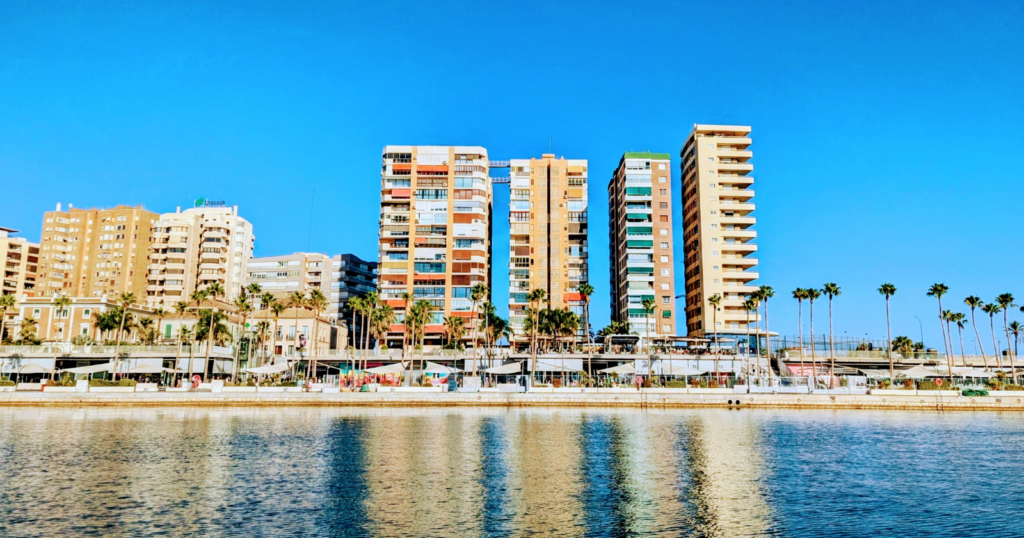
Here is what I had pictured. The sea. A coffee I would drink slowly instead of on the way to somewhere. Long walks with nowhere in particular to be. A version of me who had finally, after months of not quite catching my breath, learned how to do very little on purpose.
By the time I actually reached Málaga, I had already been evacuated from a wildfire.
I want to sit with that sentence for a second, because I still find it a little funny, in the way things are funny once they’ve stopped being alarming. I did not go looking for a dramatic story — if anything, I went looking for the opposite. Spain, evidently and once again, had other plans.
The part where the mountains caught fire
Before any of the resetting was scheduled to begin, I was in the hills outside Toledo for a personal-development project, sitting with a small group doing one of the more searching exercises of the week, when the sky started changing color. Ash first, then a shift in the light that none of us wanted to name out loud.
Within what felt like minutes, the language went from calm to unambiguous: pack your things, we’re leaving now.
We ended up at a Red Cross reception center in Talavera de la Reina, along with a few hundred other displaced people, sleeping bags and small dogs and long queues for the bathroom. This was a real emergency for a lot of people in that shelter, people who lost land and homes and years of work.
I was not one of them. I had a backpack and a return flight. Still, it is a strange thing to have gone to Spain for a program about connection and presence and safety, and to have ended up, within days, literally displaced from the place I was staying.
Even I couldn’t have written a more on-the-nose metaphor if I’d tried.
Fine, I remember thinking, somewhat deliriously, standing in a toilet queue with a stranger who had also lost track of what day it was. Málaga will fix this.
Then the airport joined in
It did not help that getting there involved its own small collapse. A delay long enough to eat an entire evening, an airport floor that became, briefly, my only stable surface in Spain, and the specific fatigue of watching a departures board refuse to commit to a gate. Nothing here was dramatic on its own — it was just one more thing agreeing to go slightly wrong, on schedule, like the trip had a theme it intended to keep.
By the time I landed, I had stopped expecting anything to go smoothly, which was probably the most useful thing that happened to me all week, even if I didn’t clock it as useful at the time.
Roughly the temperature of a convection oven
Málaga itself was gorgeous, in the specific way Spanish cities are gorgeous in August, which is to say gorgeous and also actively trying to cook you.
The heat sat somewhere in the mid-30s most afternoons, thick enough that walking two blocks felt like a small athletic event. I had pictured myself doing a great deal of unhurried wandering. What I actually did was move from one patch of shade to the next like a very tired lizard, occasionally stopping to sit in a café for no reason other than that it had air conditioning and I did not.
The sea, which I had been counting on to save me, turned out to have other ideas. It was cold. Genuinely, almost unfairly cold for how hot the air around it was, so that wading in felt less like relief and more like a second, opposite kind of shock to a nervous system that had already had a fairly eventful week. The air was trying to cook me, and the Mediterranean was trying to preserve me, and I stood there in between the two of them feeling, not for the first time on this trip, like the joke was on me specifically.
What did work, oddly, was the same thing that had already been working before any of this started: sitting still in cafés, drinking specialty coffee, watching a city move around me at its own pace instead of mine.
It wasn’t the reset I had pictured on the plane over. It was something smaller and more portable, and it got me through the worst of the afternoons.
The hike nobody asked me to take
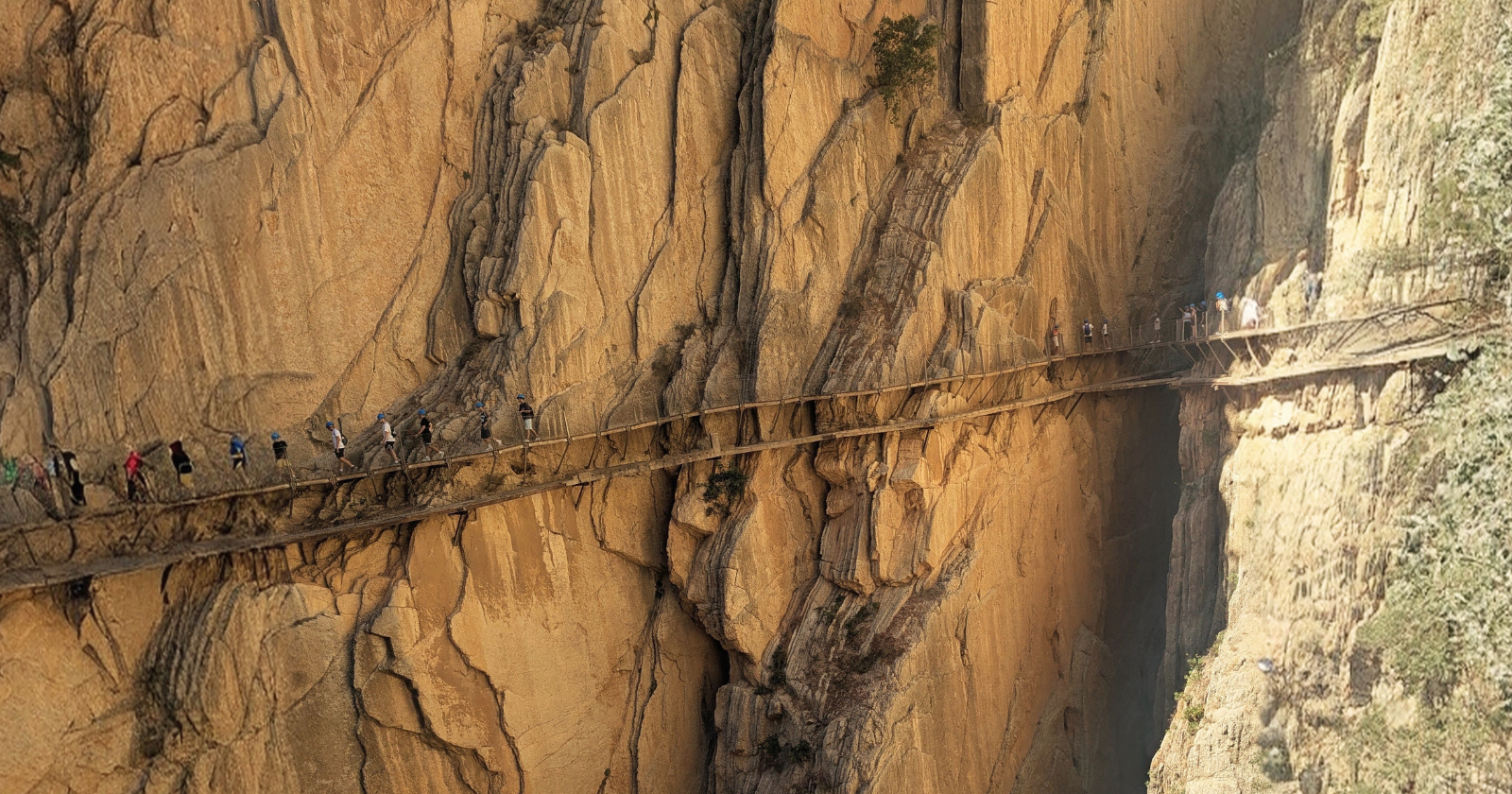
Then, on my last full day, entirely of my own free will, I decided to hike the Caminito del Rey.
If you don’t know it, it is a walkway bolted into the side of a gorge outside the city, 7.7 kilometers of narrow paths clinging to cliff faces a hundred meters above a riverbed, built originally for hydroelectric workers and now visited, sensibly, by people who book weeks in advance.
I had not booked weeks in advance. Official tickets were sold out. This was, in retrospect, the universe handing me a perfectly reasonable excuse to lie on a beach towel for a day and call the trip complete.
Instead, I spent an unreasonable amount of effort tracking down a last-minute tour operator with a single remaining spot, in the middle of a heatwave, on the one day I had left, to walk along a cliff.
Why have a relaxing holiday, I apparently asked myself, when you could climb the side of a gorge instead.
It was, without much competition, the best day of the entire trip.
Some questions aren’t actually asking for an answer. That day, mine just wanted the cliff.
What actually needed resetting
I’ve spent a fair amount of my working life reading about what makes time off actually restorative, so I’ll admit it was a little humbling to have my own week disprove half of what I thought I knew. Psychologists Sonnentag and Fritz define psychological detachment fairly plainly, as refraining from job-related activities and mentally disengaging from work during time off the job. By that definition, most of my week in Spain should have failed spectacularly. I was thinking about logistics constantly. My body had been through an actual adrenaline spike. There was very little disengaging happening anywhere.
And yet I came home from the Caminito del Rey more exhilarated than I had felt in months, not despite the exertion but because of it. Rebekka Grun von Jolk, a researcher who writes on vacation psychology for Psychology Today, puts it more precisely than I could: “Vacations that combine rest with novel, learning, and engaging activities often lead to a deeper sense of refreshment.”
Refreshment, not relaxation.
Those turned out to be different things, and I had spent the whole trip assuming they were the same one.
What if calming an overstimulated nervous system doesn’t always mean removing stimulation from it?
What if, sometimes, it means giving the nervous system something to do that it actually chose, cliff included, instead of a stillness it never asked for in the first place.
What I actually got out of it
I went to Málaga expecting to reset my nervous system. Instead, I got an evacuation, an airport delay, a heatwave that fought me for four straight days, and, through choices entirely of my own making, a cliffside hike I had no business attempting on zero sleep and a sold-out ticket.
None of it went according to plan, and I’m no longer sure the plan was the point.
Maybe the thing that actually needed resetting wasn’t my nervous system at all. Maybe it was my quiet, stubborn belief that a good trip, or a good year, or a good life, is supposed to go the way you pictured it on the plane over.
Mine didn’t, not even slightly, and I still came home lighter than I left.
