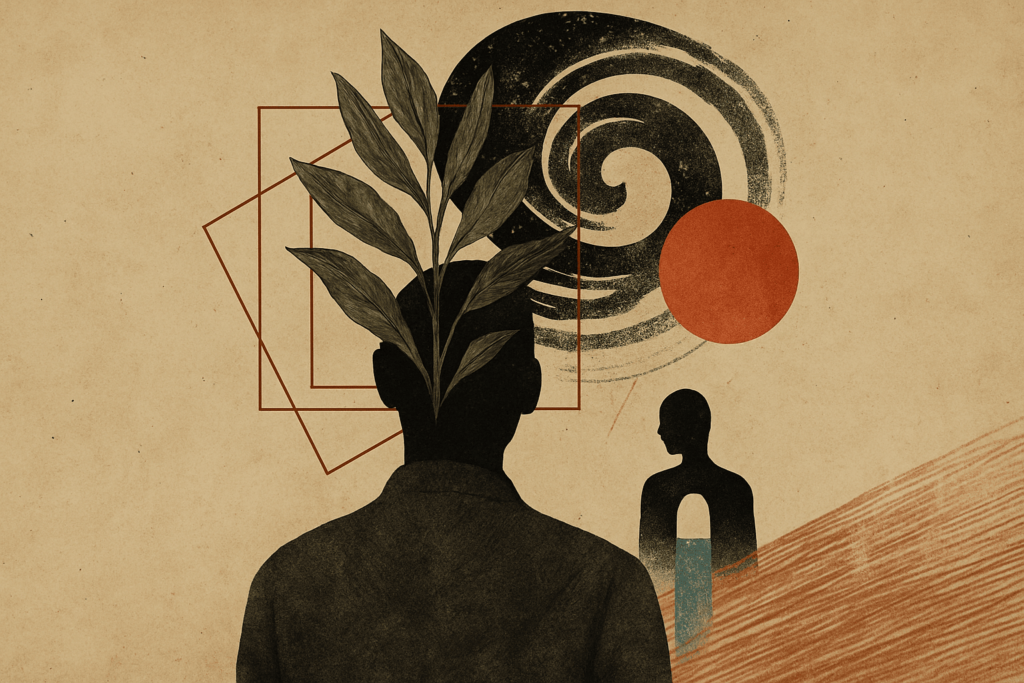
In the final months I lived in the United States, everything looked right from the outside. I was running a business, juggling projects that were “impressive” by all accounts. I had the credentials, the reputation, the kind of productivity most people mistook for purpose. But I was unraveling quietly in ways no one could see. I didn’t have time to think, let alone feel. My nervous system was in a permanent state of overdrive, like I was gripping the wheel of my life too hard without knowing where I was even trying to go. Every interaction felt like a performance. Every decision, a strategy to gain approval or maintain control. And beneath all of it, I couldn’t locate myself. I was living entirely from the outside in.
That feeling—of being estranged from your own life—is hard to name when you’re in it. It doesn’t announce itself as a crisis. It shows up in the quiet dread of Monday mornings. In the way you scroll your phone late at night searching for something you can’t define. In the strange fatigue that sleep never solves. I remember once looking out over New York from a conference room window, talking with high-level executives about scaling influence, and wondering how I’d become an expert in something that no longer felt tethered to anything real.
I had met Rudá Iandê in that same city—New York—years earlier. He wasn’t flashy. He didn’t wear the spiritual costume. But he carried something I couldn’t fake: presence. In rooms filled with people trying to prove something, he sat like someone with nothing to defend. I didn’t understand it at the time, but I felt it. We met a few times. Conversations that felt more like mirrors than exchanges. And somewhere deep inside the noise of my schedule and ambitions, I stored the feeling that I’d eventually need to see him again. Not for another conversation. For something else.
When I finally booked the ticket to Brazil, I didn’t tell many people. I framed it as a personal retreat, but it was more like a pilgrimage. Not to find answers—I was too tired for that—but to step out of the life I’d built so unconsciously. I landed in the thick air of São Paulo, then took a small plane, then a long drive down a red clay road until all I could hear was the rustling of trees and my own uncertainty. I arrived at Rudá’s home feeling like someone between worlds: no longer willing to pretend, but not yet sure how to be anything else.
What followed wasn’t a dramatic transformation. There were no lightning bolts. No sermons. Just silence, space, and a man who refused to buy into the story I’d spent decades performing. One of the first things Rudá said to me—after I tried to explain what I did, who I was, why I was there—was: “You can drop the costume now. The forest doesn’t care who you’re trying to be.”
That sentence landed like a small detonation. I’d spent my adult life building identities. The PhD student. The entrepreneur. The thought leader. The partner who always knew what to say. These weren’t lies. But they were all performances—personas carefully sculpted to gain status, admiration, safety. And underneath them, I’d lost the thread of what was true. Rudá didn’t tell me to abandon it all. He simply invited me to see it clearly. And once I did, I couldn’t unsee it.
Modern neuroscience has a name for the web I’d been trapped in: the “default mode network.” It’s the part of the brain responsible for constructing our internal narrative—who we think we are, how we compare, what we fear others might see. It’s essential for functioning in society, but left unchecked, it becomes a loop of comparison and self-monitoring. Social psychologists call it the ego project: a never-ending campaign to be seen a certain way. Every curated social media post, every strategic career move, every sentence carefully phrased to seem modest but brilliant—these are ego projects. And they are exhausting.
In Brazil, stripped of context, surrounded by nature and unfamiliarity, I began to notice how deeply I’d internalized the need to impress. Not just publicly—but in private too. My own thoughts had become an audience I was trying to win over. There were moments when I’d find myself alone, in silence, and still rehearsing. For what? For whom? I didn’t even know. The need had become reflex.
Rudá’s teachings weren’t about rejecting the ego—he wasn’t selling spiritual amnesia. Instead, he guided me to recognize the story for what it was: a well-meaning illusion. A set of protective adaptations that had once served me but now stood in the way. One evening, he told me, “The point isn’t to kill your ego. The point is to see it clearly enough that it no longer runs your life.”
That clarity didn’t arrive all at once. It came in waves—usually when I least expected it. Watching the light shift through trees. Sitting in a hammock, doing nothing. Listening to the sound of my own breath. Without the constant noise of achievement and productivity, my nervous system began to downshift. And in that space, I started to feel something unfamiliar: presence without performance. Existence without strategy.
But something else showed up too, just beneath the silence: fear. Not loud or dramatic, but insidious. A tremor in the gut. A question that kept whispering, “If you’re not who you’ve always claimed to be, then who are you?” It was terrifying. For someone who had built an entire life on certainty, to sit in that kind of not-knowing felt like standing at the edge of a cliff with no rope. And yet, slowly, I learned to listen.
Fear, Rudá said, isn’t the enemy. It’s energy. Pure life force. It’s what sharpens the senses, alerts us to change, and holds the key to our instincts. Western psychology often treats fear as a symptom to be managed, while shamanic traditions see it as a threshold to cross. Both perspectives have their place—but in that space, barefoot in the forest, fear began to feel like an invitation. An inner drumbeat asking me to stop running and start listening.
The irony is that for all my supposed intellect, I had ignored my body for years. My gut, in particular, had always been the place where truth tried to speak—tightening in meetings where something felt off, fluttering in conversations where something clicked. Only I’d overruled it constantly in favor of logic and strategy. Yet science now affirms what ancient traditions have always known: the gut is lined with over 500 million neurons—an entire network known as the enteric nervous system. It’s not just a metaphorical compass; it’s a biological one.
As I settled into this new relationship with fear and instinct, my choices began to change. Not dramatically at first, but subtly. I’d find myself saying no to things I couldn’t rationally explain, simply because they felt wrong. I’d pause before answering questions, allowing my body to register truth before my mind leapt in with polished responses. And slowly, reality started to reconfigure.
The external shifts followed quietly. My work became less about scale and more about substance. I no longer pursued partnerships based on prestige, but on resonance. I began to create offerings—videos, articles, projects—not to build a brand, but because they felt necessary. And paradoxically, they reached more people. When you stop trying to impress, people feel it. It’s magnetic in a different way.
My relationships changed too. I found myself drawn to people who weren’t dazzled by my resume. People who listened with their whole body. People who weren’t trying to fix me, but also wouldn’t let me lie to myself. I lost some connections along the way. But what I gained were human beings I could sit in silence with, and still feel understood.
Even the small things changed. I moved more slowly. I cooked differently. I dressed not for effect, but for ease. Life took on a tactile quality—as if I had been living in grayscale and color had returned. It wasn’t always comfortable. But it was real.
Fulfillment, I learned, isn’t a peak experience. It’s a steady frequency. It comes not from acquiring, proving, or arriving—but from aligning. From living each day as if it were a quiet yes to your deeper nature. The science of fulfillment is still catching up to the art of it. But both point to the same thing: we are healthiest, happiest, and most impactful when we stop contorting ourselves into what the world wants and start listening to what life is asking of us.
There are still moments when I feel the old reflex—the need to impress, the fear of being overlooked. But I no longer build from that place. I let it pass like weather. And then I return to that red clay road in Brazil, where a man I respected looked me in the eye and told me the forest didn’t care.
And neither, now, do I.
Did you like my article? Like me on Facebook to see more articles like this in your feed.