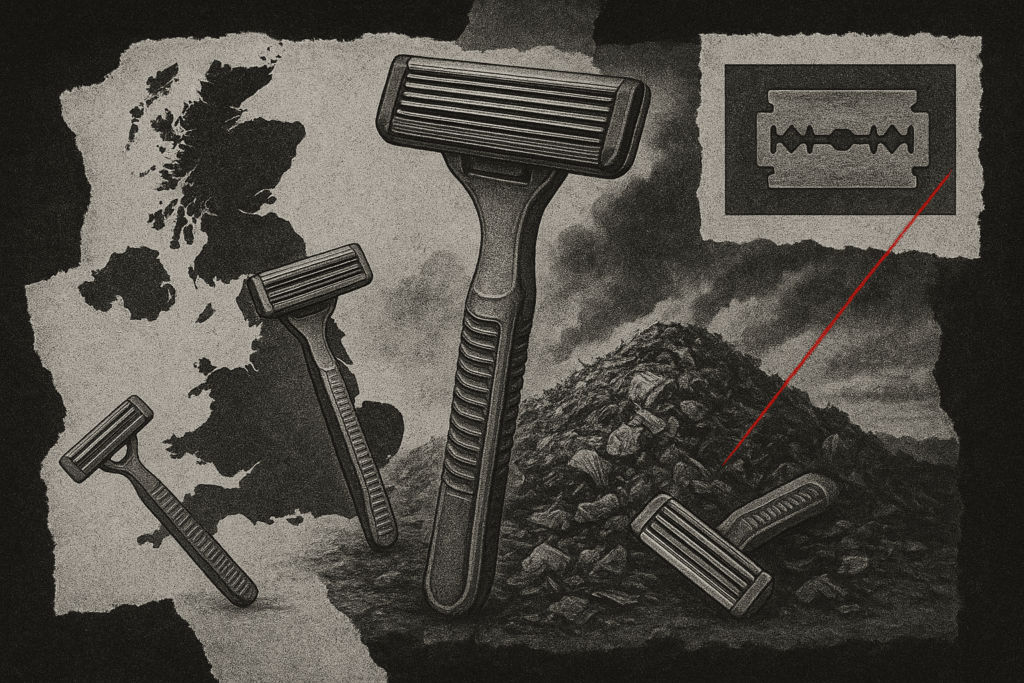
Every morning, as steam fogs bathroom mirrors across Britain, millions of hands reach for the same small plastic object. A few swift strokes across skin, then into the bin it goes—another disposable razor meeting its end after just a handful of uses. This daily ritual, repeated in bathrooms from Glasgow to Brighton, feeds a hidden environmental crisis that dwarfs the impact of plastic straws and shopping bags we’ve spent years debating.
The numbers tell a startling story. In 2020, 5.45 million people in Great Britain used disposable razors, while another 13.36 million opted for refillable systems. Yet even this seemingly more sustainable choice generates substantial waste through constant cartridge replacement. When combined with the reality that the average person who shaves daily can go through 40-50 disposable razors per year, the scale of Britain’s razor waste problem becomes clear. Conservative estimates suggest that tens of millions of razors and razor components end up in UK landfills annually—a figure that could easily approach 80 million when accounting for all disposable razors and cartridge refills.
This waste crisis has quietly enriched a handful of corporate titans who have built empires on our need to shave—and throw away. At the apex sits Procter & Gamble’s Gillette, the undisputed king of razors. According to Euromonitor data, Gillette sold $6.22 billion of men’s razors and blades and $1.28 billion of women’s razors and blades worldwide in recent years. The company P&G acquired for $57 billion in 2005 still dominates the global market, holding a 52.8% market share of men’s razors and blades in the U.S.
Behind Gillette lurks Edgewell Personal Care, the corporate home of Schick and Wilkinson Sword brands. BIC Group, the French company better known for pens and lighters, has carved out a profitable niche in ultra-cheap disposability. BIC produces around 2.6 billion shavers and 4.9 billion blades every year, feeding a global appetite for throwaway convenience.
The environmental consequences stretch far beyond British shores. The EPA estimates that at least 2 billion disposable razors are thrown into landfills every year in the United States alone. Globally, the picture becomes truly staggering: about 5,000 billion disposable razors are used per year worldwide, according to research by BEYOND PLASTIC.
What makes this waste particularly insidious is its persistence. Unlike paper or organic waste, disposable razors are made from a combination of plastic and metal, which are not biodegradable and can take hundreds of years to decompose. During this extended decomposition period, they can leach harmful chemicals into soil and waterways, creating contamination that outlasts the people who discarded them.
The recycling myth compounds this environmental nightmare. Disposable razors present a perfect storm of recycling challenges: they’re made from multiple materials that are difficult to separate, their sharp blades pose safety risks to workers, and their small size makes them economically unviable to process. As Stephanie Moses from TerraCycle explained to HuffPost: “In order to send it through your curbside or municipal recycling program, the logistics and processing of the razors is actually more than the value of the material for the processing facilities. They can’t make a profit from it, so it’s deemed non-recyclable.”
Faced with mounting environmental pressure, the razor giants have launched various “sustainability” initiatives that critics argue are more about marketing than meaningful change. Gillette partnered with TerraCycle to create the first nationwide program for recycling disposable razors. Yet the program remains impractical for most consumers—as of 2019, there were only 200 recycling centers, and those without nearby drop-off points must pay shipping costs to mail used razors to TerraCycle.
The irony runs deeper than corporate greenwashing. King Camp Gillette’s original 1904 invention—the safety razor—was designed to last a lifetime. The original version was made of high-carbon steel, but in the 1960s Gillette figured out how to use stainless steel for blades, making them last much longer without rusting. Around the same time, BIC introduced the first fully disposable razor, marking the beginning of our throwaway culture.
This shift reflects a broader transformation in corporate thinking. The razor industry operates on what’s known as the “razor-razorblade model”—selling handles cheaply and making profits on replacement blades. But for disposable razors, the entire product becomes the profit center, creating powerful incentives for waste. When entire disposable razors can be manufactured and sold for under a pound, economic incentives push consumers toward the most wasteful option.
The human cost extends beyond environmental degradation. In the U.S., 158.10 million people used disposable razors in 2020, a figure projected to increase to 160.16 million by 2024. Back in the early 1990s, the U.S. Environmental Protection Agency reported that America produced 2 billion disposable razors and blades annually. Today’s numbers likely far exceed those estimates.
Yet change remains possible. The solution isn’t necessarily to stop shaving—it’s to return to more sustainable practices that our grandparents would recognize. Modern safety razors offer what environmentalists call a “circular economy” approach: durable handles that last for decades, paired with recyclable metal blades. The only part of a safety razor that needs disposal is the blade, and many users collect used blades in containers to take to scrap recycling plants.
The corporate response reveals the industry’s priorities. Despite P&G’s decision to write down Gillette by $8 billion in 2019 and an 11% decline in the U.S. men’s market for shaving products over five years, the major players continue doubling down on disposability rather than sustainability.
The razor waste crisis embodies a broader cultural shift that has normalized the absurd: using a product designed to last minutes to remove hair that will regrow within days, then discarding that product where it will persist for centuries. As Darby Hoover, senior resource specialist at the Natural Resources Defense Council, observed: “I think we have to look at that as part of the overall culture and crisis of disposable plastic items. We keep making more and more things from plastic, which is a nonrenewable fossil fuel-derived material, and then we keep using these things once and throwing them in a landfill. It’s ludicrous and outdated at this point.”
Every morning, as those millions of hands reach for disposable razors across Britain, they’re participating in a system that prioritizes corporate profits over environmental responsibility. The tens of millions of razors and razor components entering UK landfills annually represent more than waste—they embody a culture that has forgotten the difference between convenience and necessity. Until we remember that difference, every morning shave comes with a hidden cost that will outlast us all, buried in the ground beneath our feet, a testament to the shortsightedness of our throwaway age.
Did you like my article? Like me on Facebook to see more articles like this in your feed.