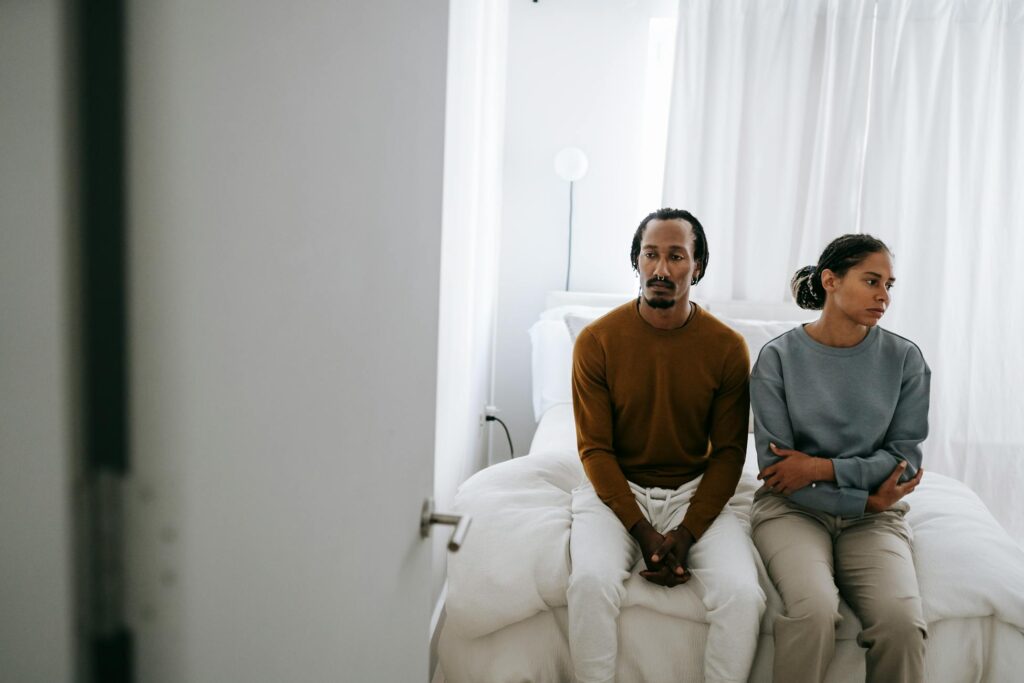
The generation born between 1955 and 1970 didn’t grow up watching love. They grew up watching maintenance. Two adults sharing a kitchen, a mortgage, a set of in-laws, a Sunday roast, and a pact never to discuss what was missing. The vows held. The marriages held. And underneath the holding, a quieter inheritance was being passed down, a set of unspoken rules about what love is supposed to feel like, how much of yourself you’re allowed to want, and what you’re expected to swallow in exchange for being chosen.
Most contemporary writing about this generation frames them as the lucky ones, with stable homes, intact families, parents who stayed. The conventional read is that watching your parents stick it out gave you a model of commitment that the divorce-saturated cohorts behind you never got. That framing isn’t wrong, exactly. But it misses the strange weight of being raised by people who were partners on paper and strangers at the dinner table. The model you absorb in that house isn’t commitment. It’s containment.
I want to walk through the eight quiet beliefs about love I think a lot of this cohort still carries, beliefs that may have never been said out loud, never been examined, and never quite stopped working in the background.
1. That love is something you tolerate, not something you receive
If you grew up watching your mother sigh through forty years of a marriage she never named as unhappy, you learned that love is endurance with a wedding ring on it. You learned that the measure of a good partner isn’t whether they make you feel alive, but whether they show up, pay the bills, and don’t leave. Pleasure was never part of the equation. Receiving, being adored, being delighted in, being actually known, wasn’t on the menu.
Many people in this cohort still flinch at being doted on. They mistake softness for performance. They wait for the catch. The patterns we form by watching our caregivers can shape how we read affection later. If affection wasn’t part of the script you watched, you may still be translating it as suspicious.
2. That wanting more makes you ungrateful
The duty generation of parents didn’t have language for emotional dissatisfaction. They had language for catastrophe, illness, money, war, and they had language for gratitude. Anything in between was vanity. So when their kids grew up and started feeling that tug of this isn’t quite enough in their own marriages, the inherited reflex kicked in: count your blessings, stop romanticizing, grow up.
This belief is one of the quietest and most corrosive. It convinces otherwise thoughtful people that their longing is a character flaw. That if their partner isn’t cruel, isn’t unfaithful, isn’t broke, what right do they have to feel lonely inside the marriage? Advice columns are full of letters from people in their seventies still negotiating with this question, decades after it first showed up.

3. That conflict means the relationship is failing
Their parents didn’t fight. Or rather, their parents fought in the corridor between the bedroom and the bathroom, in clipped tones, behind closed doors, with the TV turned up. Conflict was treated as evidence that something had gone wrong, not as the normal friction of two interior lives rubbing against each other.
So this cohort often grew up associating disagreement with danger. They became experts at smoothing, deflecting, withdrawing. Many of them still cannot tell the difference between a healthy argument and a relational emergency. The body reads both as collapse. Many long marriages experience their first real argument in the late fifties, when the kids leave and the strategy of avoidance finally runs out of cover.
4. That a good partner is a useful partner
The duty marriages were functional arrangements first. He earned, she ran the house, or some negotiated variation. Love, if it appeared, was a bonus on top of the operational structure. Children of these marriages absorbed the math without realizing it: you choose someone who works, not someone who moves you.
Decades later, you can hear it in how they describe their long-term partners. He’s a good provider. She’s a great mother. He’s never given me any trouble. All true. All also a deflection from a question nobody taught them to ask out loud, which is whether they actually like the person they wake up next to. Mate-selection patterns often echo the templates we watched, often in ways we don’t notice until we’re well inside them.
5. That leaving is a moral failure
Their parents didn’t leave. Even when leaving would have been the kinder, saner, more honest choice, they didn’t leave. So this generation grew up with a moral framework in which staying is virtue and leaving is collapse, regardless of what’s actually happening inside the marriage.
This belief is why so many people in this age bracket end long marriages with profound shame rather than relief. They watched their parents perform endurance as the highest expression of love, and now any decision to choose themselves feels like a betrayal of the lineage. There’s a particular grief in this, the grief of finally giving yourself permission to want something better, and discovering you also have to grieve the part of yourself that was raised to never want it at all.
6. That intimacy is what happens after the kids are asleep
Watching parents who treated romance as a private, almost embarrassing footnote to family logistics teaches you that desire is a back-room activity. Affection in front of the children was rare. Tenderness was rationed. The actual texture of romantic intimacy, playfulness, longing, sustained attention, was never modelled in daylight.
So the cohort grew up to be perfectly capable of marriage as a household but often clumsy at marriage as a relationship. They can divide labour, raise children, manage holidays, look after aging parents. What they often cannot do, without a great deal of unlearning, is sit across from their partner and let themselves be seen.

7. That the children will be fine if the structure holds
This is maybe the most painful belief, because it’s the one their parents told themselves to justify staying, and now it’s the one they’re learning was never quite true. The duty-marriage generation believed that as long as the household didn’t break, the kids would absorb stability. What they didn’t account for is that children also absorb atmosphere, the long silences, the resignation in the hallway, the way nobody touches anyone.
The adult children of these marriages often arrive at midlife carrying a strange mix of gratitude and grievance. Grateful for the stability. Quietly angry at what the stability cost. Some of them are working through that grievance in difficult, sometimes estranged conversations with parents who genuinely thought they were doing the right thing, and in many ways, by the standards of their own upbringing, were.
8. That love, in the end, is supposed to be quiet
Of all the inherited beliefs, this one runs the deepest. The duty-marriage parents didn’t expect love to be transformative. They expected it to be steady, undramatic, useful, and largely silent. They didn’t expect to be undone by their partner. They didn’t expect to be rebuilt by them either.
The cohort raised in those houses often replicates that emotional climate without meaning to. They mistake quiet for peace. They mistake low expectations for maturity. They mistake the absence of friction for the presence of love. And then somewhere in their sixties, often after a health scare or a parent dying or a child finally saying something honest, the question surfaces: was that what it was supposed to be?
What this generation is doing now
Some of them are renegotiating their marriages in ways their parents would have found unthinkable, going to therapy in their seventh decade, reading books about attachment, having conversations they should have had thirty years ago. Some are leaving. Some are staying and finally talking. Some are listening differently to their adult children, who are telling them, gently or otherwise, what the silence cost.
And some are holding the inheritance exactly as it was given to them, because changing it would mean admitting that the people who raised them were doing something slightly off, and that’s a debt the heart isn’t always willing to call in.
What strikes me about this cohort is how rarely they’re given credit for the particular work of being the bridge generation. Their parents did duty. Their children did self-actualization, sometimes to a fault. They were handed one script and asked, somewhere around midlife, to write a different one with no model to copy from. There’s something quietly heroic in that, even when the rewriting is messy, even when it comes late, even when the only thing they manage to change is what they refuse to pass down.
The eight beliefs aren’t a verdict. They’re a starting point, a way of naming the water this generation has been swimming in since childhood. Naming it doesn’t dissolve it. But it does make it possible, finally, to ask whether love was ever supposed to be that quiet, or whether the silence was just what their parents did with everything they couldn’t say.
Did you like my article? Like me on Facebook to see more articles like this in your feed.