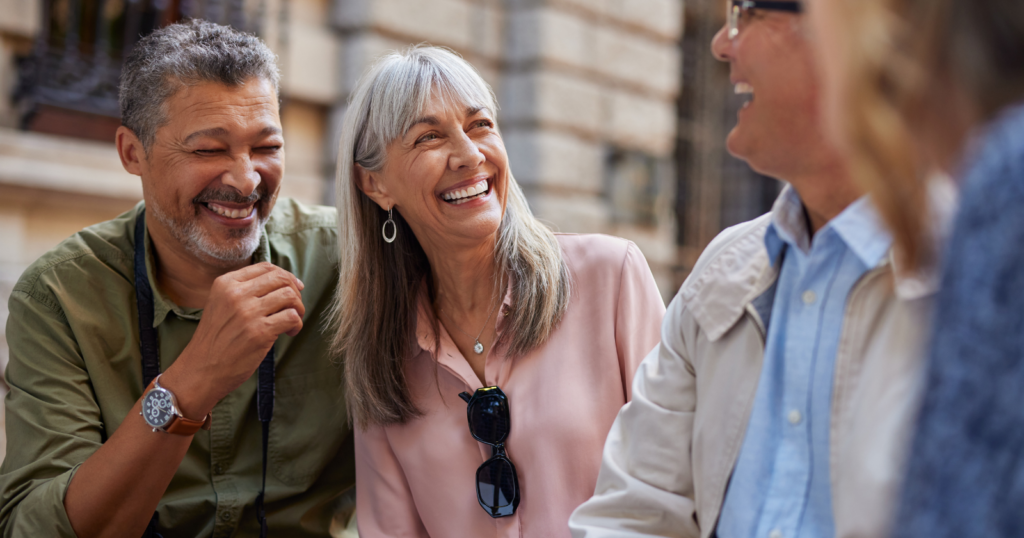
There’s a woman who lives in our building in Itaim who is somewhere on the older side of sixty. I see her two or three times a week, usually walking out the front door in unfussy clothes with a tote bag of books, on her way to a class or a lunch or a coffee that matters more to her than it would to me. She is not glamorous in any way that costs money. She is, however, the most vivid older person I’ve met in a long time. Her face moves. Her eyes scan a room. She laughs without checking who is watching first.
I know, from chatting in the elevator over the last two years, another woman in the building who is the same age and who reads as the opposite. Polite, well-kept, perfectly groomed. And dimmer, in a way that took me a while to name. Less of her seems to be present in the room each time I see her. Same age. Same neighborhood. Same basic economic situation. Two trajectories. The contradiction at the heart of this article is that the difference between them doesn’t look like the kind of thing money can fix, and on closer inspection, doesn’t even look that dramatic on any given day.
Fading is rarely about getting older
The second woman, the dimmer one, is not unhealthy. She is not lonely as far as I can tell. She is not poor. The fade I notice in her isn’t a medical event. It’s a slow narrowing. Her days appear to be increasingly the same. The same small loop of errands, the same coffee place, the same Netflix glow visible from her window at the same hour every night. Nothing wrong with any of it. The cost of a life made entirely of low-friction repetition is that, somewhere along the way, the part of you that is curious about new things stops being asked to show up.
That kind of fading isn’t triggered by a birthday. It can happen at forty as easily as it can happen at seventy. It’s a rhythm problem more than an age problem. The world stops being something a person is engaging with, and quietly becomes something they are managing.
Blooming is rarely about youth
The first woman, the vivid one, is also not doing anything youthful. She is not going to clubs or chasing fashion or “acting her age” in either direction. The difference is that her daily rhythm includes inputs she did not have last week. A new author. A class on something she knew nothing about. A friend two decades younger or older than her. A topic that requires her to think. There is a body of research that suggests this kind of engagement matters more than it sounds.
In a 2014 study published in Psychological Science, Patrick Hill, then at Carleton University, followed more than 6,000 adults over a 14-year period and found that a stronger sense of purpose in life predicted lower mortality risk at every age, regardless of retirement status. “Our findings point to the fact that finding a direction for life, and setting overarching goals for what you want to achieve can help you actually live longer, regardless of when you find your purpose,” Hill said. He noted that this protective effect showed up for younger, middle-aged, and older adults alike. Direction, in other words, works the way a daily vitamin is supposed to.
The actual difference is rhythm, not luck
If you watch the two women in our building closely, the daily difference between them is not a magazine-quality lifestyle gap. Both walk. Both eat. Both shower. Both have nice families. The vivid one’s schedule simply has more friction built into it, on purpose. She agreed to teach a class she didn’t feel qualified to teach. She joined a book group whose taste annoys her. She has a running disagreement with a younger neighbor about a Brazilian writer, and shows up every week to continue it. None of that is exotic. It’s just slightly more demanding than the path of least resistance.
The fading version of late adulthood and the blooming version of it can be running in parallel on the same street, in similar apartments, with similar bank accounts. The difference is whether the day still contains something that asks the person to grow into it. The cosmetics aisle has not made anyone bloom yet. The Sunday where you said yes to the unfamiliar dinner, the class, the awkward new friend, has.
Most of the rhythm is unbought
This is the unhelpful, hopeful thing about the daily-rhythm answer to aging well. You can’t buy your way into it. Almost every input that seems to matter, from a research and observational standpoint, is functionally free. Walking. Talking to people who interest you. Doing one thing that requires you to learn. Putting yourself in mild but recurring contact with people younger or older than you, who do not let you fall into the version of you that’s easiest to be at home. That’s most of it.
I’m not a psychologist or a gerontologist, and I’m wary of writing as if I have figured out what makes a person stay vivid until eighty. If you’re reading this and noticing that your own daily rhythm has narrowed in a way that scares you a little, please talk to someone you trust about it, or to a therapist, before you talk to a shopping cart. There is no serum for the feeling that less of you is showing up to your own life. There is, as far as anyone can tell, a slow correction available through what your week is actually made of.
The vivid neighbor of mine is going to keep being vivid, I think, because she keeps building her week out of things that ask her to be awake. That, more than any product on the shelf, is the version of aging well I would most like to copy.