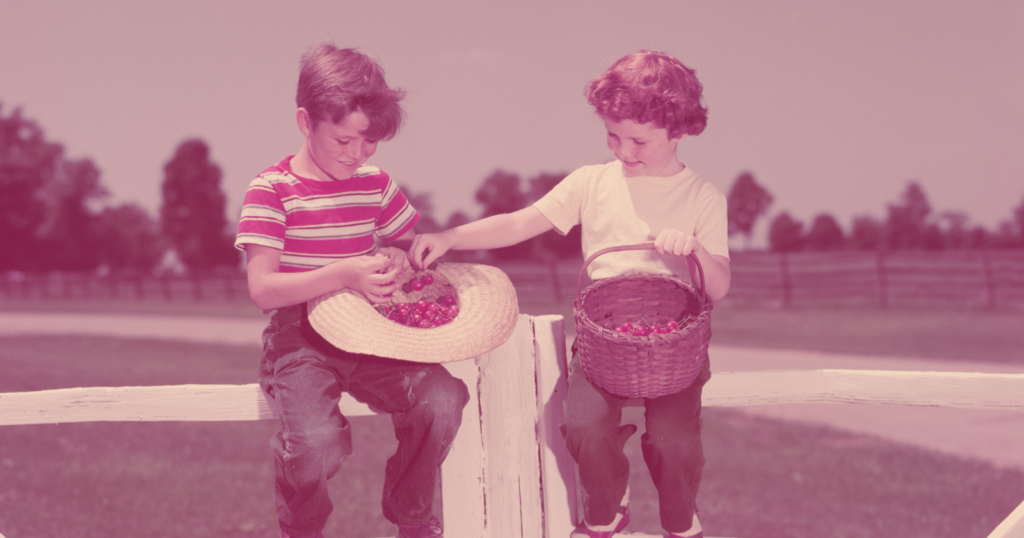
In the 1970s, a particular kind of childhood was entirely unremarkable. You came home from school, let yourself in, and handled things. You made yourself a snack. You did your homework, or you didn’t. If something went wrong, you figured it out before a parent got home from work. Nobody called it anything. It was just a weekday afternoon, unsupervised, and this was simply what was expected of a child your age.
There was a whole generation of children raised in this atmosphere, and the world did not think much of what it was asking of them. Higher divorce rates, women entering the workforce in significant numbers, and a general cultural belief that children were resilient creatures who benefited from being left to figure things out on their own. By 1982, an estimated three million children between the ages of six and thirteen were regularly left to care for themselves after school.
Many of those children are in their fifties and sixties now. Most of them turned out fine, by most measures. But there is something that fine does not always capture, which is the particular shape their self-reliance took, and what it still costs them.
What that era asked of children
Julie Lythcott-Haims, who spent years as the dean of freshmen at Stanford University, was herself a latchkey child in the 1970s. In an interview with the Minneapolis Star Tribune, she described the experience straightforwardly: “I developed self-sufficiency, responsibility. It was great.” And for many people who came of age during that era, that’s an honest account of what it gave them. A practical competence. A calm in a crisis. An ability to sit with discomfort, solve problems, and not need a great deal of reassurance.
These are real skills, and they served people well. The children who learned to manage alone often became adults who could handle a great deal, independently, without complaint. Lythcott-Haims herself went on to say, “We are quite proud to be folks who gained a good measure of independence and a sense of self.” That pride is earned. The question is not whether the independence was real. It was. The question is what it required, and what it quietly displaced.
What it displaced, in many cases, was the experience of being helped. Of asking for something and receiving it. Of running into a problem and having someone show up, unprompted, to take some of the weight. That experience, repeated often enough in childhood, is what teaches a person that help is available. That asking is safe. That being in need does not mean being a burden. For a generation that largely had to manage without it, that particular lesson often just never arrived.
What that independence looks like now
Someone I know from that generation recently navigated a genuinely difficult stretch without once asking for practical support. Not because people weren’t willing to offer it. But because, when I watched them do it, I got the distinct sense that asking simply didn’t occur to them as an option. The doing alone was so deeply ingrained that the alternative didn’t register.
This is the contrast that matters most: not between those who were latchkey children and those who weren’t, but between the capability those children built and what that capability sometimes forecloses. Mental health researchers who study Gen X have noted that the emotional and support needs of that generation were often deferred in childhood and then quietly deprioritized in adulthood, passed over again as culture shifted its focus elsewhere. The result, for many people, is a self-sufficiency that reads as strength but can also function as a kind of wall.
You can be highly capable and still find it nearly impossible to say the words “I could use some help with this.” The two are not mutually exclusive. In fact, for people raised in an era when no one was reliably coming, the capability and the difficulty often go hand in hand. You learned to manage because you had to. And you may have also learned, less consciously, that needing something did not mean it would come.
The difference between being capable and being closed
It is worth separating two things that often get confused. Self-reliance, in the sense of being able to handle things independently and not requiring constant reassurance, is a genuine asset. It carries people through hard situations. It allows for a kind of calm competence that is useful in almost any context.
But there is a version of self-reliance that tips from skill into closure. Where “I can handle this” quietly becomes “I should handle this alone, no matter what.” Where accepting support feels uncomfortable, exposing, or even vaguely embarrassing. Where asking for a hand, even from someone who clearly wants to offer one, requires more psychological effort than it should. That version is not a skill. It is the echo of a childhood in which help was not reliably there, and the adaptation that formed around that fact.
Understanding the difference matters, both for people who grew up that way and for the people who love them. The self-reliance is not stubbornness. It is not a comment on the relationship. It is a habit laid down in a particular era, by a particular set of circumstances, before anyone thought to ask whether a child was ready to carry that much on their own.
I am not a therapist, and how this plays out for any one person is specific to their history. But if you recognize this pattern in yourself or someone close to you, and if it has shaped relationships in ways that feel hard to shift, talking to someone who works with these kinds of early patterns can help. Not because something is broken. Because some habits were formed so early that we often don’t even recognize them as habits. We just think that’s who we are.
The generation that raised itself did something genuinely hard. It would be worth letting them be helped, a little, now that the option actually exists.