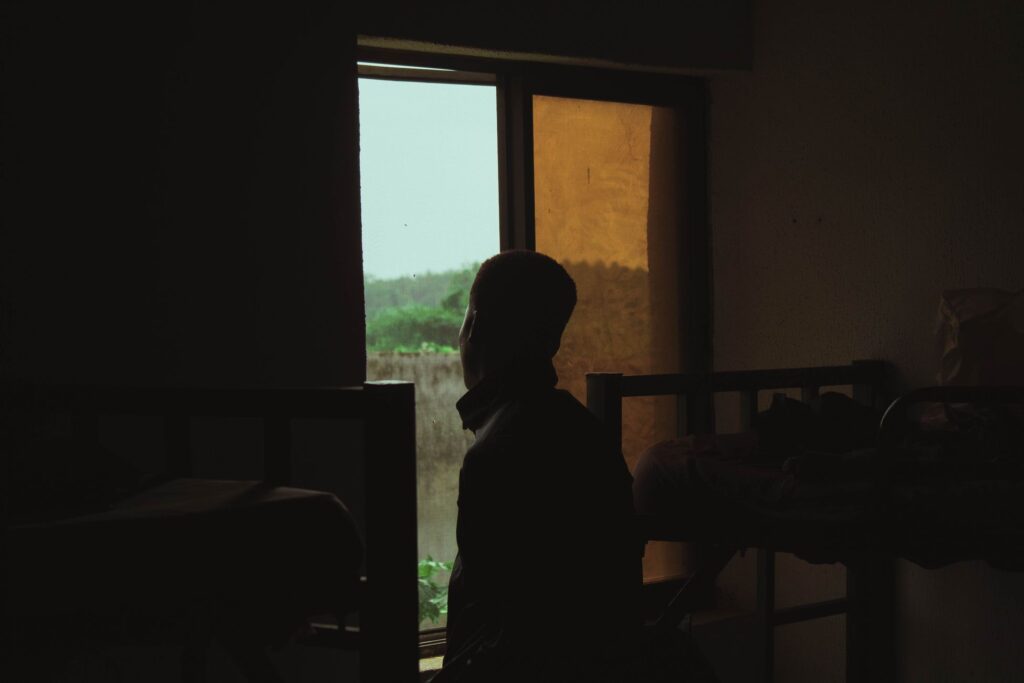
Three in the morning. The house has stopped breathing the way it does at dusk. The fridge hums. A car passes on a road you never notice in daylight. Your body is horizontal, obedient, tired — and your mind is a lit window in a dark street. You have tried the breathing. You have tried the app. You have tried not trying. The sleep is not coming.
Before you reach again for the phone, consider a possibility your culture has almost entirely forgotten: that the night has not failed you. That something is trying to be met.
The night was never only for sleeping
For most of human history, the hours between dusk and dawn were not a single unbroken sleep. The historian A. Roger Ekirch of Virginia Tech spent years combing medieval and early-modern records — diaries, court transcripts, medical texts, prayers — and found strong evidence that people before the Industrial Revolution routinely slept in two separate stretches, waking for a while in between, in what he calls segmented sleep: a first sleep from around nightfall, a wakeful hour or two in the deep middle, and then a second sleep until dawn. The wakeful hour had names in different tongues. People used it to pray, to talk quietly to a bedfellow, to make love, to tend the fire, to write down a dream while it was still wet, to walk out and look at the stars.
The gap was not a malfunction. It was a room in the house of the night. Industrial lighting, factory shifts, and the flattening moral pressure of the eight-hour block collapsed that room and turned any waking in the dark into evidence of disorder. Now, when you find yourself alert at three, you are not broken. You are, in some quiet way, ancestral. You have stumbled into a chamber your grandmothers’ grandmothers knew.
The question is what to do inside it.
Vigil is older than insomnia
Every serious spiritual tradition has, at its centre, a practice of staying awake on purpose. Monks rose for matins in the coldest hour. Desert contemplatives fasted through the dark. Indigenous initiations across the Americas placed the seeker alone on a hilltop for nights at a time, without food, without fire, without company, waiting for something to arrive that would not arrive during the day. The Hebrew scriptures are full of night wrestlings. Gethsemane is a vigil. The Buddha’s awakening happened between one dusk and one dawn.
None of these traditions treated sleeplessness as an emergency to be optimised away. They treated the wakeful night as a threshold — thin, uncomfortable, revealing. What comes forward in that thinness is not always pleasant. It is often the material the day is built to keep at bay: the grief you outran with meetings, the decision you have been half-making for a year, the sentence someone said to you when you were nine, the animal fact of your own mortality. The vigil is the practice of not running back inside.
Modern sleeplessness is rarely framed this way. It is framed as a hygiene problem. Blue light, caffeine curfew, magnesium, mouth tape, a colder room, a heavier blanket. Some of this is genuinely useful; bodies are bodies. But if the only vocabulary you have for a wakeful night is failure, you will spend every dark hour fighting the very stillness that might, if you let it, tell you something you have needed to hear for months.
What the dark actually does to a mind
There is a physiology to this, and it is worth taking seriously as a conversation partner rather than a scold. In the deep night, cortisol is low. The default mode network — the part of the brain that stitches together self, memory, and narrative — becomes unusually loose and associative. Melatonin softens the borders of ordinary thought. The prefrontal watchman that spends the day filing your feelings into acceptable folders has clocked off. This is why grief tends to visit at three, why old shames find their way back through the window, why sudden clarities about your marriage or your work arrive without invitation.
In the 1990s, the psychiatrist Thomas Wehr of the National Institute of Mental Health tried to recreate that older rhythm under lab conditions, keeping volunteers in darkness for fourteen hours a night. Within weeks their sleep split into two blocks with a wakeful hour between them, and Wehr’s brainwave readings from that interval reportedly resembled a state of meditation rather than agitation. The mind, unhurried and unwatched, seemed to do something the day will not permit: it wandered through its own rooms, opening doors.
The tragedy of the modern wakeful night is that this fertile, ancient state gets met with a screen. The loosened mind gets flooded with other people’s outrage, other people’s bodies, other people’s opinions on sourdough. The most porous hour of the twenty-four becomes the hour spent pouring in exactly the noise the day was spent drowning in. Then comes the wondering why sleep will not return.
The animals in the room
Writers here have been circling this territory for a while, in different weathers. This site has sat with the phoenix and its long relationship with what has to burn. It has walked with the wolf, who knows the geography of the dark better than we do. There is a reason these older images keep returning when the topic is night. They carry a knowledge the productivity-language of sleep hygiene cannot carry.
The wolf does not experience three in the morning as a problem. The owl does not consult an app. The night, to the animals who live inside it, is not a broken day; it is a whole country with its own laws. Something in you knows this country. Some old part of your nervous system, older than clocks, older than electric light, older than the word insomnia, is entirely at home in the dark and has been waiting for you to come and sit with it.
You do not need to become a mystic to honour this. You only need to stop treating the wakeful night as a mistake.
What a vigil actually looks like in a small apartment
This is not a prescription. It is a description of what people who have made peace with the wakeful night tend, quietly, to do.
They get out of the bed. The bed is for sleep and for love; it is not a good place to lie fighting the ceiling. They move into another room, or another corner, and they keep the light low — a candle, a lamp with an old-fashioned bulb, nothing that mimics noon. They do not reach for the phone. This is the whole discipline, and it is harder than any breathing exercise. The phone is the mouth of the day; it will pull you back into the day, and the night’s offering will withdraw.
Instead, they let the mind wander. They might sit with tea. They might write, longhand, without trying to make sense — just letting whatever wants to come come. They might stand at the window and look at the particular character of their street at this hour, which is nothing like its daytime character. They might pray, if that word means something to them, or simply address whatever it is they address when no one is listening. They might weep, briefly and without theatre, over something they had not realised they were carrying.
Then, often, sleep returns. Not because they chased it, but because they stopped standing in its doorway shouting.
And sometimes sleep does not return, and morning comes, and the day is harder than it would otherwise have been. This is real. A vigil is not free. The old traditions knew this too; they fed the vigil-keeper afterwards, and gave them a quiet day. This is a culture that demands the meeting be productive by nine. That is a wound of the culture, not of the night.
The company of another nervous system
There is one more thing worth naming, because it complicates the romance of the solitary vigil in an honest way. Humans are pack animals. This site has looked at research suggesting that two nervous systems quietly synchronise when they share a bed — heart rates draft each other, breathing finds a common tempo, sleep architecture stabilises. The body of another mammal is, physiologically, one of the oldest sleep aids we have.
Which means some of what we call insomnia is grief. Grief for the shared fire. Grief for the sibling on the next mat, the grandmother in the next room, the dog against the small of the back, the lover who is not there or is there but has become far away. The night reveals these absences because the day is loud enough to cover them.
This is not a reason to blame yourself for sleeping alone. Many nights alone are chosen and good. It is only a reason to notice that the wakeful hour may be pointing, not at a supplement you have failed to take, but at a loneliness you have been too busy to feel. That, too, is what the vigil is for. To feel the thing. To let the feeling change shape by being felt. To be met by yourself in the room where no one else is watching.
A different question to bring to bed
The culture will keep offering you tools to defeat the night. Some of them work. Use them without shame. But underneath the tools, keep a different question available, in case you need it at three:
What is awake in me that has not been given a chance to speak?
Not as a productivity prompt. Not as journaling homework. As a real question, asked into the real dark, by a real animal in a real body, who has stumbled into an old chamber the day cannot enter.
The night is not withholding sleep from you. The night is a teacher who has been trying, for years, to get a word in. Sleep will come back. It always does, eventually. The question is whether, in the hours before it returns, you will keep the vigil — or keep the fight.
Somewhere, a wolf is walking without hurry through a landscape you cannot see. Somewhere, a candle is being lit in a kitchen at three. Somewhere, a woman is writing down a dream while it is still wet. You are not alone in the wakeful hour. You are, in fact, in very old company.