There is an old accounting that predates money. It does not appear in ledgers or quarterly reports. It runs underneath the visible economy like a second river, and every human culture that lasted more than a few generations learned to read its current. The rule was simple, and it was not moral so much as ecological: what you take, you answer for. A fish pulled from the water. A tree felled for a canoe. A story received from an elder. A night of another person’s care. Each was a transaction with weight, and each required a return — a song, a tobacco offering, a season of rest for the soil, an hour of listening back.
Modern life has largely dismissed this as superstition. And yet the arithmetic keeps working, whether or not we believe in it. Fields taken from without return go pale. Friendships taken from without return go thin. And an attention span taken from without return — scrolled, mined, sold, refreshed, sold again — goes strange in a way that is harder to name but easier to feel at 2 a.m.
This is an essay about that older accounting. About reciprocity as a way of being alive, rather than a virtue to perform. And about the particular rot that sets in when a life is organized around taking without offering — from the land under your feet, from the people around you, and, most quietly and most catastrophically, from yourself.
The land remembers what the receipt forgets
Walk into any forest that has been managed for centuries by the people who live inside it, and you will notice something the satellite images do not quite capture. The forest is dense but not chaotic. There are clearings where clearings should be. There are species that thrive because someone, generations ago, planted them next to something else on purpose. Ecologists call these anthropogenic forests — landscapes shaped by human hands over such long spans of time that the forest itself has become a collaboration.
The people who tended these places did not think of themselves as owners. They thought of themselves as guests with responsibilities. If you took bark from a tree, you thanked the tree and you took only from the side facing away from the sun. If you hunted, you left the first kill. If you gathered, you left the grandmother plant standing. This was not sentimentality. It was, in the most literal sense, a business plan for staying alive over the long term.
Now compare that to the way most of us relate to the ground under our apartments. We do not know the name of the river that runs, culverted, beneath our street. We do not know which trees on our block were here before the sidewalk. We do not know whose bones are in the soil. We take our coffee, our lithium, our winter tomatoes, our cheap cotton, and we do not ask what the ledger looks like on the other side.
You do not have to become a farmer to feel the wrongness of this. You only have to stand still long enough to notice that something in you is not fed by extraction, even when extraction is comfortable. There is a particular hollowness that comes from consuming a place without belonging to it. The land does not curse you for this. It simply stops speaking to you. And after a while, you stop noticing that it has gone quiet.
The people you have been metabolizing
The same accounting runs through your relationships, and it is harder to look at there because the debts have faces.
Think, for a moment, of the people in your life who give more than they receive from you. Not the strangers. The specific ones. The friend who always texts first. The parent whose calls you screen. The colleague whose labor makes yours possible. The partner whose emotional weather you rely on but do not tend. This is not an invitation to guilt — guilt is a cheap substitute for reciprocity and often replaces it entirely. It is an invitation to see clearly.
Anthropologists who study gift economies have long pointed out that a gift is not really a gift if it does not eventually move. Objects, care, attention, and stories were meant to circulate. When they stop circulating — when they pile up in one household, one class, one country, one person — the whole system begins to sicken. The gift becomes a hoard. The hoard becomes a wound.
You can feel this in a friendship where one person has become, without ever agreeing to it, the therapist. You can feel it in a family where one sibling has become the emotional load-bearing wall. You can feel it in a workplace where certain kinds of labor — the noticing, the smoothing, the remembering of birthdays — are invisible because they are always done by the same people. Something is being taken. Something is not being returned. And the rot is quiet but real.
Reciprocity is not tit for tat. It is not a spreadsheet. It is closer to a rhythm — the sense that care is moving through the room, that no one is only a source and no one is only a sink. When that rhythm breaks, even the person doing the taking suffers, because they are slowly being surrounded by resentment they cannot yet name. This site has sat before with what it means to stand your ground without shutting down. The other half of that teaching, less often spoken, is learning to open your hands without emptying yourself.
The theft you commit against yourself
Here is where the essay turns, because the most consequential extraction in most modern lives is not from the land or from other people. It is from the self.
Consider your attention. Consider how many hours of it, this week, were spent on things you did not choose and would not, if asked cleanly, have chosen. Consider the small, involuntary reach for the phone in the elevator, in the bathroom, in the pause between one sentence and the next. Consider what is being taken, and by whom, and what is being offered back to you in exchange.
The honest answer, most of the time, is: almost nothing. A flicker of novelty. A brief hit of outrage or envy or amusement. A vague sense of having been informed about something you will not remember by Thursday. This is extraction. You are the land being strip-mined. The ore is your capacity for sustained attention, which is also your capacity for love, for craft, for prayer, for grief, for any of the states that require staying in one place for longer than a scroll.
And because you are both the miner and the mined, the rot moves fast. A person whose attention has been chronically extracted begins to lose the ability to be with themselves without static. Silence becomes uncomfortable. Boredom becomes intolerable. The inner life — the strange, wild, uncurated territory that used to belong to you — becomes a place you no longer visit, because you have forgotten the road.
This is the deepest reciprocity failure. Not with the earth. Not with your friends. With the animal that is you, which needs to be walked, fed, rested, sung to, listened to, and periodically taken somewhere it can smell weather. When you take from it constantly and offer it nothing back — no unstructured time, no real food, no darkness, no encounters with anything larger than yourself — it does not file a complaint. It simply gets quieter, and stranger, and less available. Writers on this site have circled this territory before, in essays on the life that burns and the parts of us that keep flying up out of the ash. What burns can renew. What is merely mined does not.
What offering actually means
The word offering has been softened by centuries of use into something faintly embarrassing — the kind of word that shows up on scented candles. Let us try to give it back some weight.
An offering, in the older sense, is not a purchase. You are not buying favor from the land or from the ancestors or from your own future self. An offering is an acknowledgment that you are inside a web, that you did not spin the web, and that your presence in the web has consequences you cannot fully see. It is a small, deliberate act that says: I noticed. I received. I am not pretending this came from nowhere.
What does this look like, unromantically, in a life that involves rent and email and a body that gets tired?
It looks like knowing the name of one tree on your street and greeting it, even silently, when you pass. It looks like sending back to a friend the same quality of attention they have been sending you. It looks like paying, actually paying, the people whose work has fed you — the teacher, the writer, the farmer, the musician — instead of treating their gift as an infinite spring. It looks like sitting for twenty minutes with no input at all, letting your own mind be strange again, giving your inner life the courtesy of your presence.
None of this is difficult in the way that climbing a mountain is difficult. It is difficult in the way that turning around is difficult when you have been walking in one direction for a long time. It requires admitting that the direction was wrong, or at least incomplete, and that the old accounting was not superstition after all.
The rot, and what grows after it
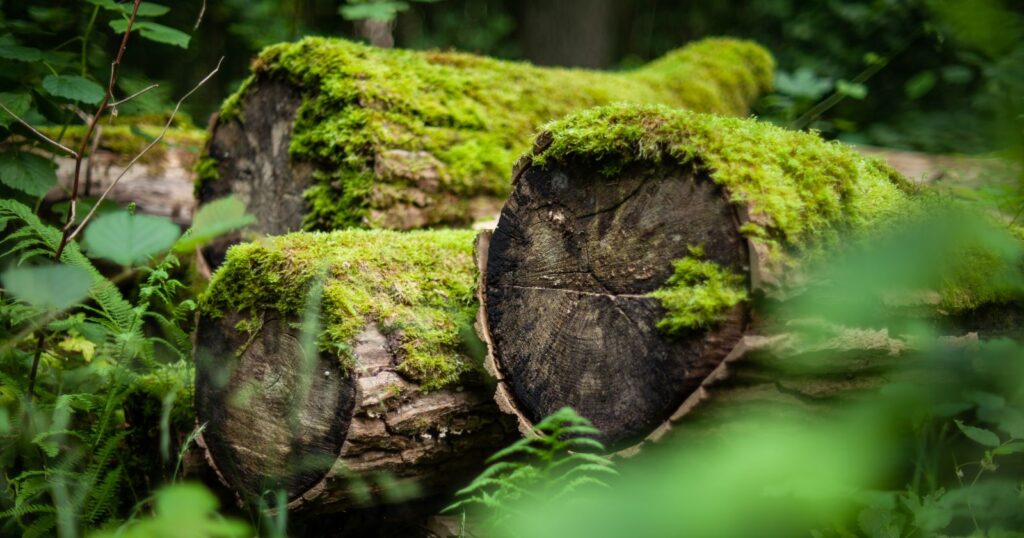
Here is the thing about rot, though. In a forest, rot is not the end of the story. Rot is how the forest feeds itself. A fallen tree, left to decompose, becomes the nursery for the next generation. Fungi thread through the dead wood, releasing nutrients that had been locked up for a century. The rot is only catastrophic if you refuse to let it become soil.
If you have been living, as most of us have, inside an economy of extraction — from the land, from the people who love you, from your own attention — the first honest step is not shame. Shame is another form of taking. The first step is to notice the smell of the rot, to name it plainly, and to ask what it might yet fertilize.
Because a person who has taken too much and finally sees it is not a lost cause. They are, potentially, someone about to become useful in a way they have never been before. They know the weight of what they owe. They have felt the hollowness of the alternative. They are, if they are willing, on the edge of becoming an offering themselves. This site has written elsewhere about the fire we guard and the loyalty we owe our own belonging. Reciprocity is the older word underneath both.
So the question this essay leaves you with is not a program. It is closer to a mirror held at an unfamiliar angle.
What have you been taking, quietly and continuously, without offering anything back? From the ground. From the people. From the animal that is you. And what would it mean, this week — not next year, this week — to begin, in some small and unromantic way, to answer for it?
The old accounting is still open. It has been waiting.