

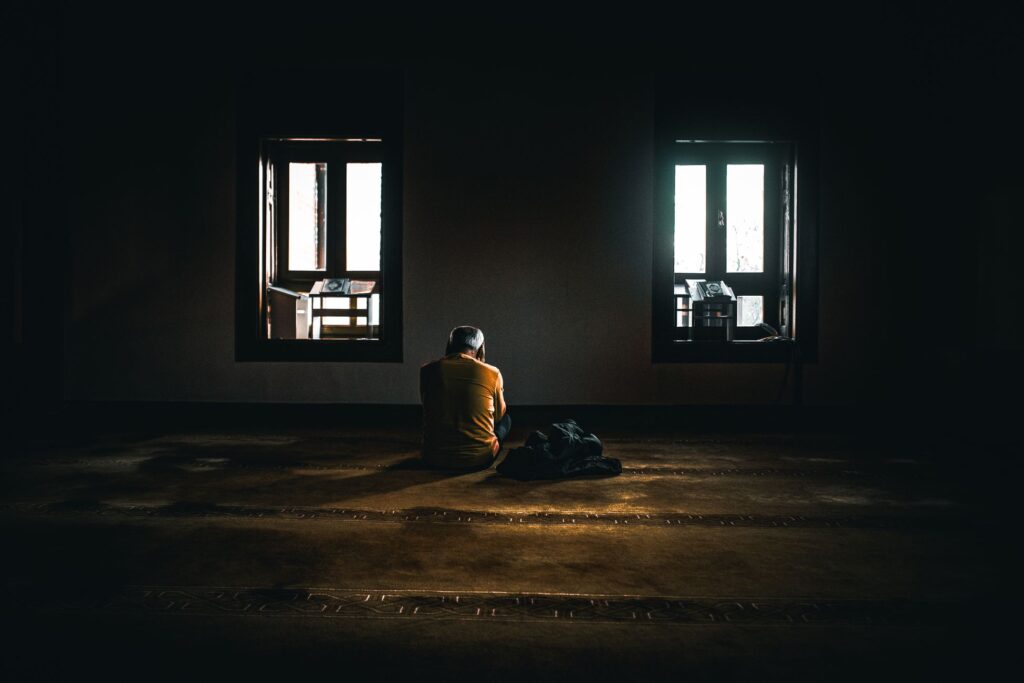
There is a particular ache that most people carry as if it were their private wound. It shows up in quiet moments, between tasks, when the noise drops. A sense that something is missing. Not a specific thing — not the job, the partner, the money, the recognition, though it wears those costumes convincingly. Something more foundational. A piece of the self. A piece of life itself. Something everyone else seems to have received and you were somehow skipped over.
Most people spend decades trying to name that missing piece. Some call it purpose. Some call it love. Some call it enlightenment, healing, wholeness, home. The names change with fashion. The ache doesn’t.
I want to suggest something uncomfortable. The missing piece is not missing. It was never there. And the belief that it should have been — that you are supposed to feel complete, resolved, finished — is not a personal intuition rising from your depths. It is a cultural program installed so early that you mistake it for hunger.
The story that something essential is absent
Human beings do not encounter reality in a neutral state. We inherit frameworks before we can question them. Before you could form the words I feel incomplete, you had already absorbed thousands of images, stories, songs, sermons and advertisements telling you what a complete human being looks like. Whole. Fulfilled. At peace. In love. Aligned. Awakened. Successful. Free. Choose your vocabulary — religious, therapeutic, entrepreneurial, spiritual. The grammar is identical.
The grammar says: there is a finished version of you, and you are not it yet.
The grammar says: something is missing, and if you find it, you will arrive.
The grammar says: the ache you feel is evidence of the gap between where you are and where you should be.
Notice how efficient this program is. It converts every ordinary human experience — restlessness, boredom, grief, doubt, desire — into evidence that you are broken. It creates a permanent market for the thing that will finally complete you. It keeps you reaching. And because the reaching feels like your own — because the ache is genuine, even if the interpretation is inherited — you rarely think to question the frame itself.
What if the ache is real and the story about it is false?
Completeness is not a human condition
Look at anything alive. A tree is not complete. It is growing, shedding, cracking, being colonized by fungi, feeding birds, dying at the tips and pushing new tissue at the roots. A river is not complete. A body is not complete. Cells are dying inside you as you read this. New ones are being made. Your thoughts have already moved. You will not be the same organism tomorrow morning.
Life is not a finished form waiting to be assembled correctly. It is movement. It is process. It is a wild, dynamic, contradictory unfolding that does not resolve because resolution would be its end.
The demand to feel complete is, at its root, the demand to stop moving. To arrive somewhere so final that nothing more is required. That place exists. It has a name. We bury people who reach it.
This is not a metaphor for depression or nihilism. It is closer to the opposite. If completeness were possible, life would already be over. The fact that you feel unfinished is not proof that something has gone wrong. It is proof that you are still here, still participating, still capable of movement. The ache you interpret as absence is often just the sensation of being alive in a body that has not stopped.
Who benefits from your hunger
A useful question when a story feels natural: who profits from its naturalness?
Consumer culture requires a permanently incomplete consumer. Someone satisfied is a market failure. The romantic mythology of the missing half — the soul mate who will finally complete you — sells films, novels, weddings, therapy, divorces, and second weddings. The self-improvement industry requires a self that is always about to become itself. Religious systems, at their worst, require a soul that is fallen, distant from God, in need of the specific mediation only that tradition provides. Spiritual marketplaces require an unawakened student, forever one retreat, one ceremony, one teacher away from the real thing.
I say this as someone who works within a spiritual tradition. The critique is not from the outside. The temptation to sell completeness is present in every field that touches human longing, and shamanism is not exempt. Any teacher who tells you they can hand you the missing piece is either mistaken or working the same script in different clothes.
None of this means the traditions are worthless. Ritual, therapy, art, love, meditation, discipline, medicine — these can be genuinely valuable. They become distorted only when they are sold as the resolution of a wound that was never a wound to begin with.
The problem is not that these paths exist. The problem is that they are marketed as answers to a question that was planted in you, not born in you.
The inherited hunger
Consider how the sense of incompleteness actually enters a life.
A child arrives without a story about being unfinished. The child is hungry, tired, curious, angry, delighted — moment by moment, without interpretation. Then the interpretation begins. You are too much. You are not enough. You are almost there. You will be lovable when. You will be acceptable if. Look at your cousin, look at your brother, look at the neighbor’s child. The comparisons start early and they never stop. School introduces grades. Adolescence introduces the mirror and the endless corrections it invites. Adulthood introduces career ladders, relationship milestones, life scripts. At every stage, the message is the same: you are not yet the correct version of yourself. Keep working. Keep buying. Keep striving. Keep seeking.
By the time you are old enough to ask whether the hunger is truly yours, you have been feeding it for decades. It feels like the deepest thing in you because it has been there longer than most of your memories. But being early is not the same as being true. Some of what feels most intimate in us is simply what was installed first.
This is not an argument that your parents failed you, or that society is evil, or that you are a passive victim of programming. Conditioning is not a villain. It gives you language, structure, and access to collective life. But once you can see it, you have a different relationship with it. You are no longer only living inside it. You are also, at least partly, looking at it. That change matters.
What is actually happening in the ache
If the missing piece is not missing, what is the ache?
I would be careful with any single answer. The sensation people call incompleteness is probably many different things wearing the same coat.
Sometimes it is unlived desire — a real hunger for a life you have not permitted yourself to want. Sometimes it is grief — for people, versions of yourself, possibilities that did not survive. Sometimes it is loneliness in the specific, unromantic sense: you need contact with other human beings and you are not getting enough of it. Sometimes it is the body asking for movement, sleep, food, sex, silence, sunlight — ordinary things the intellect keeps overriding. Sometimes it is the intelligence noticing that the life being lived does not match the life that was actually chosen. Sometimes it is the sensation of being a small mortal creature aware of its own smallness and mortality, which is not a problem to solve but a condition to inhabit.
None of these are evidence that a piece of you is missing. They are signals. They point to something that wants attention, participation, contact, honesty. When you translate them all as I am incomplete, you generalize the signal into a story that cannot be answered, because the story is not true. You end up searching for a thing that does not exist while ignoring the specific, answerable requests underneath.
The ache is information. The interpretation is inheritance. Learn to feel the difference.
What changes when the frame drops
Something practical shifts when you stop believing you are missing a piece.
The urgency loosens. Not the aliveness — the urgency. You stop needing every relationship to be the one. You stop needing every career move to be the right one. You stop needing every spiritual practice to work in the sense of finally delivering you to the completed self who is standing just beyond the next threshold. The frantic quality of a life organized around arrival begins to give way to something slower and more honest: a life organized around participation.
Participation is not a smaller ambition than completion. It is a different one. Completion asks: when will I be finished? Participation asks: what am I in relationship with right now, and how present am I to it? One is a race with no finish line, disguised as a finish line. The other is what animals, forests, rivers and children do without being told.
This is where a lot of the older, earthier language becomes useful again — not as decoration, but as description. Burning and renewing is not a completion; it is a cycle. Standing your ground is not an achievement; it is a posture you re-enter every day. Instinct and belonging are not phases you graduate from. These are not steps on a ladder toward the finished self. They are ways of being in the movement of a life that will never resolve, and does not need to.
The responsibility that remains
Seeing the program does not free you from your life. It changes your relationship with it.
If nothing is missing, you cannot use the search for the missing piece as an alibi anymore. You cannot postpone the difficult conversation until you feel whole. You cannot delay the work, the boundary, the risk, the apology, the change of direction until the ache resolves. The ache is not going to resolve. It was never a puzzle with a solution. It was a companion, sometimes a signal, occasionally a liar you were taught to trust.
You can still want things. Wanting is not the enemy. Desire is a living force, and the death of desire is not maturity — it is just a quieter kind of resignation. Pursue what you love. Build what calls you. Refuse what diminishes you. But do it because you are alive and interested, not because you are trying to purchase a completeness that was never for sale.
The life you have is not a rehearsal for the life you would have if the missing piece arrived. There is no missing piece. There is this body, this hour, these people, this hunger, this fatigue, this attention. That is not a consolation prize for the whole self you never became. That, as far as anyone can honestly tell, is the whole thing.
You were not shortchanged. You were sold a story that told you you were. The story is old, it is powerful, it is nearly invisible from the inside — and it is not yours. You can put it down. Not once, ceremonially, in a moment of insight, but a hundred times a day, whenever you notice yourself reaching for a completion that keeps receding.
The ache will still come. Let it. It is not evidence that a piece of you is missing. It is often just the sound of being alive in a story you have not finished revising.
