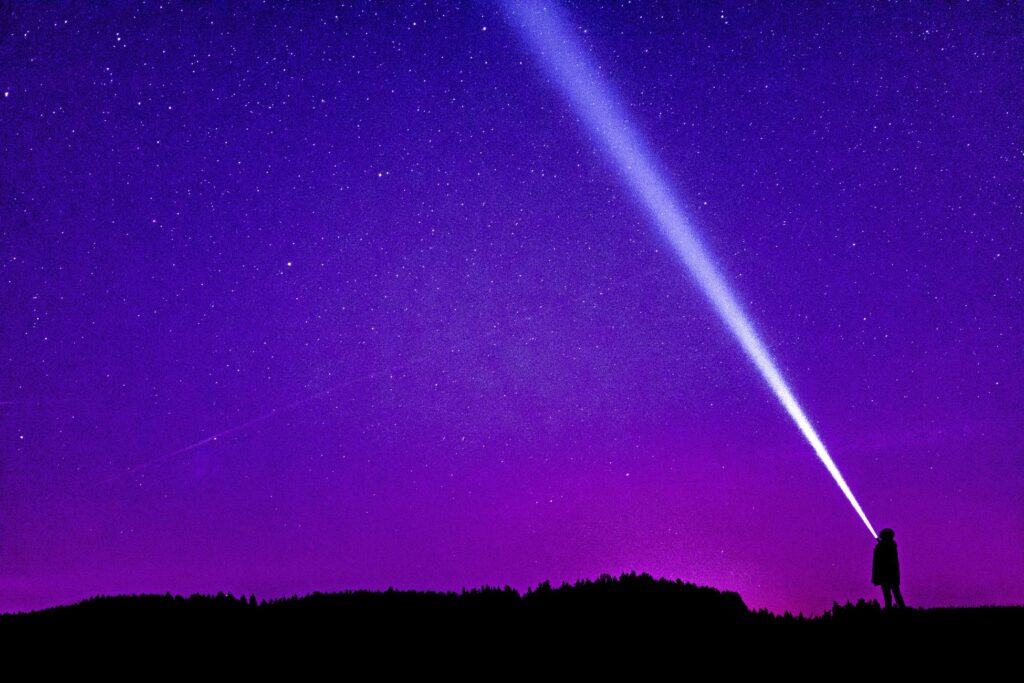
There is a moment, standing at the edge of a canyon or under a sky thick with stars, when the machinery of the self briefly stops clicking. The inner monologue trails off mid-sentence. The body forgets to rehearse its next complaint. Something older than language moves through the chest — a mixture of smallness and belonging so sudden it almost hurts.
Researchers have a word for this. They call it awe. They have been measuring it for two decades now — in labs, in redwood forests, on virtual reality headsets, in Petri dishes of saliva looking for the fingerprints of cortisol. And what they keep finding, quietly, is that the thing they are measuring does not entirely like being measured.
The scientists who went looking for wonder
In the early 2000s, two psychologists — Dacher Keltner and Jonathan Haidt — sat down to define what awe actually was. Their conclusion was disarmingly simple: awe involves perceived vastness, and a need to accommodate that vastness by revising your mental maps. Something too big for your current model of the world walks in, and the model has to stretch or break.
Since then, whole laboratories have grown up around this feeling. They have shown that awe seems to reduce inflammatory markers in the body. That it makes people more generous, more patient in traffic, more willing to help a stranger pick up dropped papers. That it dilates the perception of time. That it shrinks the ego — literally, in self-portrait drawings, people sketch themselves smaller after an awe experience.
The findings are real. The findings are also, if you sit with them long enough, a little uncomfortable. Because the moment awe becomes a documented health intervention, a subtle inversion begins. Wonder is no longer a visitation. It becomes a supplement. Something to be dosed.
The problem with prescribing the sublime
Consider the strange arc of the awe walk. A researcher publishes a study suggesting that walking outdoors while intentionally attending to what feels vast and unexpected improves mood in older adults. Beautiful. Then the finding travels. It becomes an app notification. A wellness column. A morning practice. A checkbox on a habit tracker between floss and drink water.
And somewhere in that translation, the walk changes. You leave the house already trying. You arrange your attention like cutlery. You catch yourself waiting for the vastness to arrive on schedule, and when it doesn’t, you feel obscurely cheated — as if the sunset had failed to perform its contractual duty.
This is the paradox at the heart of the awe laboratory. The state depends on being surprised by something larger than you. But protocols are the opposite of surprise. Protocols are the mind’s way of pre-negotiating with reality so it doesn’t have to be disturbed. You cannot both ambush yourself and know the ambush is coming.
Anthropologists who have spent time in cultures with living relationships to the sacred tend to notice this quickly. Wonder there is not scheduled between yoga and journaling. It is woven into how a river is greeted, how a fire is fed, how a death is spoken to. It has weather, not a timetable. It is a way of being addressed by the world, not a mood you cultivate for cardiovascular benefit.
What the drum knows that the app doesn’t
There is a reason ceremonial traditions across continents rely on drums, on repetition, on smoke, on long nights. These are not aesthetic choices. They are ways of tiring out the part of the mind that keeps asking whether this is working yet. The measuring mind — the one holding a stopwatch to your own experience — has to be worn down before something else can speak.
Awe, in this older grammar, is not an outcome. It is a byproduct of surrender. You do not go into ceremony to get wonder. You go to stop being the manager of your own inner weather for a few hours, and wonder is what sometimes walks in through the unattended door.
Contemporary awe research, to its credit, keeps bumping into this. Studies on so-called threat-based awe — the awe of thunderstorms, of vertiginous heights, of encounters with the numinous that are not entirely pleasant — suggest that the sanitized wellness version misses half the territory. Real awe has teeth. It humbles. It disorients. It is closer to being briefly hunted than to being gently soothed. This site has sat with a similar thought in the phoenix essay: the transformations worth having tend to require a kind of controlled burning, not a candle-lit ambience.
The inbox and the cosmos
None of this means the research is wrong to look. The instinct to study wonder is itself a form of reverence — a refusal to leave the strangest parts of being human unexamined. Critical thinking is not the enemy of the sacred. It is one of its more devoted expressions, when it remembers its humility.
The trouble begins only when the map is mistaken for the terrain. When the cortisol reading becomes more real than the sky that lowered it. When someone stands under the Milky Way and, instead of being pierced by it, mentally logs the experience for later reference in a gratitude journal.
There is a piece on this site about how some people find the cosmos calming not because they are hunting for meaning, but because the sheer scale of it makes their unread messages briefly stop existing. That is honest awe. It is not a technique. It is a mercy — the universe being large enough to make your urgencies laughable for a moment. You did not earn it by attending correctly. It was given because you happened to look up.
Self-awareness without self-surveillance
There is a distinction worth naming here, because the culture of measurement blurs it constantly. Self-awareness is not self-surveillance. Daniel Goleman once said — and this site has quoted it before in a thought on emotional intelligence — that without the capacity to know and metabolize your own feelings, intelligence itself hits a ceiling. That is true. But the version of self-awareness that turns every inner state into a data point being tracked, optimized, and reported back to yourself is not what he meant. That is the ego learning to wear a lab coat.
Wonder cannot survive under that kind of lighting. It needs shadow. It needs the part of you that is willing to not know what is happening, and to not require a metric to prove that something happened at all. The most honest response to an encounter with vastness is often not a journal entry. It is silence. A long walk home. A slightly different way of setting down the keys on the table.
How to court what cannot be scheduled
So what does it mean to keep wonder alive without turning it into a protocol? The question resists a clean answer, which is probably a good sign. But a few gestures suggest themselves — not as instructions, more as postures.
You could stop hunting for awe and start making room for it. There is a difference. Hunting means you have a bag and a target. Making room means you leave certain hours of the week uncolonized by productivity, and see what fills them. Sometimes nothing does. Sometimes something enormous does. The unpredictability is the point.
You could pay attention to the small vastnesses. Awe research tends to feature grand landscapes and galaxies, but the same physiological signature shows up in the face of a child watching an ant, an old musician playing something too honest, a tree whose age you cannot quite fathom. Vastness is not always physical. Depth counts. Time counts. A moment of unexpected kindness from a stranger can crack the same door open as the Grand Canyon, if you let it.
You could resist the urge to immediately narrate. The moment you begin composing the caption, the encounter is already leaving the room. Let some experiences remain unrendered. Let them stay in the body. Not everything sacred wants to be shared.
And perhaps most importantly, you could allow wonder to unsettle you. The sanitized version promises calm. The older version promises reorganization. Something you believed about yourself may need to loosen. Some plan you were defending may need to be relinquished. This site has explored a similar idea in the buffalo essay — how standing your ground and staying open are not opposites but partners. Awe asks something like that of you. Stay standing. Let the wind through.
The measurement will always trail the mystery
The laboratories will keep doing their work, and this is good. We will learn more about what awe does to the vagus nerve, to inflammation, to loneliness, to political rigidity. Some of what we learn will be useful. Some of it will be quietly co-opted by industries that would like to sell wonder back to you in a subscription box.
But the mystery itself will keep slipping out the back door of every protocol built to contain it. That is not a failure of science. That is the nature of the thing. Awe is what happens at the edge of what your current self can hold. The instant you build a reliable container for it, it has already moved further out.
The invitation, then, is not to abandon the study of wonder. It is to remember that studying it and being changed by it are two different acts. One happens in the mind. The other happens somewhere the mind cannot follow, and returns you to your ordinary day slightly rearranged, unable to fully explain why the light in the kitchen looks different now.
What would it mean to stop trying to prove your wonder is working? To let the sky be enough without asking it for a receipt? Somewhere between the laboratory and the fire, there is a way of being addressed by the world that has no metric attached. It is still available. It is, in fact, waiting for you to look up.