There is a moment in every serious ecology paper on forest cooperation when the language begins to strain. The nouns arrive in Latin. The verbs — share, warn, nurse, remember — arrive in English wearing quotation marks, as if the writer wants to say the thing and disown it in the same breath. The quotation marks are doing a great deal of work. They are holding a door shut that the data keeps pushing open.
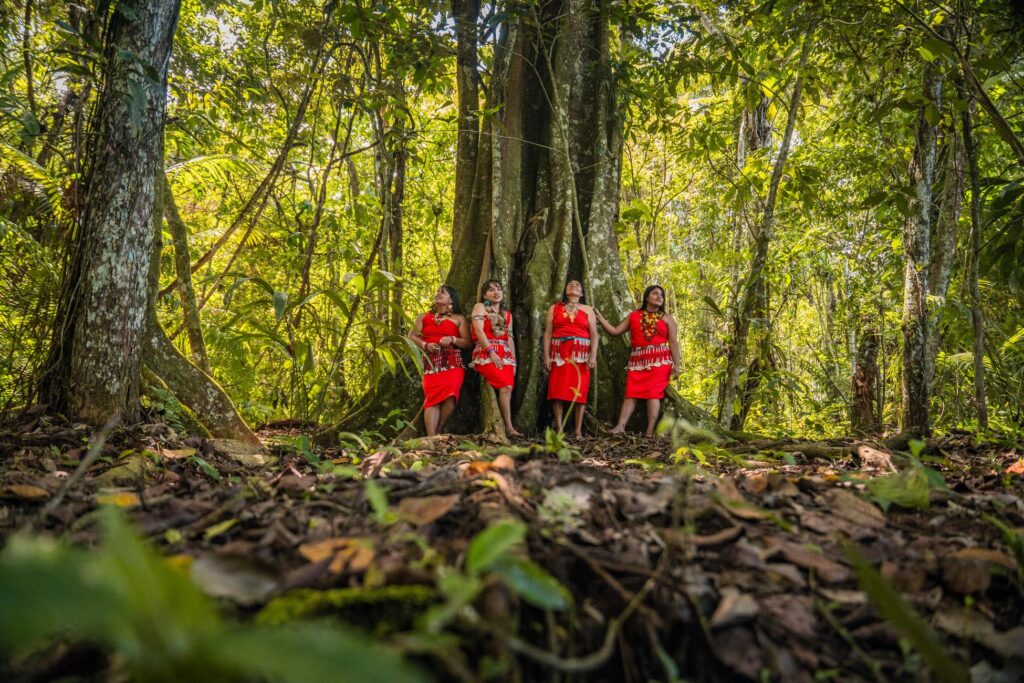
Meanwhile, a few thousand kilometers away from the peer-review queue, an elder in a forest that has not been clear-cut says something almost identical, without the quotation marks. The trees look after each other. The old ones feed the young ones. The forest listens. The forest remembers who was kind.
For a long time the assumption ran one direction: the lab would eventually explain what the forest people had been approximating in metaphor. The metaphor was charming; the mechanism was real. That story is quietly coming apart. Not because indigenous knowledge is being vindicated — a word that still assumes the courtroom belongs to the West — but because the two descriptions have begun to sit down at the same table and notice they have been eating the same meal.
Two Maps, One Territory
Consider what a mycologist means now when she talks about a forest. She means a slow, chemical conversation happening under the soil, in which carbon and nitrogen and warning signals move between trees through fungal threads finer than hair. She means that a dying Douglas fir will offload its remaining sugars into the network before it goes. She means that a mother tree recognizes her own seedlings and favors them. She means, if she is honest at three in the morning, that the forest is a being that thinks with its whole body and does not need a brain to do it.
Consider what a Kichwa or Yawanawa or Ojibwe knowledge-keeper means when they say the forest is alive. They do not mean it as a poem. They mean the forest has agency, memory, preference, grief. They mean you are being watched by something that is not a person and not a machine, and that your behavior in its presence has consequences that outlast you.
These are not the same sentence. But they are pointing at the same country. And the interesting question is no longer which one is correct. The interesting question is: what kind of attention did each tradition have to cultivate to arrive at that country at all?
What the Instruments Were Missing
The scientific method was built, in part, to protect knowledge from the wishful thinking of the knower. This is one of its glories. A double-blind trial does not care how badly you want the medicine to work. Replication does not care about your reputation. This discipline has given us antibiotics, vaccines, the ability to see a black hole eat a star.
But the same discipline that filters out wish also filters out relationship. If the observer must be absent from the observation, then any knowledge that requires being in relation to the thing in order to perceive it will be quietly disqualified. A forest studied by someone who has never wept in it, never buried anyone in it, never been hungry in it, never had to ask it for something — that forest will show you certain truths and hide others. Not out of spite. Out of the ordinary shyness that any living system shows to a stranger with a clipboard.
Indigenous ecological knowledge is not folk science waiting to be upgraded. It is a different instrument. It measures with a body that has been in the same watershed for four hundred generations. It measures with grief when a species goes quiet. It measures with dreams, with fasting, with the granular attention of someone whose survival depends on being wrong as rarely as possible about which mushroom, which weather, which silence in the canopy means what.
The lab and the forest were not measuring the same variables. They were measuring the same world with different organs.
The Trouble With Translation
For most of the last century, the well-meaning move was to translate. Take what the shaman says, strip out the cosmology, keep the pharmacology. Take what the elder says about the salmon, strip out the ceremony, keep the run-timing data. The cosmology and the ceremony were treated as decorative packaging around a nugget of extractable fact.
What that translation missed is that the cosmology is the method. The ceremony is not wrapping paper around the knowledge; it is the laboratory in which the knowledge was generated and is maintained. Remove the relational frame and you do not get purer data. You get data that has been severed from the discipline that keeps it honest.
This is why the recent turn in serious ecology — the willingness of researchers to co-author with knowledge-keepers, to name reciprocity as a real variable, to say gift and kinship without quotation marks — is not a soft-focus concession to indigenous feelings. It is a methodological maturation. It is scientists noticing that the instrument they had refused to pick up was, in some domains, the more sensitive one.
And on the other side, the best indigenous thinkers have never been afraid of the microscope. The suspicion runs one way more than the other. A Sami reindeer herder who reads satellite ice data and integrates it with her grandmother’s frost lore is not compromising her tradition. She is doing what her tradition has always done: use every organ available to perceive the actual world.
Reciprocity Is Not a Metaphor
The word that keeps surfacing, in both the papers and the ceremonies, is reciprocity. It is a plain word in English and it has been badly worn down. On a wellness poster it means being nice to the planet. In a mycorrhizal study it means measurable exchange of resources with something like negotiated fairness. In a Potawatomi grammar it means the world is composed of verbs and gifts, and that receiving a gift without responding is a kind of theft that eventually starves the giver.
Put these three uses next to each other and the poster version starts to look thin. The other two are describing something with teeth. Reciprocity, in the deep sense, is not moral advice. It is a description of how living systems continue to exist. A forest that only takes collapses. A river that is only dammed sours. A human who only extracts — from land, from lovers, from ancestors, from their own body — hollows out along a predictable curve.
This is where the essays this publication has sat with on the phoenix and the buffalo keep circling the same fire. Not because animals are metaphors for personality types, but because the old images know something about the shape of a life that is in exchange with its world rather than at war with it. The wolf is not a mood. The wolf is a way of being in a pack, in a territory, in a season. The image carries the ecology inside it.
What Attention Costs
There is a reason both traditions — the empirical and the ancestral — are demanding. Real attention is expensive. The ecologist who spends thirty years in one valley learning which lichen indicates which air pattern is paying the same price, in different currency, as the initiate who spends thirty years learning which song belongs to which stretch of river. Both are refusing the shortcut. Both are letting a specific place shape their nervous system until they can hear what a casual visitor cannot.
The modern crisis of attention is not primarily a phone problem. It is a relational problem. We have been taught that attention is a resource we spend on content, when in older economies attention was the thing that made a place a place, a person a person, a forest a forest. To attend to something for long enough is to enter into obligation with it. This is why so much of contemporary life is arranged to prevent it.
The older imagery knew this. The dragon guards a hoard because attention concentrated over centuries becomes something worth guarding. You do not stumble on it. You earn your way toward it, or you are eaten by it.
When the Descriptions Converge
So what happens in the room, actual or imagined, where the mycologist and the forest elder are finally allowed to speak without one having to defer to the other?
Something quite ordinary, in the best cases. They compare notes. The mycologist describes carbon transfer between species and the elder nods and offers the name her people have used for that transfer for as long as anyone can remember. The elder describes a particular grief that comes when a certain tree is cut, and the mycologist recognizes the phenomenon from her data on network collapse. Neither is translating the other. Neither is being folded into the other’s framework. They are two competent observers of the same country, discovering their maps overlap in places neither expected.
The overlap does not prove either of them right in the way a debate would. It suggests something more interesting: that reality, when attended to with sufficient discipline from more than one angle, tends to confirm itself across languages. And where the languages do not overlap, the honest response is not to force a merger but to notice the gap and wonder what kind of attention would be required to see into it.
Leaving the Forest in the Forest
There is a temptation, at the end of any essay like this, to extract a lesson. To turn the convergence into a program. To say: therefore we must integrate indigenous wisdom into environmental policy, therefore we must decolonize science, therefore, therefore. These conclusions may be true. They are also, in a way, the old extractive move in gentler clothing — taking the meaning out of the forest and bringing it home in a bag.
The harder invitation is to let the forest keep its own meaning. To notice that the convergence between the lab and the ceremony is not a resource to be mined for insight but a doorway to a different way of standing in the world. One in which you are not the sole author of what you perceive. One in which the trees, the fungi, the ancestors, the data, the elders, the instruments, and your own tired attention are all understood to be in conversation, and your job is less to conclude than to keep showing up to the conversation with something worth saying.
The forest was right all along, in the specific sense that it was never waiting to be verified. It was waiting to be joined. The lab is beginning, in its slow institutional way, to walk toward the same clearing. What might it mean to arrive there — not as translators, not as extractors, not as tourists of each other’s languages — but as two long-attentive traditions setting down their instruments for a moment and listening to what the place itself has been saying the whole time?
And what, in your own life, are you still translating that might simply be asking to be heard?