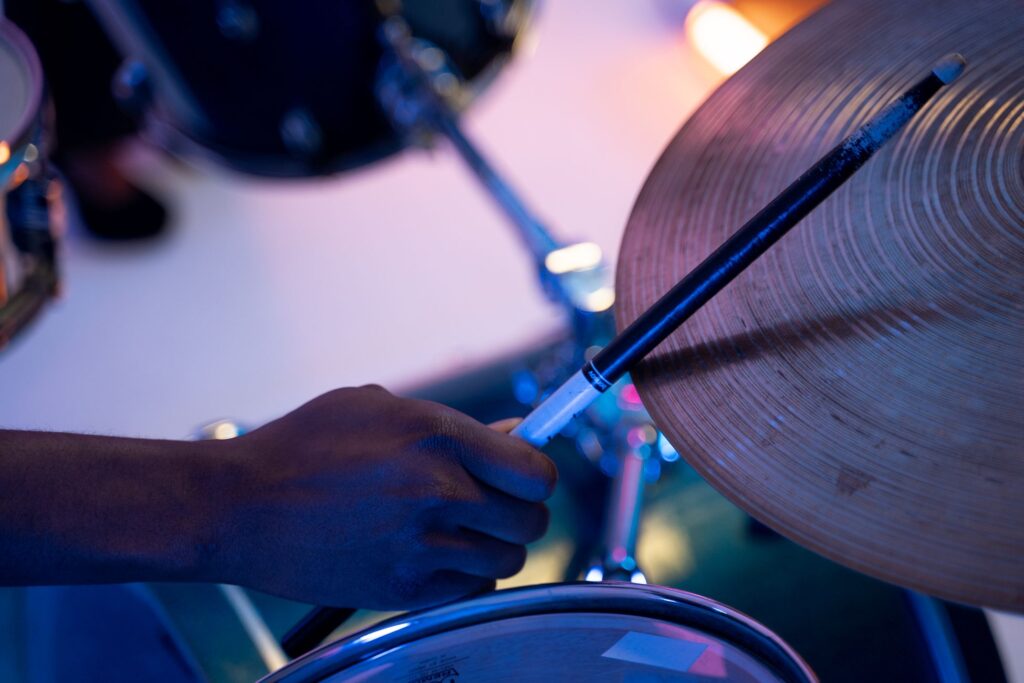
Before there was a word for the nervous system, there was a drum.
Someone stretched a hide across a hollow, struck it with an open hand, and the room changed. Breath slowed or quickened. Shoulders dropped or lifted. Strangers found the same pulse without agreeing to. Something in the body recognized something in the sound, and the recognition was older than language.
We tend to talk about ancient instruments as if they were charming precursors to real technology. Cute, wooden, superseded. But the drum was a technology. It still is. It just happens to be a technology aimed at the interior of a human animal, and that interior has not changed as quickly as our tools around it. The nervous system you carry to your desk this morning is roughly the same nervous system that sat around fires in the Paleolithic, waiting for the low thud that meant the night was being held.
An instrument tuned to the body, not the ear
Most instruments are designed for the ear. The drum, if you listen honestly, is designed for the chest.
You feel a bass drum before you hear it. The frequencies live in the sternum, the belly, the soles of the feet. A hand drum played close to the body vibrates the ribs. This is not metaphor. It is physics meeting anatomy. Low-frequency sound moves through soft tissue and bone and asks the organs to move with it, in the small way organs can. Your heart is already a drum. It was going to keep time with something. The question is what.
Ethnomusicologists have mapped drums across nearly every inhabited landscape: the frame drums of Siberia and the Sámi north, the djembe and dundun of West Africa, the bodhrán of Ireland, the taiko of Japan, the water drums of the Haudenosaunee, the maracá and the shakers that keep time in Amazonian ceremonies. Different woods, different hides, different hands. A stubborn commonality underneath. Humans, over and over, independently, decided that hitting a stretched surface in repeating patterns was worth building a life around.
That is not a coincidence. That is a species telling you something about itself.
What the physiology finally caught up to
The recent decades have been kind to old instruments. Not because science has confirmed anything mystical — it hasn’t, and it shouldn’t pretend to — but because it has finally started measuring what practitioners always claimed was happening.
Steady rhythmic sound, particularly in the range a hand drum produces, tends to shift brainwave activity toward slower, more coherent patterns — a 2025 review in the Annals of the New York Academy of Sciences found that rhythmic drumming increases coherence in the brain’s alpha band, the frequency range linked to relaxed, absorbed attention.
Group drumming has also been linked to measurable changes in stress hormones and immune function: a 2001 study in Alternative Therapies in Health and Medicine found that an hour of group drumming raised the ratio of DHEA to cortisol and increased natural killer cell activity, markers that moved in the opposite direction from the body’s usual stress response.
Researchers studying entrainment — the tendency of one oscillating system to sync with another — have measured heartbeats beginning to align across a room of people drumming together; a 2020 study in Scientific Reports found that strangers’ heartbeat intervals grew more synchronized the longer they drummed as a group, and a broader review of research on musical synchrony notes that rhythm can entrain heart rate, breath, and the brain’s own electrical activity across a room of listeners.
Clinicians working with trauma have leaned on rhythm and movement for related reasons. The psychiatrist Bessel van der Kolk, whose decades of research helped shape how trauma is treated today, has argued that traumatic memory is often held in a form talk therapy alone cannot reach, and that body-based practice can work where language stalls. The parts of the brain that hold terror do not, after all, speak in sentences. They speak in tempo.
None of this is news to the grandmothers. It is news to the instruments we use to measure grandmothers.
And this is where the conversation gets interesting, if you can hold two things at once. The old technology was not primitive intuition waiting to be validated. It was empirical in its own way — thousands of years of humans watching what a certain rhythm did to a grieving village, a frightened child, a warrior returning from something the village could not follow him into. The lab is not the judge of the drum. The lab is a very late arrival at a very long conversation.
Why the nervous system was waiting for this
Consider what a nervous system is actually doing most of the day. It is scanning. It is asking, below the level of your attention, whether you are safe. It is reading faces, tones, room temperatures, the sound of footsteps in the hallway, the electric hum of a screen, and building a running estimate of threat. When the estimate stays elevated for too long — which for most modern lives is most of the time — the body pays. Sleep frays. Digestion narrows. The jaw sets. The chest becomes a cage instead of a room.
The drum interrupts this in a way that almost nothing else can.
Slow, steady, low-frequency rhythm gives the scanning system something to lean on. It says, in a language older than reassurance: the ground is holding. The ground is holding. The ground is holding. Not as a promise. As a pulse. The nervous system, which is a pattern-recognition device before it is anything else, notices. It exhales. The scan loosens. Something underneath the vigilance gets to come up for air.
This is why drumming shows up around birth, around death, around initiation, around war, around anything a person cannot metabolize alone. It is not that the drum contains magic. It is that the drum contains time, offered generously, in a form the body can accept when it can no longer accept words.
The room becomes one animal
Something else happens when more than one person drums together, and it is the part the physiology is only beginning to describe.
Watch a circle. In the first few minutes, the rhythm is ragged. People are self-conscious, listening more to their own hand than to the room. Then, without instruction, the pulses begin to knit. Someone lays down a low heartbeat. Someone else finds a counter-figure. A third person stops trying and just breathes into the pattern. Within ten or fifteen minutes, if the circle is honest, there is no longer a collection of drummers. There is one animal made of many bodies, and the animal has a pulse.
This is entrainment at the social scale. It is also, quietly, one of the oldest forms of belonging our species has. Long before we had cities or contracts or shared languages, we had the ability to synchronize with each other through sound and movement. The Oxford evolutionary psychologist Robin Dunbar, who has spent much of his career studying how synchronized activity bonds groups, has found that moving together in rhythm — dancing, drumming, chanting — releases endorphins and builds trust in a way solitary activity does not. It is part of why anthropologists argue that this capacity — the willingness of separate bodies to become temporarily one body — is a foundation of everything else we call culture.
You can feel the loss of it in a life spent mostly alone with screens. The nervous system knows it was built for a circle it rarely finds anymore. This site has sat with related hungers before: the fire that will not stop asking to be tended in the phoenix in you, the rooted refusal that lives in the buffalo, the pack intelligence traced in the wolf. The drum belongs in that family. It is another form of remembering what the body already knows how to do, once it is given permission and company.
What gets lost when we mystify it
There is a temptation, when talking about old instruments, to reach for language that flatters the speaker more than it serves the listener. Sacred frequencies. Vibrational healing. Ancient codes unlocked. The drum does not need this dressing. It is more interesting without it.
What is actually happening when a person plays a frame drum at roughly the tempo of a resting heartbeat is not mystical. It is physiological, neurological, social, and — yes — existential, because a human being is all of those things at once and cannot be sliced cleanly into departments. The drum works on the body. The body is inseparable from the psyche. The psyche is inseparable from the room. The room is inseparable from the culture that assembled it. To call any layer of this the whole story is to misunderstand what a human is.
The crystal-shop version of shamanism sells a drum as an object with power. The older version, the one the elders have been trying to hand down without being interrupted, treats the drum as a relationship. You take care of it. You learn what it can and cannot do. You do not ask it to fix you. You sit with it long enough that your own rhythm becomes honest, and then you find out what honest rhythm does to a room.
This is closer to the temperament of the dragon than to any wellness marketplace: a fire that requires respect, not a product that requires purchase.
The pulse you are already keeping
Here is the quieter question underneath all of this.
Your life already has a rhythm. It has a tempo you did not entirely choose — the pace of your inbox, your commute, the notifications, the small percussive anxieties that tap on your chest between meetings. Something is drumming for you every day. The question is not whether you are being entrained. You are. The question is by what.
The old instrument, in the end, is not asking you to become a drummer. It is asking you to notice that you are always already being played by something, and to get curious about whether the rhythm you have absorbed is one you would have chosen if you had been asked.
A slow, steady pulse in a dim room, held by hands that know what they are doing, is not a cure for a modern life. It is a reference tone. A tuning fork struck once so the body can remember what it sounds like when nothing is trying to sell it anything, when time is being kept generously, when the ground is allowed to hold.
The drum knew first. It has been waiting, patiently, for the rest of us to catch up to what it was doing all along. It is still waiting. It is not in a hurry. That, too, is part of what it teaches.
What is drumming for you today — and would you have agreed to its tempo, if it had bothered to ask?