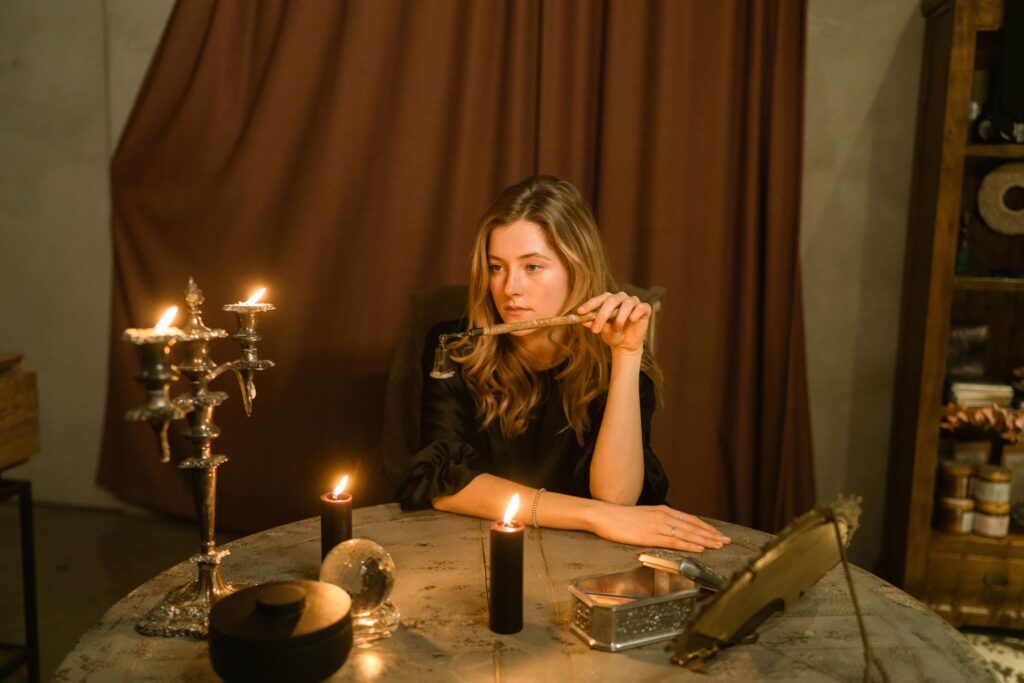
There is a small knife that lives on every real altar. Not for sacrifice. For hygiene.
You use it to scrape wax off the stone. To trim the wick before it smokes. To cut the cord on the offering that has started to rot in its bowl. The blade is not the enemy of the sacred. It is what keeps the sacred from turning into decoration, or worse, into theater.
Somewhere along the way, seekers were taught that doubt is the opposite of devotion. That to question the teacher, the tradition, the vision, the download, the ayahuasca insight, the astrology, the inner voice — is to betray the mystery. As if the mystery were fragile. As if truth needed to be protected from the mind that was built, over millions of years, precisely to test what is real.
Consider the possibility that this is backwards. That skepticism, done with love, is one of the oldest devotional practices a human being can perform. And that the most dangerous guru you will ever meet is not on a stage in saffron robes. It is the one who lives behind your own eyes, wearing your own certainty like a crown.
The oldest tool in the medicine bag
Anthropologists who have spent long seasons with living animist cultures tend to come back with a quiet, inconvenient observation: the people who actually work with spirits are usually the most skeptical people in the room. They test. They cross-check. They ask the vision what it wants, then ask again in three days when the fever has broken. They know which plants lie. They know which dreams are just dinner.
The romantic Western fantasy of the shaman as an ecstatic believer, swept away by unfiltered contact with the invisible, is largely a projection. In the field, the elders are more likely to be dry, funny, and deeply suspicious of anyone — including themselves — who claims to have received the final word from anywhere. They have watched too many people go mad from believing their own smoke.
Critical thinking, in this older sense, is not the cold rationalism of the seminar room. It is a form of hygiene. You wash your hands before you touch the wound. You question the vision before you build a life around it. You test the teacher against the fruit of their students’ lives, not against the beauty of their metaphors. The blade keeps the altar clean.
The modern spiritual marketplace has largely forgotten this. It sells certainty in beautiful packaging. It punishes doubt as a lack of surrender. It confuses the goosebump for the truth, the download for the discernment, the charisma for the medicine. And a whole generation of thoughtful people, hungry for something real, have been taught to distrust the one instrument that could have kept them safe: their own capacity to ask, is this actually true, or does it just feel true because I want it to be?
The guru problem, and its quieter cousin
The external guru is the easier case. The signs are visible now, catalogued in a hundred documentaries: the isolation of followers, the sexual coercion dressed as initiation, the financial extraction dressed as offering, the demand that doubt itself be treated as ego, as resistance, as the very thing the teacher will heroically dissolve. If you have been near one of these figures, you know the specific flavor. A room that feels charged but somehow airless. The way questions get redirected into questions about the questioner.
Skepticism, at that level, is straightforward self-defense. Ask what the teacher’s inner circle looks like five years in. Ask who left, and why, and whether they were allowed to leave with their dignity. Ask whether the teaching survives being written down in plain language, or whether it depends on the presence of the man.
But there is a quieter, more intimate version of the guru problem, and it is the one this house column keeps circling back to. It is the guru you meet in the mirror.
She is subtler than the man on the stage. She does not ask for your money. She asks for your loyalty to a story about yourself. She whispers that the last insight you had — on the retreat, in the ceremony, in the therapy chair, in the 3 a.m. journal — is the final one. That you have finally seen through it. That the pattern is broken now, the trauma understood, the shadow integrated, the trip complete. She hands you a small crown and asks you to wear it.
And then, three months later, you find yourself doing the exact thing you swore you had transcended, and you cannot understand how. This is not failure. This is what happens when the inner guru is not questioned. She was never enlightened. She was just the most recent voice in a long parliament, and she got hold of the microphone.
Doubt as an act of love
Here is the strange inversion at the heart of this: the deeper your devotion, the more rigorous your skepticism needs to become. Not less. More.
If you truly love the mystery, you owe it the courtesy of not confusing it with your own projections. If you truly respect an ancestor, a plant, a teacher, a tradition — you owe them the honor of testing what comes through, rather than swallowing it whole and calling that reverence. Uncritical belief is not respect. It is a kind of laziness that flatters itself as faith.
Psychologist Dacher Keltner and his colleagues have spent two decades building a formal science around what the old traditions already sensed. In a 2015 study of more than two thousand people, published in the Journal of Personality and Social Psychology, Keltner and coauthor Paul Piff found that awe measurably shrinks a person’s sense of an individuated self and increases generosity and ethical behavior. Awe genuinely rewires perception — it makes people more generous, more connected, more willing to belong to something larger than themselves. It is also, precisely because of its power, extraordinarily easy to hijack. The same openness that lets the vision in lets the parasite in. Awe without discernment is a door with no lock.
This is why the mystics who lasted — the ones whose lineages did not curdle into cults within two generations — were almost always, underneath the poetry, ferocious skeptics. They tested spirits. They cross-examined visions. They demanded that revelation prove itself in ordinary daylight, at the dinner table, in the way a person treated their neighbor. They understood that the sacred is not diminished by scrutiny. Only the fake is.
The animal you already are
There is a reason this site has sat with the phoenix, the buffalo, the dragon, the wolf. Not because they are aesthetic. Because each of them carries a form of intelligence the domesticated mind has forgotten.
The wolf does not trust the stranger just because the stranger is smiling. The buffalo does not move because someone in a nice voice said move. The dragon does not hand over its hoard to the first supplicant with a good story. The phoenix does not mistake every small pain for the great death. These animals live inside a skepticism so old it doesn’t feel like skepticism anymore. It feels like being awake.
Somewhere in your body, that animal skepticism still functions. You have felt it. The lecture that made everyone else cry left you cold and you couldn’t say why. The teacher everyone adored made your shoulders climb toward your ears. The insight you had at 4 a.m. felt enormous, and then, in the morning light, felt like a slightly embarrassing sentence. That was not your ego resisting the medicine. That was, quite possibly, the medicine itself.
The tragedy of the modern seeker is that they have been trained to override this signal in the name of openness. To call the flinch a wound. To call the hesitation a block. To interpret their own well-tuned nervous system as an obstacle to be dissolved by the next practice, the next plant, the next teacher. A whole industry now depends on you distrusting the one thing in you that was actually keeping watch.
Keeping the altar clean
What would it look like to bring the blade back to the altar? Not as cynicism — cynicism is just belief that has given up and started calling its own exhaustion wisdom. Something else. A practice. A stance.
Perhaps it looks like holding every strong experience, including your own, at a slight, respectful distance for a while before building on it. Letting the vision sit on the shelf for a season. Watching whether it grows anything true in the actual soil of your life, or whether it just makes for a good story at dinner parties.
Perhaps it looks like noticing, with a small internal smile, whenever you catch yourself using a spiritual concept to avoid an ordinary human conversation. Everything happens for a reason, as a way of not sitting with someone else’s grief. Trust the process, as a way of not looking at your own part in what went wrong. The vocabulary of the sacred is very good camouflage for very old avoidances.
Perhaps it looks like getting suspicious of your own certainty in exact proportion to how good it feels. Not because good feelings are wrong. Because the ones the inner guru manufactures tend to feel very, very good, right up until they don’t.
And perhaps, most of all, it looks like extending the same doubt to yourself that you would extend to a stranger claiming to be enlightened. If someone walked into your life tomorrow announcing they had transcended their family patterns, healed their trauma, integrated their shadow, and finally understood their purpose — you would, if you were wise, buy a small drink and wait a year. Consider offering yourself the same courtesy.
The question the blade leaves you with
None of this is an argument against devotion. It is an argument for devotion that has grown up. Devotion that has walked through a few teachers, a few certainties, a few versions of itself, and come out on the other side still willing to kneel — but no longer willing to close its eyes while kneeling.
The altar is real. The mystery is real. The ancestors are real, whatever real turns out to mean when the neuroscience and the cosmology finally sit down at the same table. None of that is threatened by your questions. It is only threatened by your refusal to ask them.
So the question this piece leaves you with is not what do you believe. It is quieter than that. Where, in your current life, have you stopped being willing to doubt? Which teacher, which insight, which story about yourself, which vision, which voice has been placed beyond examination? And what would it cost — what would it actually cost, in honest currency — to pick up the small knife again, walk to that altar, and clean it?
The blade is not the enemy of what you love. It is how you find out whether what you love is real.