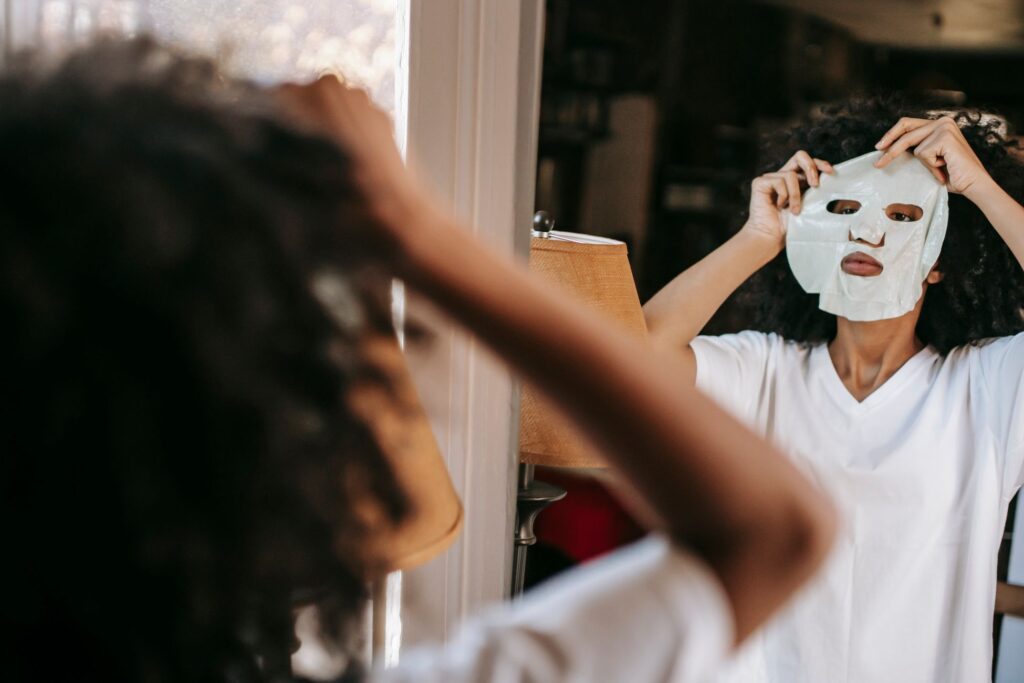
There is a particular kind of exhaustion that arrives after you have finally decided to stop pretending. You come home, close the door, and something in you expects the mask to slide off — a face beneath the face, ready to breathe. Instead you find another face. Slightly softer. Marketed as unguarded. Rehearsed in the mirror of your own attention for so long you cannot remember when you began composing it.
This is the strange predicament of contemporary authenticity. We are told the true self is buried under performance, and if we could only excavate it, we would arrive at something raw and unmistakable. But the excavation itself has become a genre. The unfiltered post is filtered by the aesthetics of unfiltering. The vulnerable confession follows a beat structure. Even solitude has a look now — linen, morning light, a mug held with both hands.
What if the authentic self, as currently sold, is also a costume? And what remains when you stop performing even the self that refuses to perform?
The market learned to sell the unperformed
Every era invents a self it can sell back to itself. The Victorian self was sold moral uprightness. The mid-century self was sold aspiration and appliances. The self of the last decade has been sold something subtler and more difficult to refuse: authenticity itself. The unvarnished. The messy. The real.
Notice the sleight of hand. The moment authenticity becomes a value the culture rewards, it becomes a currency. And currencies are minted, circulated, counterfeited. The unpolished caption is a polished object. The confession posted at 11pm has been drafted since Tuesday. The person who tells you they don’t perform is performing the not-performing, and the market — which is nothing more than the aggregated attention of others — pays them for it in likes, contracts, belonging, love.
This is not a moral failure. It is what happens when a species built for small bands finds itself watched by thousands. You cannot be seen at scale without shaping what is seen. The camera cannot help but change the animal in front of it. And the internal camera — the one you carry even when nobody is looking — was installed long before you knew you had swallowed it.
The self as a costume the costume is wearing
Anthropologists who have sat with masking traditions across the world tend to describe something the modern self-help vocabulary keeps missing. The mask, in ceremony, is not a lie covering a truth. The mask is a threshold. Something moves through it. The wearer is temporarily undone so that something older can speak.
Modernity kept the masks and forgot the threshold. We wear the face of the good employee, the good partner, the good citizen, the good healer, the good rebel — and none of them are portals anymore. They are storefronts. And behind the storefront, we have been told, is the real you, waiting like a shy animal for permission to come out.
But the shy animal is also a story. Sit long enough with what you have called your true self and you may notice it has a wardrobe, a preferred lighting, a set of grievances it likes to rehearse, a shape it prefers to be witnessed in. It has learned which honesties are rewarded and which are punished. It has curated its own rawness.
None of this makes you a fraud. It makes you a social mammal who learned, before the age of language, that being loved required legibility. The costume is not the enemy. The problem is mistaking the costume for the body underneath it, and then mistaking the next costume for finally being naked.
What the disorientation is actually saying
There is a moment — sometimes it arrives in the middle of a marriage, sometimes after a career you built for a decade, sometimes in the flat gray of a Wednesday — when the whole architecture of you seems to hum at the wrong frequency. Nothing has technically broken. You just cannot locate the person who was supposed to be at the center of all this.
The culture has a word for this. It calls it a crisis. Writers here have explored how people who feel lost after major life transitions may not be breaking at all — they may be experiencing the disorientation that precedes something more honest arriving. The old costume no longer fits. The new one has not been sewn. And in the naked interval, the mind panics and reaches for whatever fabric is nearest.
This is usually the moment the market steps in with a wardrobe. A new identity kit. A retreat, a certification, a diet, a diagnosis, an aesthetic, a spiritual lineage rebranded for the timeline. Any of them may hold real medicine. All of them can also become the next uniform of the unperformed self.
What if the disorientation is not asking you to pick a new costume faster? What if it is asking you to stand in the interval a little longer than is comfortable, and notice who is standing there when nothing has been decided?
The silence that is not a brand
There is a version of quiet that has become fashionable. Digital minimalism. The soft life. The dopamine fast. These are not wrong. But notice how quickly quiet, too, became a look. A curated retreat from performance that could be photographed and sold.
The silence this essay is pointing at is stranger and less photogenic. It is the silence that arrives after you stop composing captions in your head about the walk you are taking. The silence that arrives when you catch yourself rehearsing how you will describe your solitude to someone later, and let that rehearsal collapse. The silence in which you are not, for a moment, curating anything — not even your own restraint.
This site has sat with what it feels like when someone begins pulling back from social life not as a strategy but as a slow unlearning of who they had become in order to be liked. What tends to emerge is not a truer costume. It is a quieter relationship with the fact that there is no final costume, and that this is not a tragedy.
Ecologists have a term — edge effect — for what happens at the boundary between two ecosystems. Forest meets meadow. River meets bank. The edge is the most alive part of the landscape. More species. More exchange. More weather. The self, too, is most alive at its edges — the places where your inherited identities meet what has not yet been named. Stand there long enough and you stop asking which side is the real you.
What remains
So what is left, when you retire the performing self and then retire the self that performs its refusal to perform?
Something quieter than an identity. Something more like a stance. A quality of attention. The way a body listens to a room before it decides how to enter. The way a hand knows how much pressure a piece of clay wants. The way you find yourself laughing at your own theatrical suffering, mid-sentence, because you have been telling this story to yourself for twenty years and it turns out even the sadness had choreography.
What remains is not a truer character. It is the capacity to be a character less compulsively. To wear the face the moment requires without believing it is the whole of you. To let the storefront go dark sometimes and not need to explain the darkness to anyone. To feel the weight of being understood by few, including yourself, and stop treating that weight as a problem to be solved.
There is a physiological piece to this that neuroscience has begun to circle. The default mode network — the part of the brain that hums with self-referential story — quiets during states of awe, deep focus, ceremony, grief. In those quieting moments, people often report feeling more themselves, not less. As if the self that was so busy performing itself was, all along, in the way of something simpler underneath it. A being. An awareness. A creature.
The invitation, if there is one
The pieces this publication has spent time with — the phoenix that has to be reduced to ash before flight, the buffalo that walks into the storm rather than away from it, the dragon that guards what will not be sold — keep returning to the same threshold. Not who you should become. Who is left when the becoming pauses.
You do not have to burn every costume you own. Most of them are useful. The costume of the professional gets you through the meeting. The costume of the good parent gets the children fed. The costume of the friend who listens holds someone through a hard night. These are not lies. These are the clothes a social animal wears in the weather it finds itself in.
The invitation is subtler. It is to notice, once in a while, that you are wearing them. To feel the seams. To feel the body underneath the seams. To notice when a costume has fused with skin and gently, without drama, work it loose. To stop looking for the final outfit — the one that will make you legible to yourself forever — and make peace with the fact that the wardrobe changes because you are alive.
The authentic self was never a destination hidden under the performances. It was the one doing the performing, and the one watching the performing, and the one who, in rare and unphotographable moments, forgets both. That one does not need a costume. It also does not need to announce that it has stopped wearing one.
What would it be like, this week, to let one small performance go unperformed — and not tell anyone, including the part of you that would love to be praised for the letting go? What remains in that unwitnessed quiet is closer to you than any name you have used for yourself. And it has been waiting, patient as weather, for you to stop introducing it.