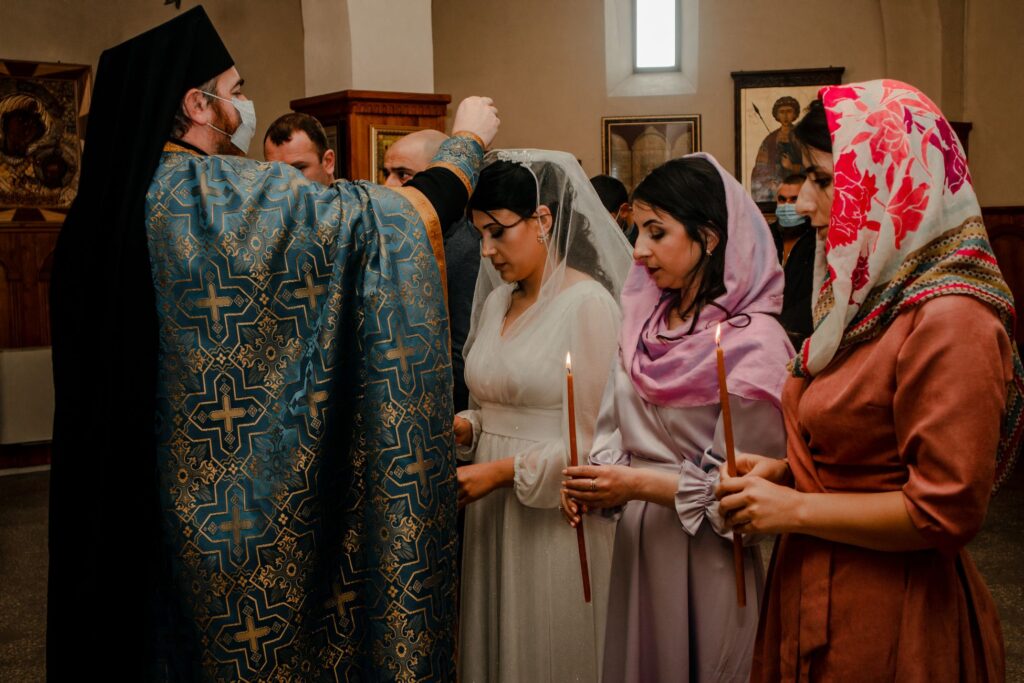
There is a candle on a table. Someone lights it. The air in the room does something — or it doesn’t.
That is the whole question.
Not whether the candle is beeswax or paraffin. Not whether the person lighting it wore linen and spoke in a lowered voice. Not whether the moment was filmed on a phone propped against a stack of books, edited with a slow zoom, and set to a drum loop bought from a sample library. The question is simpler and more merciless than any of that: did the room change, or did it stay exactly as it was while somebody performed the shape of change over it?
This is the line between ritual and performance. It has almost nothing to do with aesthetics. It has almost everything to do with what the act is for.
What a ritual is actually for
A ritual, stripped of costume, is a technology for shifting attention. Anthropologists have circled this for a century — Victor Turner called it liminality, the threshold state where ordinary social identity loosens and something else becomes briefly possible. Neuroscientists studying repetitive movement, chant, and fasting describe measurable changes in autonomic tone, in the default mode network, in the sense of self at the edges. Ecologists who watch initiation practices in small societies note that these acts are usually tied to a real transition: a body becoming an adult, a marriage forming, a death being metabolized by the living, a season turning, a hunt beginning, a war ending.
None of this is decoration. The candle, the drum, the water poured on a stone — these are handles. They exist so that a group of people, or one person alone, can grip something invisible and move it.
The test is embarrassingly practical. After the ritual, is the grief lighter, the fear metabolized, the decision made, the boy now standing among the men, the field now blessed and therefore actually planted? Did anything move from one room to another? Or did the participants simply feel briefly moved and then return, unchanged, to the exact life they had before?
Feeling moved is not the same as moving.
The algorithm is a different kind of altar
The feed is also a technology for shifting attention. That is not an insult. It is a description of its function. The feed exists to concentrate the gaze of many strangers on a single frame for a few seconds, and to reward the frames that hold the gaze longest.
This means the feed has its own liturgy. Slow openings. Whispered voice. Firelight. Feathers. A hand entering the frame from the left holding sage. The specific cadence of the word ancestors. A drum in the background just loud enough to sit under speech. The camera at hip height, tilted up, so the practitioner looks large and the sky looks close.
None of these things are wrong. Some of them are borrowed, some invented, some accurate to real lineages the practitioner has actually trained inside. The problem is not that the frame is beautiful. The problem is that the frame is now the point.
When the frame is the point, the room stops being the client. The audience becomes the client. And the moment a ritual has an audience it was designed to please, it has quietly changed species. It is no longer altering the room. It is describing, with great skill, the idea of a room being altered.
How to tell them apart from the inside
You cannot tell them apart from the outside. This is important. A camera cannot see the difference. Neither can a stranger. Neither, often, can the practitioner, which is where things get interesting.
But the body knows. The room knows. The people who sat in the circle know within a few hours whether something actually shifted or whether they simply had a nice evening with candles.
Some questions worth sitting with, if you find yourself either leading such a moment or attending one:
Was there anything at stake? A real ritual is expensive. Not necessarily in money — in exposure, in risk, in the possibility of failure. The person leading it could be wrong. The spirit called could refuse to come. The grief could crack open and not close cleanly by dinnertime. If the outcome was guaranteed to be beautiful, it was probably choreography.
Who was allowed to be ugly? Ceremonies performed for an audience require everyone to remain photogenic. Real ones require someone, at some point, to make a sound that would never be uploaded. Snot, rage, laughter at the wrong moment, the ancient and undignified noises of a nervous system letting go. If nobody was permitted to be unlovely, the room was a set.
What happened the next morning? A ritual has a wake behind it, like a boat. Days later, choices are being made differently. A conversation that was avoided for years happens. A job is quit. A parent is called. A pattern that had gripped the body for a decade loosens by half a turn. If nothing downstream moved, upstream was theater.
The costume problem
There is a specific temptation, in this century, to borrow the visual grammar of peoples whose ceremonies actually work — meaning, whose ceremonies are still embedded in a living community that depends on them — and to wear that grammar in contexts where nothing is embedded and nothing depends on anything.
This is the tribal cosplay problem. It is not solved by having permission, or lineage papers, or a teacher who said yes. Those matter, but they are the floor, not the ceiling. The deeper issue is that a headdress in a village where the whole village knows what the headdress costs is a different object than the same headdress on a stage in a city where nobody knows anything and everyone is filming.
The object has not changed. The field around it has. And ritual objects are field-dependent the way a fish is water-dependent. Move them into thin air and they die, no matter how carefully you hold them.
This does not mean contemporary people are locked out of ceremony. It means the opposite. It means the work is to build the field, patiently, in the actual life you actually live — with the actual people who will actually still be around next winter — rather than to import the visible surface of somebody else’s field and hope the depth comes with the props.
The altar that changes a room is usually made of things the room already contained. A bowl from the kitchen. A stone from a walk that mattered. A photograph of a dead person who is genuinely missed. A candle, yes, but this candle, lit for this reason, on this night, because something specific is being asked or released or named.
Science, awe, and the honest measurement
Researchers studying awe — Dacher Keltner’s group at Berkeley, among others — describe it as a state in which the self reports feeling smaller and the world reports feeling larger, and in which subsequent behavior tends toward generosity, patience, and a longer time horizon. This is a measurable thing. It happens in cathedrals, on mountain ridges, at births, at the edge of the sea, and, sometimes, in a small room where a few people are honestly attempting something together.
It also, notably, does not happen on demand. It cannot be scheduled. It cannot be guaranteed by lighting design. It arrives when the conditions are right and refuses when they are not, and no amount of ceremonial fluency can force it. This is the humbling news and the good news at once. It means the practitioner is never the source. It means the room, and whatever moves through the room, is doing its own work, and the ritual is just an invitation the room may or may not accept.
An honest practice keeps this asymmetry in view. It stops mistaking the invitation for the guest.
Writers on this site have circled adjacent questions before — what it costs to let a life burn without performing the burning, what it means to stand your ground without freezing into a pose, the difference between the dragon that guards something real and the dragon that guards only its own image, the way the wolf knows the pack from the crowd. The same fault line runs under all of them. The image of the thing is not the thing. And the image is easier, faster, and much more shareable.
What the room asks of you
None of this is an argument against beauty. Rituals should be beautiful. The old ones were staggeringly beautiful, and the beauty was part of the technology — it captured attention, opened the chest, softened the guard. Beauty is not the enemy. Beauty performed at people, instead of with them, is the enemy, and it is an enemy mostly to the performer, who slowly loses the ability to tell the difference.
The quiet discipline of a real practice, contemporary or ancient, might be something like this: to keep asking, before and during and after any ceremonial act, who this is actually for. Is it for the grief in the room, the decision waiting to be made, the season turning, the child crossing over, the couple binding themselves, the dying person being helped across? Or is it for the version of yourself you can post tomorrow?
Both can wear the same clothes. Both can use the same words. Only one of them changes anything.
The candle is on the table. Someone is about to light it. The question that matters is not whether anyone is watching. The question is whether, when the flame catches, the room becomes even slightly different than it was — and whether you would still light it, in exactly the same way, with the same care, if no one, ever, was going to see.