
Editorial note: This article was originally published on My Inner Creative and has been updated and republished in May 2026 under The Vessel’s editorial standards.
A dream journal is one of the older categories in the journaling tradition. It is also one of the more demanding, because dreams fade unusually quickly after waking.
A few seconds spent reaching for a phone, a glance out the window, or a single thought about the day ahead is often enough to dissolve the night’s content past the point of recovery. Anyone who has tried to keep a dream record knows the small ritual that has to grow up around it: pen and paper within arm’s reach, a few quiet minutes before the rest of the morning begins, and a habit of writing things down before they are fully understood.
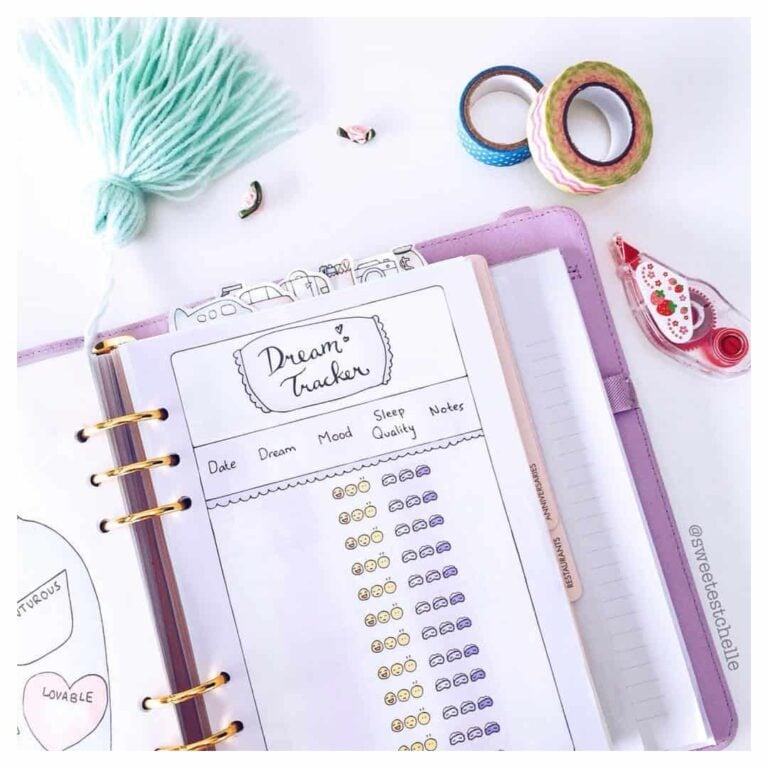
The twenty-five spreads collected below were originally featured on My Inner Creative as examples of how dream tracking can be incorporated into a bullet journal. The layouts range from a single monthly log of dates and one-line descriptions through to elaborate spreads built around recurring symbols, emotional state on waking, and small sketches of dream imagery.

Why people track dreams
Researchers have proposed a number of theories about what dreaming is for. J. Allan Hobson, writing in his 2005 book Dreaming (Oxford University Press), described the main purpose of dreaming as “to facilitate the consolidation and advancement of procedural learning.” Other writers frame dreams more loosely as a state in which the rational part of the brain stops dominating, leaving room for the more creative mind to express itself in ways the waking day rarely allows.
Recurring symbols, repeating emotional textures, and themes that surface for a few weeks and then fade can all be tracked in a way that a single remembered dream cannot reveal. The bullet journal is well suited to this kind of slow observation. A short entry per morning, kept for several months, builds a picture that any one entry cannot.
Setting up a dream tracker in a bullet journal
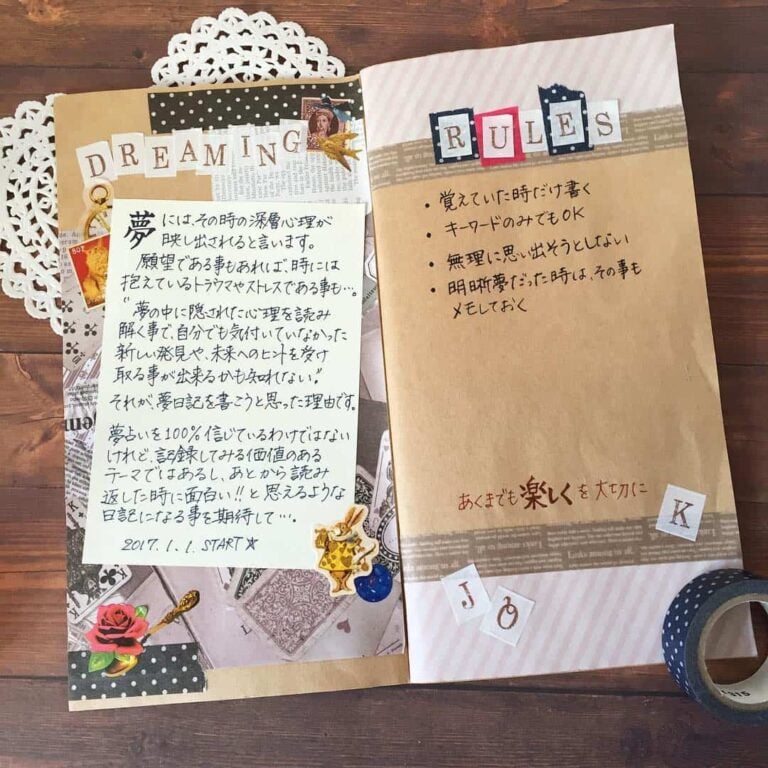
The simplest dream-tracking spread is a single page divided into three columns. A typical version records the date, a short description of the dream, and the emotional state on waking. Some people leave most days blank rather than fabricating recall; consistent partial entries tend to read back more usefully than reconstructed full ones.
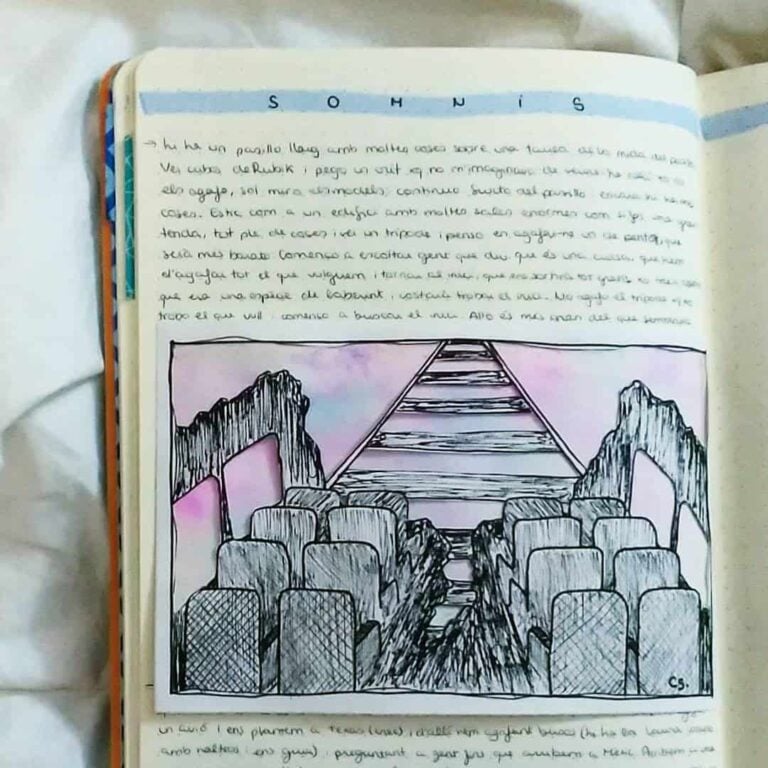
Beyond the basic log, a few variations show up regularly in the gallery below. A monthly dream-frequency tracker uses a calendar-style grid where each day is filled in with a symbol or colour representing the kind of dream that occurred. A recurring-symbols spread dedicates a page to images that show up more than once, with rough sketches and brief notes on context. Longer-form dream narratives can be written across a full two-page spread when a particular dream feels worth the additional time, and visual elements — small illustrations, watercolours, or stickers — are often added on the same spread when a person is artistically inclined.
Two practical habits help more than any specific layout. The first is keeping a notebook and pen on the bedside table so that dream notes can be made before the morning starts in earnest. Dreams fade fast enough that even moving to a different room is often too long. The second is consistency, not completeness; recording a brief fragment most mornings produces a more useful record than waiting for a clearly remembered dream that may or may not come.


What a dream journal entry actually needs to contain
The most common mistake in starting a dream journal is trying to write too much. A new keeper will often lie still after waking, attempting to hold the entire dream in working memory while composing a coherent narrative, and lose most of it in the process. The more useful habit is to write fragments first — a list of images, a name, a feeling, a colour, a location — and only attempt to connect them into a sequence afterward if the sequence is actually recoverable. A disconnected list of genuine details is more valuable as a record than a flowing narrative that has been partly reconstructed from inference.
A functional entry needs only four things: the date, a rough indication of the emotional register on waking (a single word is enough), at least one concrete sensory detail from the dream, and any element that felt significant or strange even if its meaning is not clear. Entries that include these four elements tend to remain readable months later. Entries that skip the emotional register and the concrete detail in favour of narrative summary tend to flatten into a generic account that could apply to almost any dream.
Some keepers find it useful to note the time of waking when the dream occurred during the night rather than at the usual rising hour. Dreams that interrupt sleep at 2am have a different character from those that occur in the last sleep cycle before waking, and noting the time makes this distinction visible when reviewing the journal later. This is a minor addition but one that costs almost nothing to include.
Common dream themes and how they are often interpreted
Dream interpretations vary widely across cultures, traditions, and individual contexts, and any particular reading of a dream depends heavily on the person having it. A few themes recur often enough across recorded dreams that they have collected their own common, non-clinical interpretations worth noting:
- Flying: commonly associated with feelings of freedom, control, or a desire to escape from a constraint.
- Falling: often connected to a sense of losing control, instability, or a fear of failure in some area of waking life.
- Being chased: frequently linked to avoidance of a problem, an issue the dreamer is reluctant to face, or a sense of being overwhelmed.
- Teeth falling out: traditionally connected to concerns about appearance, communication, or loss of control or power.
- Being naked in public: often read as vulnerability, fear of judgement, or a sense of being seen too clearly.
- Taking an exam or test: commonly associated with feelings of pressure, evaluation, or being unprepared for a real-life challenge.
- Water: usually interpreted in relation to its mood — calm water suggesting tranquility, rough or turbulent water suggesting emotional difficulty.
- Meeting a deceased loved one: sometimes interpreted as the subconscious processing grief, longing, or unresolved feelings about the relationship.
- Being lost: typically connected to uncertainty, a decision being avoided, or a sense of not knowing one’s direction.
None of these are diagnostic, and none should be taken as the meaning of a particular dream for a particular person. They are starting points for reflection, useful only insofar as they prompt the dreamer to think about the dream in connection with what is actually happening in their waking life.
Using interpretations as a starting point, not a conclusion
The list of common themes above is a starting point for reflection, not a diagnostic tool or a fixed symbolic vocabulary. The problem with most popular dream interpretation guides — whether found in books or online — is that they present symbol meanings as though they transfer directly from one dreamer to another. They do not. Water may suggest emotional difficulty in one person’s dream life and nothing more than a memory of a recent holiday in another’s.
The more productive use of a symbolic interpretation is as a prompt: does this reading resonate, and if so, with what? Someone who dreams repeatedly of being chased and reads that this is associated with avoidance does not have an answer — they have a question worth sitting with. The same symbol in a different person’s journal might feel entirely irrelevant. The journal itself, read over time, is a better guide to what a recurring symbol means for a particular dreamer than any external reference.
This is one reason why dream journalling is more useful than dream recall alone. A single remembered dream and a general interpretation of its symbols produces a guess. A three-month journal that shows the same symbol appearing in different emotional contexts, at different points in the month, sometimes alongside other recurring elements, produces something more like evidence — not of a fixed meaning, but of a pattern worth paying attention to.
Featured dream-tracking bullet journal spreads
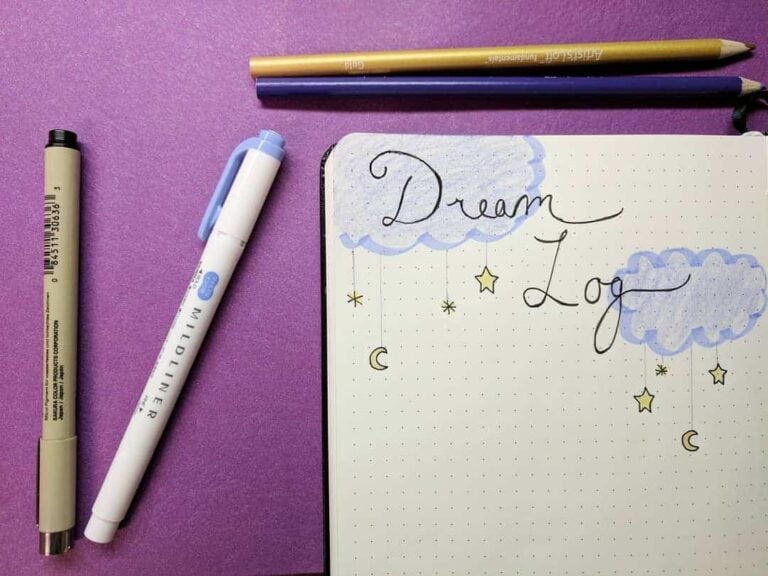
The gallery below pulls together twenty-five dream-tracking layouts originally collected by the My Inner Creative community. The styles vary widely. Some are highly structured grids; others are loose, illustrated, and almost diaristic. A few combine dream tracking with other related practices like mood tracking or meditation. The collection is useful less as a set of templates to copy exactly than as a survey of how widely this slightly unusual practice can take shape on paper.








How to review a dream journal once it exists
Most writing about dream journals focuses on how to start one. Almost none of it addresses what to do with one once it has been kept for several months. The record does not interpret itself. A notebook containing ninety entries requires some kind of reading practice to become useful, and most people who keep dream journals never develop one.
The simplest review approach is a monthly read-back. On the last day of each month, re-read that month’s entries with a pen in hand and mark any element that appears more than once — a recurring location, a recurring person, a recurring emotion, a recurring situation. Do not attempt to interpret these recurrences immediately; just mark them. After three or four months of this, the marked elements begin to form a picture that a single month cannot show.
A second approach, better suited to people who are keeping a recurring-symbols spread alongside their daily log, is to maintain a running index of those elements. Each time a symbol or figure or place appears in a new dream, add the date next to the existing entry rather than creating a new one. Over time this produces a frequency record — some elements will appear a handful of times across a year, others will cluster tightly into a few weeks and then disappear. The clustering is often more informative than the frequency.
Dreams are an unusual category of experience to record because they resist the qualities that make most journal entries useful. They are not retrievable on demand, they are not always intelligible, and they tend to feel less important by the time afternoon arrives. The point of writing them down anyway is that occasionally, over months and years, the record reveals something a single morning could not. A notebook patient enough to hold those occasional revelations does most of what dream tracking actually asks for.