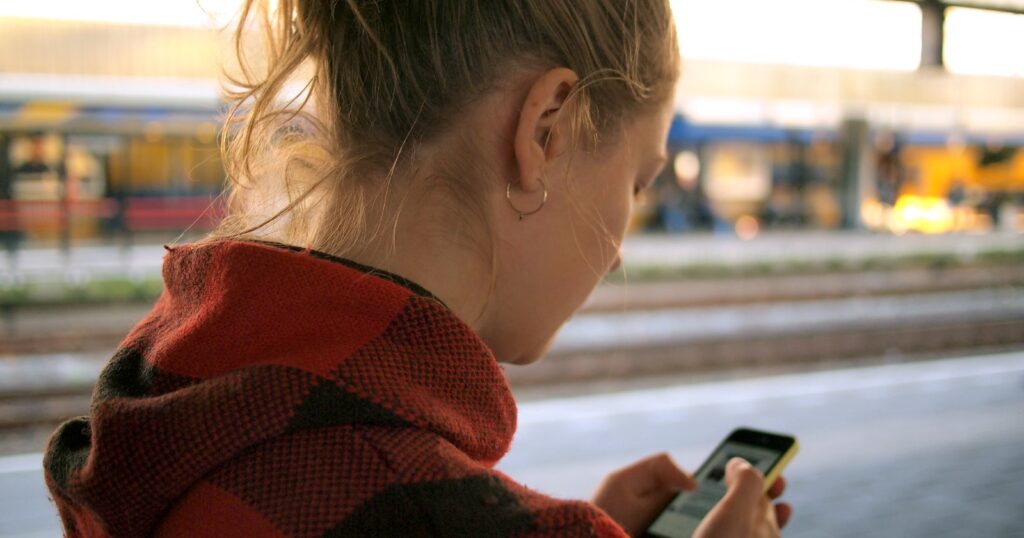
You type it at eleven at night. Hey — thinking of you, how’ve you been. Then you look at it sitting there in the box and it reads like a stranger wrote it, so you take out the dash, and then the hey, and then the whole thing, and put the phone face down on the arm of the sofa.
Nothing is wrong, which is exactly what makes it hard to write around. Nobody borrowed money. Nobody said the unforgivable thing at the wedding. The replies went from same-day to next-week, then one of them didn’t come at all, and the last line in the thread is still somebody promising to catch up properly soon. It has sat there long enough that answering it now would itself be a small event.
Deleting it feels like judgement rather than cowardice, which is why it is so easy to do. You have run an estimate of how the message would land and the estimate came back: intrusion, plus apology, plus the small labour of explaining yourself.
The estimate is wrong. Not by much, but wrong in the same direction every time, and measurable.
Four researchers — Peggy Liu, SoYon Rim, Lauren Min and Kate Min — spent thirteen studies on this for a 2023 paper in the Journal of Personality and Social Psychology, which sounds like a great deal of effort to establish that people enjoy hearing from their friends. The interesting part is which half of the pair they caught out.
The best of the studies dispensed with hypotheticals. Undergraduates were asked to write a short note to a friend they hadn’t spoken to in a while and to say how much they thought that friend would appreciate it. The researchers then delivered the notes for real and asked the friends. Fifty-four pairs came back complete. The senders had guessed 5.57 out of seven. The friends who got the notes said 6.17.
Just under six-tenths of a point on a seven-point scale. It is not a large finding and there is no use pretending otherwise; when an independent team re-ran one of the hypothetical versions with 742 people, it came back smaller still. What makes it worth reporting is that it came back at all.
The account of why is better than the finding itself. Two people look at the same message and appraise different things.
The sender is appraising a message. Is it interesting enough, is the timing odd, does the silence need explaining. What the studies measured on the other side is different. What lands is being on somebody’s mind — that somebody thought of them while standing in a queue and then, unusually, did something about it.
Everyone knows this from the other side, and nobody counts it as evidence. A name you haven’t seen in a year comes up on the screen and something in you moves before you have read a word. Then you read it and it says almost nothing, a photograph of a dog or a question about a band you both liked, and that turns out to be fine.
You can inspect your own hesitation in detail, every deleted draft of it. The half-second at the other end happens in a room you will never be in and leaves no trace unless the person mentions it, which mostly they don’t.
Which is why the effect disappears the moment the message is expected. Ask people to imagine the same gesture inside a scheme where two people are paired and a check-in is expected that month, and senders predict appreciation almost exactly right. No surprise, no error. What the studies caught, then, is the small ambush of being thought about without warning.
And it widens exactly where you would expect to be least welcome. The gap turned up for close friends and distant acquaintances alike, but among the distant ones it ran more than twice as wide. Drift makes a message more surprising, and surprise is the whole mechanism, so the further gone the friendship the further off your guess. The distance that makes it feel too late is the thing doing the work.
None of which is about your particular person. These were adults on online panels, mostly American with one large study reaching into Britain, and undergraduates on a couple of US campuses, and every message tested was one meant kindly. Nobody studied the note that arrives as too much, or the one that lands on somebody whose last exchange with you went badly; the authors raise the possibility that the error reverses there. And the appreciation being measured is a number written on a scale for a researcher, which is a thin proxy for the feeling.
They are also blunt about something most papers bury. Several of their own experiments were too small to detect an effect the size of the one they were finding, and they printed the table that says so. That is why the replication matters, and why it counts for more than a second paper by the same four people ever could.
Knowing all of this does not appear to help, which is the deflating part. In one of their own studies the researchers explained the underestimation to people and then gave them two minutes to get in touch with someone. Their predictions moved. Whether anyone actually wrote did not.
So this is not a method. Reading a stack of studies is not the same as knowing your own situation, and none of this will fix a friendship with something real wrong with it. If what is stopping you is heavier than awkwardness — a long withdrawal from people, a flatness that has outlasted whatever caused it — that belongs with a therapist or a counsellor.
Your estimate of how the message will land is a little low. It is lowest exactly where you are least likely to question it: the friend you have drifted furthest from, where the silence has run on long enough to start feeling like information.
The studies cannot tell you whether to write. They can only tell you that the person you are picturing, the one who would find it strange, is slightly a fiction, and that you have never once been in the room when a message like this arrived.