
There is a private conviction a great many functioning adults carry around like a secret: that they are winging it. That somewhere a memo went out explaining how to do this — the career, the mortgage, the parenting, the small talk about retirement accounts — and they alone missed it. They look around at colleagues and neighbors who seem to be operating from a plan, and they conclude that the gap between that composure and their own daily improvisation is a personal deficiency. It almost never is.
More often it is the opposite.
The feeling of making it up is not the symptom of someone failing at adulthood. It tends to be the symptom of someone who has stopped believing the performance.
The plan was always a performance
The person across the table projecting total certainty is, in all likelihood, improvising too. Confidence, as a social signal, is mostly volume — a tone of voice, a posture, a way of saying “obviously” before a claim that is not obvious at all. We have collectively agreed to treat that volume as evidence of an underlying plan, and so we reward it, and so everyone learns to produce it. The result is a room full of people performing certainty at one another while each privately suspects they are the only fraud present.
This is the quiet absurdity at the center of modern adult life. We have borrowed the language of the startup and applied it to being a person — five-year plans, quarterly goals, optimization, milestones, a “trajectory.” It is a strange inheritance. A human life is not a company, and it does not actually run on roadmaps and targets. But the metaphor is everywhere, and it sets a standard against which honest confusion looks like a defect rather than the baseline condition it really is.
What the attentive ones are actually noticing
The people who feel like they are improvising are usually the people who have looked closely enough to see that there is nothing else going on. They have noticed that the “plan” everyone seems to have is, on inspection, a story told after the fact — a tidy narrative arranged around decisions that were mostly intuition, accident, and response to circumstance. They have noticed that the confident people are improvising with better lighting. To feel like you are making it up is to have declined the comforting fiction that anyone is doing otherwise.
That is a form of honesty, and honesty about uncertainty tends to come with a sharper kind of attention. Someone not running on autopilot toward a predetermined destination has to actually watch where they are going. They have to read the room they are in rather than the room their plan assumed. The improviser is paying attention precisely because they are not pretending to already know.
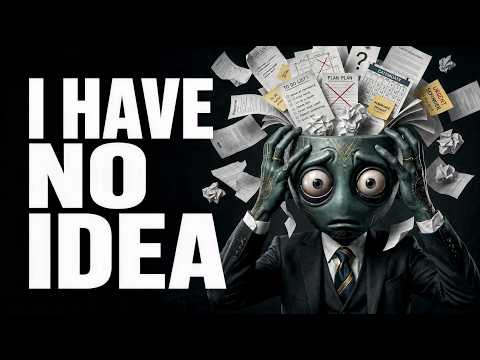
This is the territory The Vessel explores in its short film Adulthood: The Noble Art of Making It Up. The film argues that confidence is often just emotional volume, that treating adulthood like a tech company with quarterly targets is faintly ridiculous, and that the finished human being people keep waiting to become does not exist. It ends less with instructions than with an invitation to stop waiting for clarity and start participating.
The finished human who never arrives
Much of the distress around improvising comes from a hidden assumption: that there exists a completed version of oneself, somewhere up ahead, who will finally have it together. Once the next promotion lands, once the savings hit a number, once the relationship settles, once a person is forty, once they are wise — then the winging-it phase will end and the real, assembled adult will take over. The trouble is that this person is a mirage. Everyone who reaches those milestones reports the same thing: the milestone arrived, and they still felt like themselves, still improvising, just with new variables.
There is no terminal state of adulthood at which the improvisation stops. The waiting, then, is the actual problem — not the confusion. People put their lives on hold pending a clarity that is not coming, treating the present as a rehearsal for a performance that never begins. The reframe is to notice that this is it. The improvising is adult life, for everyone, permanently. The only choice is whether to do it while ashamed or while awake.
From shame to participation
What changes when this is accepted is not the circumstances but one’s relationship to them. The confusion stops being evidence of a defect and becomes simply the texture of a thinking person moving through an unscripted world. Energy spent hiding the improvisation gets redirected into improvising well — paying attention, responding to what is actually present, adjusting as understanding develops. This is what good improvisers in any art form do: they are present, responsive, and unattached to a script that was never going to survive contact with reality anyway.
It is also worth recognizing how lonely the performance makes so many people. The feeling is isolating because so many people are hiding the same thing, which means the secret keeps each person convinced they are uniquely behind. The moment one person says it out loud — “I have no idea what I’m doing either” — the room tends to exhale. The confession is almost always met with recognition rather than judgment, which is what makes it feel like relief.
The closer attention is the point
The person quietly improvising while everyone else appears to be executing a plan is often simply seeing more clearly than the performers around them. They have noticed that the plan is a story, that the confidence is volume, that the finished adult is a mirage. Those are the observations of someone paying attention — which has always been the harder way to be alive.
The task was never to stop improvising. It was to stop apologizing for it, and to get good at it.