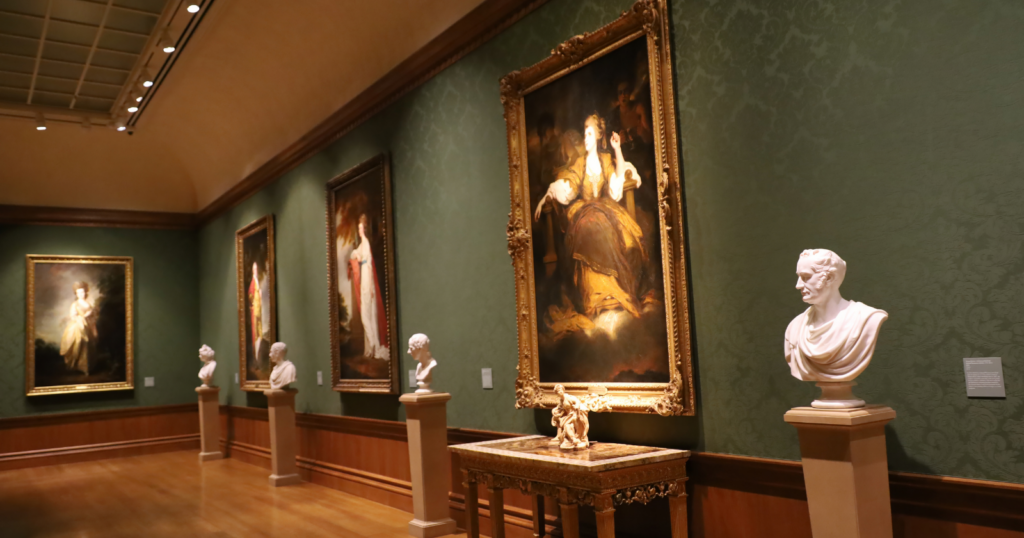
The tour lasted about twenty minutes. Volunteers at Baycrest in Toronto moved through a series of artworks with an audio guide in their ears, stopping at each piece, listening, and moving on. It was ordinary enough, the kind of afternoon that might leave behind only a vague sense of having seen some paintings. Later, one group slept overnight in a laboratory while researchers recorded their sleep, while a matched group remained awake during the day before their memories were tested again.
What remained, according to a 2025 paper in Nature Human Behaviour by Diamond, Simpson, Baena, Murray, Fogel and Levine, was oddly lopsided. The specific features of the artworks, such as a shape here or a colour there, behaved the way details usually behave: they thinned out. But the order of the tour, the sequence in which one piece followed another, survived better in the people who had slept. Follow-up testing about a year later still showed the sleep group holding an advantage for sequence, an effect the authors associated with slow-wave sleep activity recorded overnight.
The paper’s title is unusually direct about the shape of the claim: sleep “selectively and durably enhances memory for the sequence of real-world experiences.” The important word is selectively. Not everything was saved.
An art tour instead of a word list
Most sleep-and-memory research uses material that is easy to score and hard to care about, including paired words, abstract shapes, and lists that exist only inside the experiment. That precision comes at a price. Real experience is not a list. It arrives as a continuous stream in a particular place, and what someone later tries to recall is usually a mixture of what happened and when it happened relative to everything else.
The Baycrest paradigm was designed to sit closer to that kind of experience. Participants took an immersive, audio-guided walk past real artworks that lasted roughly twenty minutes and unfolded in physical space. They were not instructed to memorize the material in a particular way. They were simply told to take the tour.
Afterward, memory was tested along two separate seams. One was sequential memory: could a participant reconstruct the order in which the artworks appeared? The other was featural memory: could the participant retrieve properties of the individual pieces, including the shape-and-colour specifics that feel like the substance of what was seen?
Splitting the test that way matters because it makes the result legible. If sleep had simply strengthened “memory for the tour,” both forms of memory might have been expected to move together. They did not.
The overnight difference, and how modest it is
The design compared a sleep group with a matched wake group, with approximately 39 participants in the sleep group and 38 in the wake group for the main multi-session analysis. An initial study included 53 people. These are laboratory-scale numbers, not a population survey. The findings should therefore be read as a controlled comparison of two conditions, with appropriate caution about how far a single study can travel.
Within that frame, the pattern was clear. After a night of sleep, sequential memory rose above where it started, rather than merely resisting decay. The wake group, given an equivalent amount of elapsed time without sleep, did not show that above-baseline improvement for sequence.
The details told a different story. Featural memory declined over time, and sleep did not rescue the colour of a canvas or the particular geometry of a form in the way it appeared to strengthen the running order of the tour. Senior author Brian Levine, in Baycrest’s coverage of the work, summarized the distinction by saying that memory for features such as size and colour declines over time, while sleep can improve memory for event sequence.
It is worth considering how counterintuitive that is. The details are what feel like the memory. The order can seem like an afterthought or a filing convention. Yet it was that filing convention that lasted.
Slow waves, spindles, and a year of distance
The sleep group underwent overnight polysomnography, allowing the researchers to look beyond the fact of sleep and examine its architecture. The memory improvement was associated with the duration and neurophysiological hallmarks of slow-wave sleep, particularly spindle–slow wave coupling. This describes the timing relationship between sleep spindles and the slower waves associated with deep sleep.
That coupling is familiar in memory-consolidation research and has previously been linked to sequential neural replay. What this study adds is a real-world stimulus and an unusually long follow-up. When participants were tested again approximately one year later, the sleep group’s relative advantage for sequence had not disappeared. A year is a long distance for a twenty-minute tour to travel.
The caveats need to remain caveats. The relationship between the recorded sleep features and memory performance is correlational, not a demonstrated mechanism that researchers switched on or off. The findings do not support clinical claims about protecting anyone’s memory, and the study does not establish anything about disease. It also does not mean that sleep improves every form of memory because featural memory still declined in the same participants.
What the study suggests is narrower and more interesting: sleep may act less like a preservative applied evenly across the day and more like an editor with preferences. Something in overnight processing appears to favour the skeleton of an experience, this followed by this, followed by this, over its surfaces. The paintings blur over time. The sequence of the walk, apparently, does not fade in quite the same way.