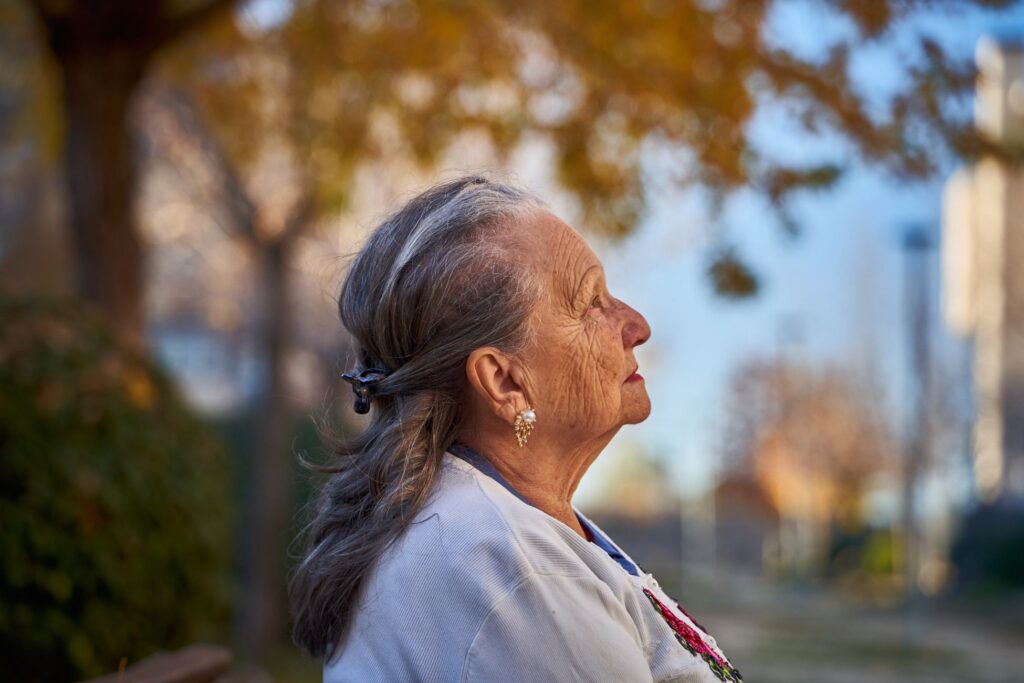
The people who become more beautiful in their fifties, sixties, seventies are almost never the ones with the most disciplined skincare routines. They are the ones who have stopped waging a low-grade civil war against their own life. You can see it in a photograph before you can name it: something in the mouth has unclenched, something behind the eyes has stopped bracing, and the face has finally been allowed to belong to the person wearing it.
The conventional story about aging attractively is a story about maintenance. Retinol, sunscreen, sleep, water, the right acids in the right order. That story isn’t wrong, exactly. It’s just incomplete in a way that misses the more interesting variable. Two people can follow the same routine for twenty years and end up looking like they lived two entirely different lives, because they did. One kept arguing with who she’d become. The other, at some point nobody could pinpoint, quietly stopped.
The face is not a canvas, it is a residue
Faces settle into the expressions they’ve held most often. The corrugator muscles between the brows deepen with years of low-grade worry. The masseter thickens with years of clenching. The small muscles around the mouth pull downward with a habit of contempt or upward with a habit of amusement, and by fifty the face is essentially a topographical map of which feelings a person has had the most practice with.
None of this is controversial. What’s less discussed is that the argument a person has with their own life shows up in the face more clearly than almost any other emotion, because it’s the one that gets rehearsed most privately and most often. The woman who spent forty years wishing she were softer, thinner, more accomplished, more loved, more anything — that argument leaves a residue. Not because wishing is a moral failure, but because a face held in low-grade opposition to itself for decades will eventually calcify around that opposition.
Then something happens, sometimes gradually and sometimes in the aftermath of an ordinary Wednesday, where the argument simply loses its charge. The person is still not who they hoped to be at twenty-two. But they no longer feel obligated to be at war with the person they became instead. And the people around them start reaching for the word radiant without quite knowing why.

What people are actually responding to when they call someone attractive
A face that isn’t fighting anything is a face the viewer can rest their eyes on. There’s a reason people describe certain older faces as easy to look at — the phrase is more literal than it sounds. The muscles are not holding a position. The gaze is not defending a perimeter. There is nothing being managed in real time between the person and their own reflection.
Attractiveness is also less fixed than the language around it suggests. Writing in Forbes, psychologist Mark Travers argues that attractiveness is far more flexible and contextual than most people realise, shaped by comparison, familiarity and presentation rather than by bone structure alone. Which leaves a great deal of room for what a face is doing, as opposed to how it happens to be arranged. Grooming can be copied. Ease cannot.
A YourTango list by editorial strategist Zayda Slabbekoorn, cataloguing what makes people respond to older women almost immediately, keeps circling one variable: these are women who are not performing or auditioning for approval. The list uses different language — confidence, self-knowledge, emotional maturity — but the underlying observation is the same. What people are responding to is the absence of an internal argument.
The specific way self-rejection ages a face
There is a particular expression that develops on the faces of people who have spent a long time not quite forgiving themselves for something. It’s rarely dramatic. Often it’s just a slight tension in the lower lids, a pull at the corner of the mouth that reads as guardedness even when the person is smiling. The face is doing two things at once: presenting to the world, and quietly disapproving of the presenter.
You can see it in family photographs across decades. The woman who spent her thirties convinced she’d married the wrong person and stayed anyway. The man who never made peace with the career he ended up in. The parent who never stopped being angry at their own body for aging on schedule. The face begins to hold the tension of that unresolved argument, and no serum reaches that layer.
The inverse is also true, and more interesting. When someone finally sets down the argument — not because they’ve resolved it triumphantly, but because they’ve grown tired of carrying it — the face tends to change sooner than anyone expects. Not lifted, exactly. Released. As if a muscle group that had been on duty for a decade was finally told it could stand down.
Why some people never make this shift
Not everyone softens. Some faces harden further with age, and it’s worth being honest about why. Chronic disapproval — of the self, of others, of how life turned out — is one of the most reliable predictors of a face that becomes harder to look at over time. The features may still be objectively symmetrical. But the viewer’s eye starts to slide off, looking for somewhere less effortful to land.
There’s a version of this that comes from years inside a relationship that required constant self-suppression. Writing in Psychology Today in June 2026, former FBI counterintelligence agent Joe Navarro and Deb Lieberman, PhD, describe how sustained pressure of that kind becomes legible in the face itself: the jaw tightens from constant clenching, the forehead furrows from repeated contraction, and the corners of the mouth settle downward. The body was holding a position it was never designed to hold indefinitely, and the position eventually became structural.
The psychoanalyst Adam Phillips, in a line that arrives in the first few pages of Missing Out, writes that we share our lives with the people we have failed to be. That failure, held tightly, is one of the most aging things a person can carry. Held loosely — with something closer to curiosity than grief — it seems to do almost the opposite.

The shift is rarely dramatic and usually late
People imagine self-acceptance as an event. A therapeutic breakthrough, a retreat, a divorce, a diagnosis, a decade of work. Occasionally it is. More often it arrives as a slow attrition of the will to keep fighting a fight that was never going to be won on its original terms. The woman doesn’t wake up loving her thighs. She just notices, on an ordinary morning, that she’s stopped thinking about them, and that she stopped thinking about them some time ago without noticing when.
This is why the shift so often happens in the mid-fifties and after. Not because there’s something biologically special about that decade, but because it takes that long to run out of energy for certain arguments. The person who spent her forties still trying to be the version of herself she’d planned on at twenty-nine finally, quietly, gives up. And giving up on that particular fight turns out to be the thing that makes her more magnetic than she has been in years, in a way she can’t quite account for and neither can anyone else.
What this means for anyone under sixty reading this
The uncomfortable implication is that a decade of expensive skincare will do less for how you age than a season of genuinely stopping the internal argument about who you were supposed to be. This isn’t a case against retinol. It’s an observation about proportionality. The face is downstream of the nervous system, and the nervous system is downstream of the story a person is telling themselves about their own life, and that story is doing more work than any serum.
The people who feel good in their later years — the ones who show up in essays about aging well — almost universally describe some version of this pivot, and they describe it as something they put down rather than something they took up. They didn’t get what they wanted. They got something else. And at some point they stopped treating the something-else as a consolation prize and started treating it as the actual life, the only one they were going to have, and worth inhabiting fully rather than resenting quietly.
What that looks like in the mirror is hard to describe and easy to recognize. The jaw is not set. The forehead is not braced. The eyes, when they meet yours, are not scanning for evidence of how you’re taking them. Something about the face has agreed to be seen. And the strange thing — the thing the skincare industry has no product for — is that once a face agrees to be seen, people want to keep looking at it, in a way that has almost nothing to do with whether the skin itself is smooth.
The person hasn’t gotten younger. They’ve gotten reconciled. And reconciliation, it turns out, is one of the most flattering lights a human face has ever been photographed in.