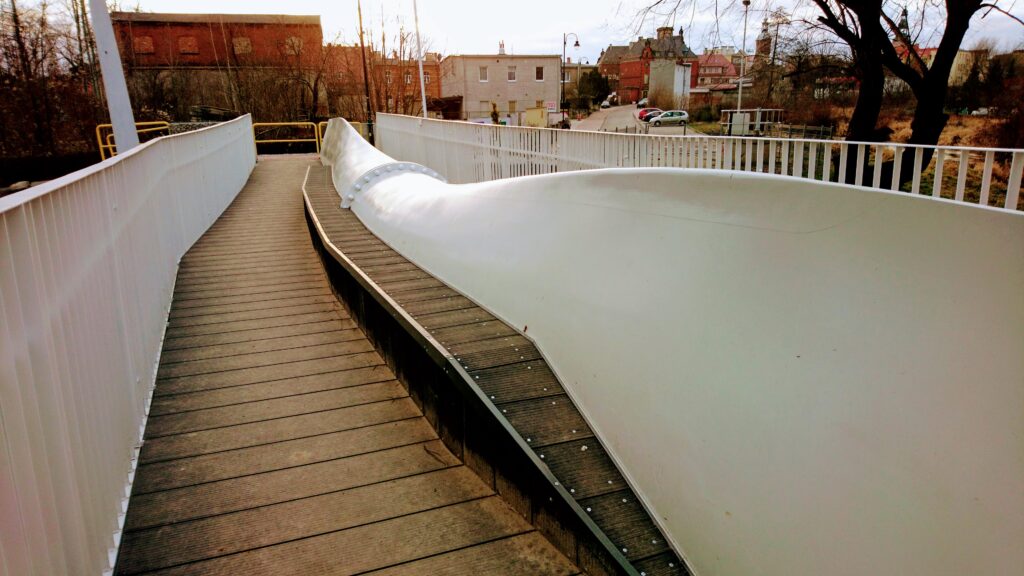
A wind-turbine blade is built to be beaten. Its shell is designed to hold shape through decades of gusts, rain, salt, and freeze-thaw at the top of a tower, and it is engineered so thoroughly against fatigue that when the turbine is finally retired the blade is usually still stubbornly, uselessly intact. At the Port of Aalborg in northern Denmark, one of those shells came down, got cut open, and went back to work about two meters off the ground: a section of a decommissioned blade now sits on steel bearings as the curved roof of a bicycle shelter, and people lock bikes under it on ordinary weekday mornings. Baltic Transport Journal covered the installation under the headline “Under a wing”, and CleanTechnica picked it up from Danish trade reporting at Metal Supply. The part of a wind farm that recyclers least want is, in this one case, doing weather duty at bicycle height.
From a needed bike shed to a cut-and-tethered midsection
The idea came from Brian D. Rasmussen, a civil engineer who works with port constructions and the environment at the Port of Aalborg. The port needed somewhere for staff to park bikes out of the rain. Next door sits a Siemens Gamesa blade facility, and a blade became available — the root end had been sent off to a test in Germany, which left the midsection without a destination. Rasmussen looked at the leftover piece and saw a roof that already had the right shape: a long hollow airfoil, curved in section, closed on top, open at both cut ends.
The hard part was that nobody had the drawings. A blade is not a simple tube; it is a shell with internal webs and spar caps, and its stiffness depends on where material sits. Cutting a doorway in the wrong place could take the stiffness out of the piece. Without the original plans to consult, Rasmussen spent a weekend building a scale model out of cardboard and wood, cutting openings into it to see which removals the form could tolerate and which ones let it slump. That model did the structural reasoning the missing paperwork could not.
From there it became a small local build. Kærsholm Diamond Drilling cut the openings in the composite. The interior was gutted carefully rather than hollowed out wholesale, so the remaining structure stayed stable. Brunø Stål fabricated the bearings and supports the shell now rests on, and the blade is tethered to them — a blade section is light for its size and generous in surface area, exactly the combination that a coastal wind likes to lift. Concrete foundations anchor the whole assembly to the ground. The result is a shelter whose roof was never drawn as a roof, held in place by steelwork made a few kilometers away.
Why the shell was available in the first place
Blades are hard to recycle for a reason that has nothing to do with effort and everything to do with chemistry. They are made of glass or carbon fibers embedded in thermoset resin. Thermosets cure into a permanent cross-linked network; unlike a thermoplastic, they cannot be melted back down and re-formed. Grinding a blade breaks the fibers and yields a filler of limited value. The most common industrial route is to chop the material up and burn it for energy, often in cement production, which recovers heat but ends the material’s life.
That is the trade Rasmussen pushed back on, in lines reported in the Danish coverage and echoed in the English-language pickup: the material is strong, close to indestructible, and — his word — quite beautiful, so reusing the shell intact struck him as better than shredding it for fuel. The Aalborg shelter takes the property that makes blades a disposal headache, their refusal to degrade, and treats it as the point.
Siemens Gamesa enters this story in one capacity only, and it is worth being precise about it: the neighboring blade factory supplied the blade. The company did not design the shelter. The concept, the cardboard model, and the cutting plan came from the port side, executed by Danish subcontractors.
What one shelter settles, and what it doesn’t
A turbine typically runs on the order of twenty to twenty-five years before it comes down, and Denmark draws a large share of its electricity from wind — roughly forty percent in recent years by most national accounting. That arithmetic points in one direction: a steady, growing flow of retired blades arriving in yards across Europe, with estimates for mid-century global blade waste running into figures large enough that no one wants to be responsible for them. Those estimates are rough. The trend is not.
One bike shelter does not touch that stream. It consumes a single blade section, at a scale set by a port’s staff parking, and its method — a weekend of cardboard modeling to substitute for missing drawings — does not obviously industrialize. Chemical recycling routes, resin systems designed to be recoverable, and blades built for disassembly are the answers that scale; a shelter is not competing with them.
What it does demonstrate is a category that mass-processing tends to skip: reuse of the shell while it is still a shell. Cutting a blade into structure — shelters, footbridges, canopies, benches — keeps the fibers long and the geometry doing load-bearing work, which is the whole reason the material was expensive to make. Aalborg’s version of that argument is not on a slide. It is a curved composite section, cut open, bolted down, tethered against the wind that used to push it, holding rain off a rack of bicycles at a working port.