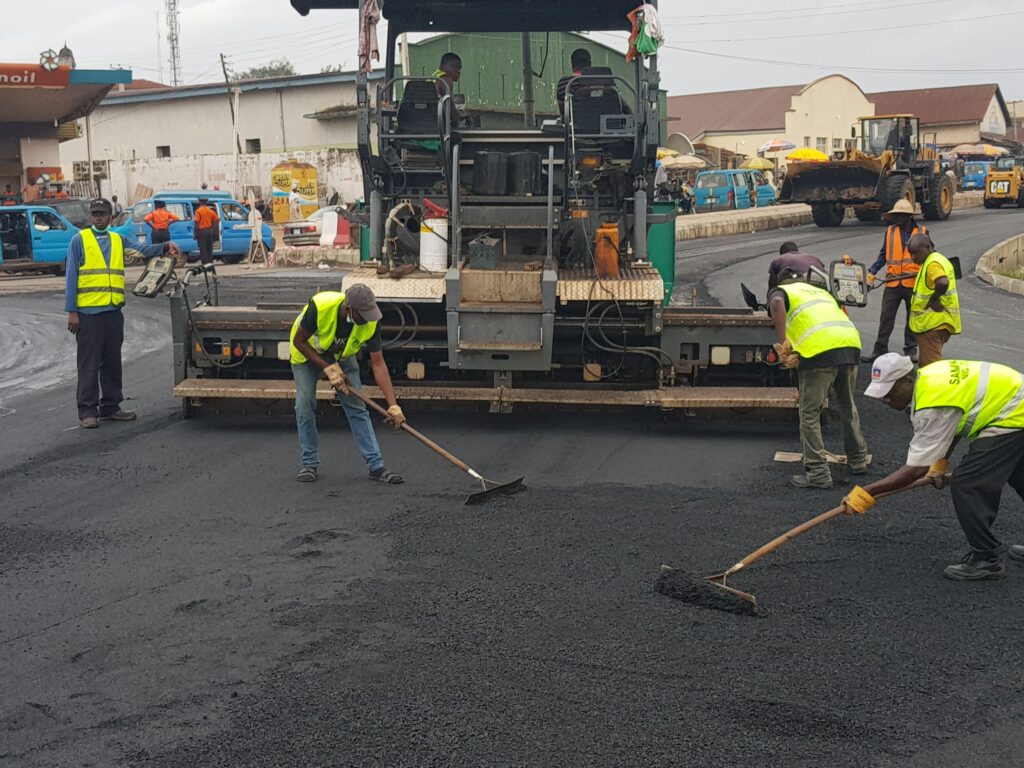
On the morning of April 22, 2021 — Earth Day — a paving crew worked a strip of the Xuhui campus at East China University of Science and Technology in Shanghai, and what went down behind the screed was not ordinary asphalt. Mixed into the binder was plastic that had spent its first life holding milk. Dow and the dairy brand Shiny Meadow describe the result as China’s first road surfaced with recycled-plastic asphalt: roughly 300 meters of pavement carrying more than 200 kilograms of plastic, sourced from more than 6,000 used milk bottles and other plastic wastes.
The number worth sitting with is not the 6,000. It is the 300 meters — a stretch a student can walk in four minutes, holding material that most recycling systems would have refused to touch.
The bottle that nobody wanted, and the chemistry that took it
A used milk bottle is a difficult object in the recycling economy, and the reason is banal: milk. Residue left inside a container turns a clean polymer stream into a contaminated one, and recyclers who are paid by the quality of their output have a standing incentive to pass. Dow’s framing of the project leans on exactly that reluctance — the bottles in this road were not scarce because plastic is scarce, but because this particular plastic tends to be sorted out and sent onward to disposal rather than reprocessing.
What changed the calculus was where the material was headed. Instead of being remade into another container, where color, odor, and food-contact rules matter enormously, the recovered plastic was routed into asphalt, where none of those properties are graded. The enabling technology is Dow’s ELVALOY RET, a reactive elastomeric terpolymer used to make polymer-modified asphalt, or PMA. In a PMA mix, polymer is blended into the bitumen binder so that the binder itself behaves differently — stiffer against rutting in heat, less brittle when cold, more resistant to the cracking that opens a road up to water.
That is the quiet trick of the ECUST road. Polymer-modified asphalt is not exotic; highway agencies specify it routinely, and the polymer normally arrives as virgin material. Here, part of the polymer load arrived as garbage. The bottles and other plastic wastes were processed and carried into the binder system rather than sitting on top of it as filler, which is why the project is described as a modification technology and not as a disposal method. The plastic has a job: it is doing structural work inside the material that holds the stones together.
Dow’s Asia Pacific packaging commercial lead, Bambang Candra, and Shiny Meadow brand director Lin Rong both framed the road publicly as a demonstration of what a hard-to-recycle package can become; ECUST vice president Li Tao spoke for the campus hosting it. The institutional shape matters — a consumer brand supplying the waste, a chemical company supplying the binder technology, a university supplying the ground.
Three hundred meters is a demonstration, not a waste stream
It is worth being precise about scale, because pavement projects invite inflation. The ECUST road is about 300 meters long, and reporting on the opening puts the recycled plastic content at more than 200 kilograms. That is a quantity a single urban district generates in a morning. Nobody involved claimed otherwise; the road was built on a university campus, not a trunk highway, and campuses are where you put a surface you intend to watch.
The value of a demonstration is that it converts an argument into an object. Before the road, the case for plastic-modified asphalt in China rested on performance data and on projects elsewhere — Dow points to earlier plastic-improved roads in Depok, Indonesia, in 2017, and to stretches in Pune and Bangalore in India, along with work in Thailand with SCG. After the road, there is something in Shanghai that can be driven over, cored, and measured through actual seasons, using material sourced from an actual Chinese consumer waste stream rather than an imported assumption.
What 300 meters cannot settle is supply. A road program of any real size needs contaminated post-consumer plastic delivered in consistent volume, at consistent quality, at a price that competes with virgin polymer — and the collection systems that would do that are the same ones currently declining milk bottles. The ECUST stretch proves the material works in the mix. It does not prove the material will show up.
What stays in the ground
There is a version of this story that ends with a claim about plastic waste solved, and it is not available. One campus road does not move a national number. The honest ending is smaller and more durable than that.
The pavement at ECUST is doing what pavement does: taking load, shedding water, holding its shape against Shanghai summers. Inside its binder sits a mass of polymer that was, not long before, more than 6,000 used milk bottles and an assortment of other plastic wastes — material whose most likely destination was a landfill or an incinerator, chosen not because it was worn out but because a film of milk made it expensive to clean.
Instead it was pressed flat, bound into bitumen, and rolled. The bottles are not recognizable. They are not recoverable as bottles. They are a modifier in a road surface, spread across 300 meters of campus, doing the one thing plastic is genuinely good at — resisting change — in a place where that stubbornness is an asset rather than a problem. When the students walk over it, the plastic is still under them, still working, still not in the ground the other way.