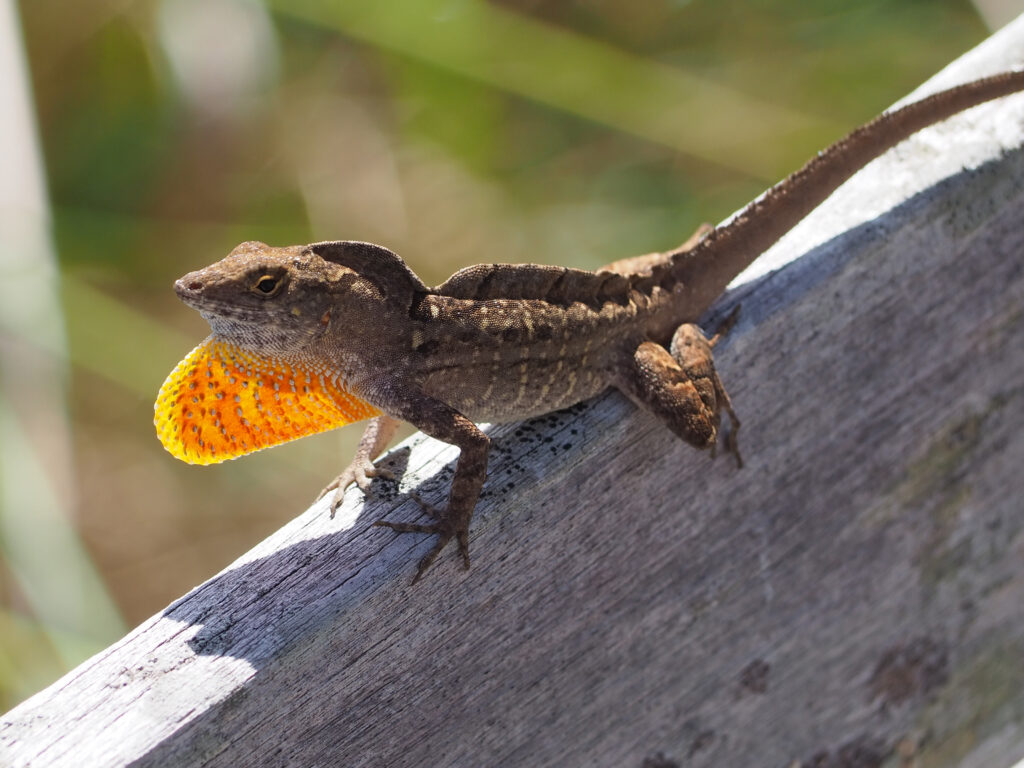
In May 2005, researchers walked onto a low Bahamian cay called Iron Cay, caught lizards essentially at random, and carried away fourteen of them — one male and one female for each of seven small islands nearby. Every receiving island had been stripped of its lizards a few months earlier, when storm surge from Hurricane Frances washed over them in September 2004. Each pair was released into an empty place. Within roughly four years, all seven of the new populations had shifted in the same direction: shorter hindlimbs relative to body size, as reported by Kolbe and colleagues in Science in 2012 under the title “Founder effects persist despite adaptive differentiation: a field experiment with lizards.”
The species is Anolis sagrei, the brown anole — a small, perch-loving lizard whose legs are one of the most closely studied trait systems in evolutionary biology. What makes this particular result unusual is not that anole limbs changed. It is that the starting conditions were known. Somebody wrote down which two animals founded each population, and on which day.
Seven cleared islands and a prediction about legs
The design leaned on a disturbance no one arranged. Frances submerged a set of very small, sparsely vegetated islands near Great Abaco and extirpated the lizards living on them. The researchers’ supporting materials report that the islands were searched repeatedly after the hurricane and again before the experiment began, with no lizards found. That left a row of comparable, tenantless habitats — a rare thing in field ecology, where nearly every experiment has to argue about what was there before.
Iron Cay, the source, is a different kind of place: a vegetated area of more than 150,000 square meters, more forested, with thicker trunks and broader branches. The seven experimental islands are tiny by comparison — vegetated areas of roughly 35 to 175 square meters — and the plants that grow on them are scrubby, with narrow perches. Those dimensions and the May 2005 introduction of one randomly selected male and female to each island are described in the original study.
That difference is what generated a prediction. Anole limb length and perch diameter have a biomechanical relationship: longer hindlimbs deliver speed and jumping power on broad surfaces, while shorter limbs are easier to control on thin, unstable ones, where a long-legged sprint mostly means falling off. Move a forest-sourced population onto narrow scrub and the expected direction of change is downward — shorter hindlimbs, relative to body size. The study’s PubMed record summarizes that prediction and reports that all seven populations adapted in that direction in response to the narrower vegetation.
So the experiment set up a comparison that is usually impossible to make. If selection is strong and the environment is consistent, all seven islands should move the same way. If founder effects dominate — if the genetic accident of which two lizards happened to be caught sets the trajectory — the islands should scatter, each carrying the idiosyncrasies of its particular pair. The seven islands offered seven independent draws from the same source.
What the measurements showed from 2006 to 2009
Populations established. The founding pairs reproduced, and the researchers sampled the islands across the following years, through 2006 to 2009, measuring limbs alongside body size. The supplementary methods describe the annual censuses, genetic sampling and morphological measurements used across the seven experimental founder islands.
All seven populations shortened. Relative hindlimb length decreased by about 6.5 percent in males and 4.0 percent in females, calculated at the median body size for each sex. It is worth being precise about what that figure compares: it tracks the change across the later sampling window rather than a direct measurement of the two founders’ own legs. The Science paper describes the shift as large enough that the 2006 means sit nearly non-overlapping with the 2009 values — the distributions barely share ground.
Parallel change across seven independent populations is the part that carries weight. Each island had its own founding pair, its own demographic history, its own bad luck and good luck in the first breeding seasons. Random drift in small populations pushes traits in arbitrary directions; it does not push seven populations the same way at once. A shared environmental pressure does. Narrow perches on all seven islands, shorter limbs on all seven islands.
There is a real caveat the authors handle rather than hide: these islands are not sealed. Genetic sampling in 2007 and 2009 identified a small fraction of putative first-generation immigrants — on the order of 11 percent — meaning some gene flow reached the experimental populations from elsewhere. The supporting analysis reports 21 of 188 sampled individuals as possible immigrants under assignment testing, with pedigree analysis producing the same overall estimate. That trickle is not enough to explain the coordinated limb shift, and it did not wash out the founding signal.
Two forces, both still visible in the same lizards
Here is where the result stops being a simple story about adaptation. Selection pulled every island’s limbs shorter, and yet the islands did not converge into one indistinguishable population. The differences seeded by the founding pairs persisted. That combination — adaptive change occurring while founder effects remained detectable — is the central conclusion summarized in the study’s Washington University research record.
Each pair carried only a slice of Iron Cay’s variation. By 2006, the experimental islands showed an average decrease of about 46 percent in allelic diversity and about 23 percent in heterozygosity compared with the source population — the genetic narrowing you would expect when a population starts from two animals. The original study reports those figures from multilocus genotypes at six microsatellite loci. And the among-island differences, both genetic and morphological, held up. Islands founded by different pairs remained distinguishable from one another even after four years of selection pushing them in the same direction.
That is the finding the title of the paper points at. Founder effects are often treated as noise that adaptation eventually erases, a transient starting condition on the way to whatever the environment demands. Over this timescale, on these islands, it did not work that way. The populations moved toward the phenotype that narrow scrub favors, and they stayed marked by the accident of who arrived first.
The trait values measured in 2009 were not set by one process or the other. They were set by both at once — the environment specifying a direction, and the founding pair specifying the point of departure, with the second still legible after the first had been working for four years. That conclusion matches the authors’ summary that founder effects and natural selection jointly determined trait values in the experimental populations.