Editor’s note: This article was originally published on Eluxe Magazine and has been updated and republished in August 2026 under The Vessel’s editorial standards.
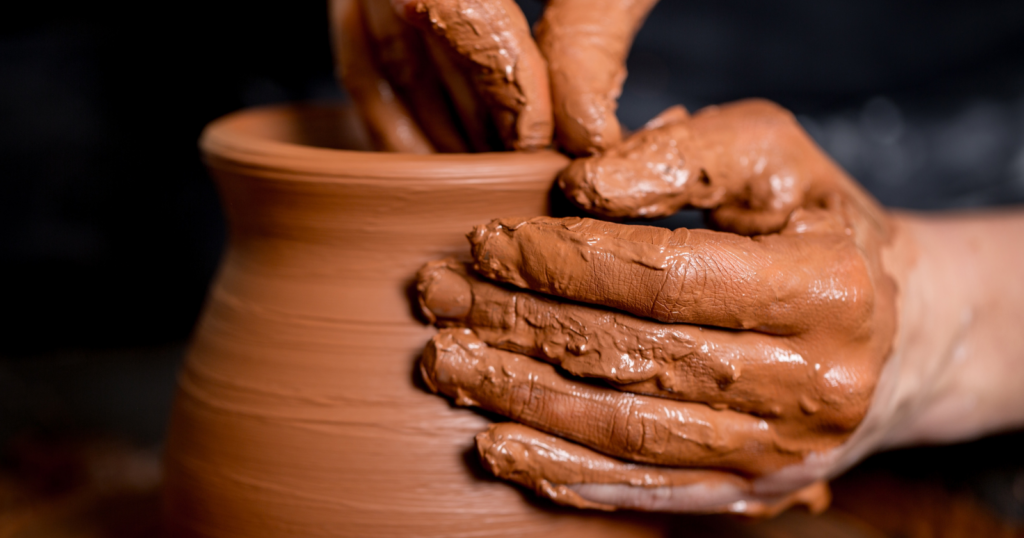
For millennia, humans have been creating drinking vessels, jugs, plates, vases, and even jewellery out of clay. Even today, given the vast variety of materials available, clay remains one of the more durable and aesthetically versatile options. Derived directly from the earth, it is formed into ceramics that are not only functional but serve as considered home interior objects. Stoneware, earthenware, and porcelain all originate from mineral-rich soil — and when their useful life is over, they can return to it.
That natural origin makes ceramics feel inherently sustainable. But a closer look at how they are mined, fired, glazed, and finished reveals a more complicated picture.
What clay is actually made of
Clay is not a single material. Different clay types produce different objects, and the source and composition of each will shape its environmental profile. The main categories in common use include:
- Kaolin, or china clay, used for porcelain
- Ball clay, a fine-grained variety that adds plasticity to porcelain blends
- Fire clay, valued for its high heat resistance
- Stoneware clay, heat resistant with a finer grain structure
- Red clay, used for bricks
The original source of the material can determine how sustainable a finished ceramic is. Natural mineral clay is well suited to safe, sustainable pieces such as vases. Terracotta clay works well for mugs, but not so well for sanitary applications such as toilets. The problems tend to arise less in the clay itself than in what happens to it afterward.
One issue worth noting: some modern ceramics now have plastics added to the clay body to make them more durable, which undercuts the claim that the finished object is a purely natural material.
The energy cost of the kiln
The most commonly cited sustainability concern with ceramics is the energy required to fire them. Kilns operate at temperatures in the thousands of degrees — high enough to vitrify clay and lock in a glaze. Many glazed pieces require two separate kiln firings to finish. When that energy comes from fossil fuels, the carbon footprint of even a single cup can be significant on paper.
A kiln is rarely fired for a single object; dozens of pieces may be baked in one load, which distributes the energy cost across the batch. Ceramicists commonly argue that pottery compares favourably with glass on firing energy, though the comparison depends heavily on the kiln, the fuel and the firing schedule. In larger studio and industrial settings, some ceramicists say heat recovery systems can capture excess kiln heat for building heating or hot water — meaning the kiln contributes to the facility’s energy budget rather than drawing further from it.
Surplus heat can in principle be pushed further out — into neighbouring community buildings, or into grow-tunnels for heat-loving crops such as tomatoes. Arrangements like these show what becomes possible when kiln energy is treated as a design consideration rather than an afterthought.
The glaze question
Glazed ceramics share the chemical stability of glass, which is part of why ceramic objects — cups, jewellery, tiles — can survive for thousands of years. Both materials are brittle under sudden temperature change, and neither has a fixed advantage over the other: borosilicate glass is engineered specifically to resist thermal shock, while porous earthenware ceramic is among the more vulnerable options in either category. Vitrified stoneware and porcelain tend to hold up better than either ordinary glass or earthenware.
That durability has a clear sustainability argument behind it: an object built to last does not need replacing, unlike single-use plastic or paper alternatives. Wood and bamboo plates and cups may last longer than those disposable materials, but they are more prone to water damage, scratches, and cuts than ceramic is.
The durability argument only holds, however, if the glaze itself is non-toxic. Certain traditional and lower-cost industrial glazes contain lead. The FDA’s position is blunt: where pottery has not been manufactured properly, lead can leach into food and drink prepared, stored or served in it — and no amount of washing or boiling will remove lead from the piece afterwards. Lead-containing glazes are also problematic if the objects are not disposed of correctly at end of life.
A wide variety of non-toxic glazes is available. For many household objects — jugs, pots, decorative vases — unglazed pottery sidesteps the issue entirely, as it is essentially baked earth with no chemical finish at all.
Greener approaches in production
A number of ceramics producers have begun addressing the glaze and waste questions more directly. The UK tableware manufacturer Denby makes its Kiln Green range in its Derbyshire factory using local Derbyshire clay fired at 1,200 degrees, and describes the range as made to last.
The company has also described recycling its glaze materials, recycling clay that fails quality inspection rather than discarding it, and restoring the land it extracts clay from to pasture afterwards. Those are the manufacturer’s accounts of its own operations rather than independently audited figures, which is the level of confidence most sustainability claims in this category come with.
Denby represents the industrial end of the spectrum. At the other end are small artisans hand-making individual pieces, where the answer depends entirely on the choices that particular maker has made. The environmental profile of a handmade studio piece and a mass-produced supermarket ceramic can differ considerably, even though both are technically “ceramic”.
Which points to the practical advice the original article landed on: seek out small makers, and ask them directly what their practices are.
Where ceramics compare well
The sustainability case for ceramics becomes stronger when measured against the realistic alternatives for specific applications. Ceramic bathroom tiling’s footprint relative to stone depends heavily on sourcing: importing granite or marble over long distances can push stone’s footprint above ceramic’s, but at least one direct lifecycle comparison found ceramic tile’s own kiln-firing energy gave it a higher footprint than locally sourced granite tile. There’s no settled answer here — it comes down to where the specific material in question was quarried or fired, and how far it traveled.
Ceramic-coated cookware is often chosen because it avoids PTFE-based non-stick coatings altogether, which is a question of what a buyer would rather not have in the pan rather than a demonstrated health advantage. And for sanitary fittings and dental implants, it is hard to picture what would substitute for it at all.
Ceramics are not the right answer for every application, and they are not automatically sustainable simply because they originate from the ground. But when the clay source is responsibly managed, the kiln energy is efficiently used or recovered, the glaze is non-toxic, and the finished object is made to last, the material’s environmental footprint is relatively modest compared to most alternatives.
The full picture of ceramics’ sustainability depends on decisions made at every stage of production — decisions that vary considerably between a mass-market manufacturer and a small studio potter. Understanding those variables is what allows a buyer to make a genuinely informed choice.