
Editorial note: This article was originally published on My Inner Creative and has been updated and republished in May 2026 under The Vessel’s editorial standards.
Doodling is one of the older companions to writing, predating the bullet journal by several thousand years. People have decorated the margins of their notes for as long as there have been notes to decorate. What is new is the bullet journal’s habit of pulling those marginal drawings into the centre of the page and making them part of the system. A small drawing beside a Tuesday task, a hand-drawn icon at the top of a weekly spread, a row of tiny doodles standing in for a habit tracker — all of these are doodles working as functional elements rather than as filler.
The sixty doodle how-to’s collected below were originally featured on My Inner Creative as step-by-step guides for adding small drawings to a journal. They cover the categories that come up most often in bullet journals — floral motifs, banners and section headers, animal characters, recurring household objects, and a miscellaneous set of items that show up on weekly spreads for no better reason than that the person keeping the notebook found them pleasant to draw.


Why doodle in a bullet journal
Doodling has a longer research history than its informal status suggests. In a 2009 study reported on the Harvard Health Blog, the psychologist Jackie Andrade asked forty people to monitor a two-and-a-half-minute dull, rambling voicemail message. Half the group doodled while listening — they shaded in a shape — and half did not. Neither group was told that their memory would be tested afterwards. When both groups were asked to recall details from the call, those who had doodled remembered twenty-nine percent more information than those who had not.
One interpretation is that doodling occupies a portion of attention that would otherwise drift away from the main task. The bullet journal is one of the more convenient places to make use of this. A small drawing beside the day’s list functions partly as decoration, partly as a way of keeping the hand and attention engaged while the rest of the page does its more functional work.
The Harvard Health Blog article that reported the Andrade study went further, suggesting that spontaneous drawings may also help relieve a kind of low-level psychological distress. People naturally try to make sense of their lives by stringing events into coherent stories, and when there are gaps in those stories that resist being filled, doodling appears, in the blog’s account, to help bring scattered fragments back together so the overall picture feels more whole. None of this is offered as a strong scientific claim. It is more of a working observation about why doodling tends to feel useful in moments that have no other obvious purpose for it.

Reported benefits of doodling
The Andrade study is the most-cited piece of evidence for doodling’s effect on attention, but it sits inside a broader pattern of observations that practitioners and researchers have noted over time. None of what follows is clinical. These are tendencies that people who doodle regularly report, and they are consistent with what the research loosely suggests.
Concentration. The leading explanation for the Andrade finding is that doodling gives the brain a low-demand secondary task. Without it, a wandering mind tends to generate its own distraction — daydreams, internal monologue, the rehearsal of unrelated problems. A simple repetitive drawing occupies just enough cognitive bandwidth to prevent that drift without pulling attention away from the primary task. This is why the effect is most noticeable during activities that are engaging enough to warrant attention but not demanding enough to hold it entirely: a long meeting, a lecture, a phone call.
Creative thinking. Doodling tends to lower the threshold for associative thinking. Working in a loose, low-stakes visual mode seems to make it easier to make connections between ideas that feel distant from each other in ordinary analytical thinking. Whether this is a direct effect of the drawing itself or simply a product of the relaxed, unfocused state that doodling induces is not well established. In practice the distinction does not matter much.
Emotional processing. Expressive drawing has a documented use in therapeutic contexts, though the kind of casual doodling people do in notebook margins is a long way from structured art therapy. The connection people report is more modest: giving a feeling a rough visual form — a shape, a pattern, a repeated motif — can make it feel more contained and less diffuse. This is probably why doodling tends to increase during stressful periods rather than calm ones.
Stress and restlessness. Repetitive mark-making — hatching, stippling, filling in shapes, drawing the same small motif over and over — has a mild self-regulating effect for many people. It is not unlike the function of other repetitive physical habits: tapping, fidgeting, walking. The rhythm is the point as much as the result.
Memory and learning. Beyond the Andrade finding on retention, there is a separate body of work on the value of making visual notes alongside verbal ones. Sketching a concept rather than (or alongside) writing it as a definition appears to strengthen encoding, possibly because it recruits more of the brain’s processing pathways for the same piece of information. This is a different claim from the attention-maintenance finding, and it applies more directly to active learning contexts than to passive listening.
Big-picture thinking. Several practitioners who use doodling as a professional tool — in facilitation, in strategy, in design — report that working visually tends to surface structure that is harder to see in text. A spatial representation of a problem makes relationships between its parts visible in a way that a list does not. Whether this applies to the casual doodling someone does in a personal journal is less clear, but it is a real effect in more deliberate visual note-taking contexts.

What you need to start doodling
The supply list for bullet journal doodling is short. A basic pen and some paper is enough to start. Markers or crayons can be used to fill in shapes once they are drawn. None of this is necessary. Many of the doodles in the gallery below were made with a single pen on plain notebook paper, and they hold up perfectly well.
For anyone struggling to find time or space for doodling in an already busy notebook, the simplest approach is to leave a small box on the weekly spread specifically for doodling. The boxes do not have to be large. The space does not need to be filled every day, and the small pressure of an empty box tends to invite a quick drawing more reliably than the open notebook does.


Featured doodle how-to’s
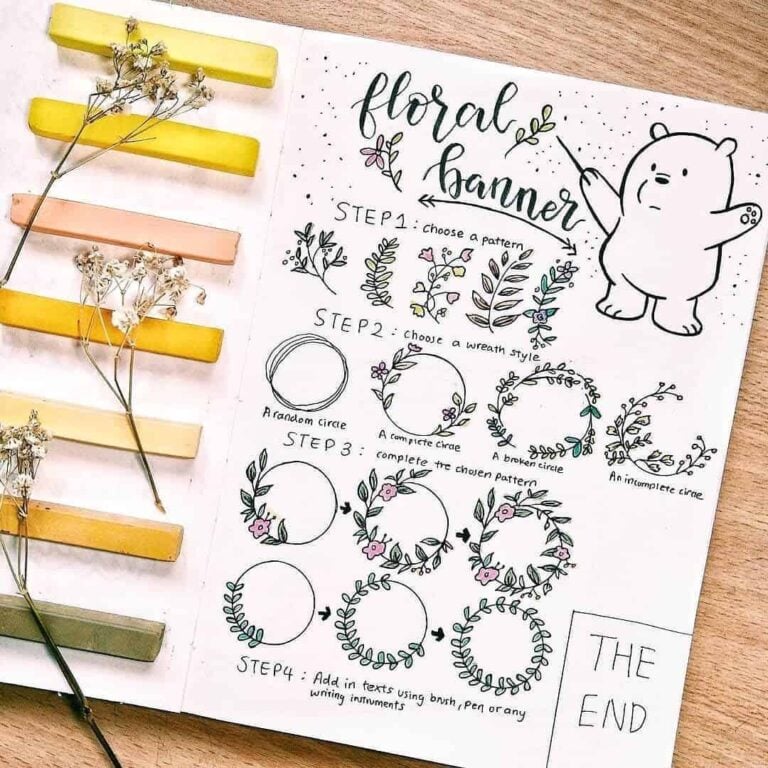
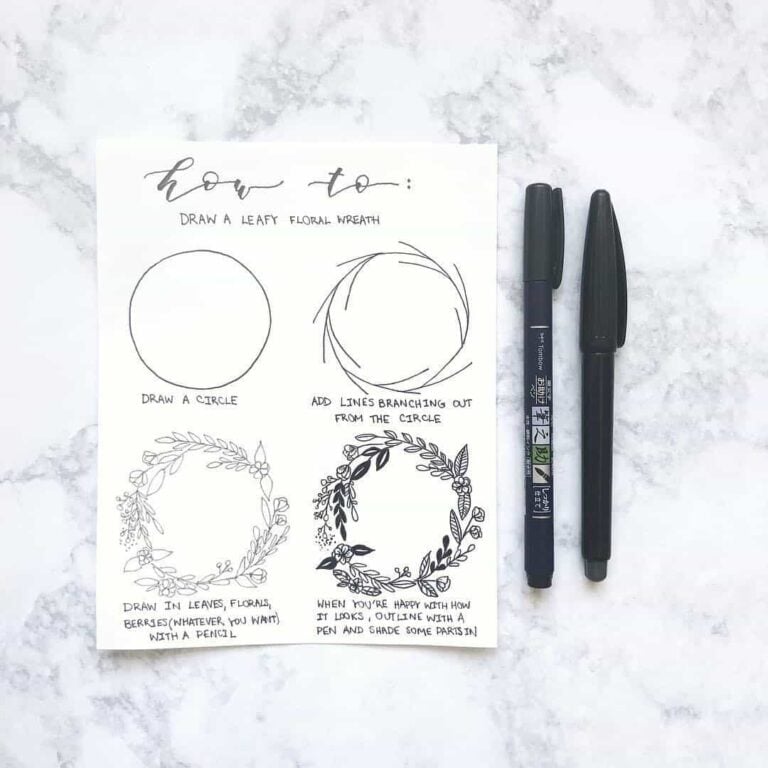
The gallery below collects sixty step-by-step doodle guides originally featured on My Inner Creative. They are grouped loosely by theme — florals, banners and headings, animals, characters, and miscellaneous household objects — and each guide breaks a doodle down into a few simple stages so that the final drawing can be approximated without practised illustration skill. The format is the same kind of thing many people remember from how-to-draw books and television shows aimed at children: a basic shape, then a few additions, then a few details, then the finished figure.
How to use these tutorials
Step-by-step doodle guides are useful in a specific way: they show you what a finished drawing can look like, and they break the path to it into stages small enough to follow. What they cannot do is teach you to draw. That distinction matters, because people who approach these tutorials expecting to produce a good copy of the final result on the first try tend to give up quickly when they do not.
The more productive approach is to treat the steps as a loose scaffold rather than precise instructions. Look at the sequence, get a rough sense of the structure of the drawing — where it starts, what the main shapes are, how the details are added — and then draw it from memory rather than tracing it step by step. A drawing made from a remembered version of a tutorial will look different from the original. That is fine. The goal is not reproduction; it is internalising a method for building a shape.
On the first attempt: Draw it small. Smaller than feels natural. A doodle that fits inside a two-centimetre square is harder to over-complicate than one that takes up a quarter of a page. Starting small also means that a bad version costs almost nothing and can be abandoned immediately in favour of a second try in the space next to it.
On repetition: Most doodles become usable after three or four attempts, not one. The first pass is diagnostic — you find out which part of the drawing resists you. The second pass addresses that part specifically. By the third or fourth, your hand has a rough muscle memory for the sequence and the drawing starts to feel automatic. This is the point at which a doodle becomes part of your visual vocabulary: something you can place on a page quickly, without referring back to the tutorial, whenever you need a small flourish in a corner or a divider between sections.
On imperfection: Bullet journal doodling does not require clean lines or consistent proportions. The hand-drawn quality is part of the aesthetic. Wobbles, uneven curves, and slightly lopsided shapes are not mistakes to correct; they are what make a hand-drawn spread look different from a printed one. The tutorials in this collection were made by people drawing in real notebooks with real pens, and they are instructive partly because they are visibly imperfect.
On choosing where to start: If you have not doodled in a journal before, the banners and heading sections are the most immediately useful place to begin. A hand-drawn banner that announces the start of a weekly spread takes about thirty seconds once you have practised it a few times, and it changes the character of the page significantly. Florals are the most popular category and also the most forgiving — a slightly asymmetrical flower reads as a flower regardless. Animals and characters are harder to bring off quickly and are better approached once you have spent some time with the simpler shapes.
Florals make up the largest section. They are popular as a bullet journal theme and they happen to break down particularly well into step-by-step instructions. Banners and headings are next; these are not strictly doodles in the freehand sense, but the same simple stage-by-stage format works for showing how to draw the small decorative banners that announce the start of a new section. Animals make up the third group, ranging from simple character drawings to slightly more detailed creatures. Doodle characters — small, expressive figures usually drawn with a few quick lines — come next, followed by a miscellaneous assortment of everyday household objects that show up most often as accents alongside other content on the page.








Building a doodling practice
The biggest obstacle to doodling regularly in a journal is not skill. It is the feeling that the notebook is too nice to draw badly in, or that a doodle has to be finished and intentional to be worth including. Neither of these is true in practice, but both are persistent enough that they keep a lot of people from starting, or from continuing past the first few attempts that do not look the way they hoped.
Start with a dedicated space, not a dedicated time. A small box drawn in pencil somewhere on the weekly spread — bottom corner, beside the habit tracker, wherever there is a sliver of margin — functions as a standing invitation. The box does not need to be filled every day. But its presence removes the decision of where to draw, which is often a larger friction than the decision of whether to draw. When the space is already there, the doodle tends to appear.
Keep the bar low deliberately. A useful frame for regular journaling doodles is to aim for something that takes under two minutes and uses only the pen already in your hand. Not a finished illustration; a mark that acknowledges the day. A rough leaf shape. A quick geometric pattern. A single repeated motif in a row across the bottom of the page. These are the kinds of drawings that accumulate into a visual language over months without feeling like a practice that has to be maintained.
Expect a period of drawing badly. The first few weeks of doodling regularly in a notebook tend to produce drawings that look worse than expected, partly because your expectations are formed by finished work you have seen and partly because your hand has not yet developed a vocabulary for translating a mental image into a mark. This phase is normal and finite. It does not last as long as it feels like it will at the time.
Borrow motifs, then modify them. Using tutorials as a starting point is a good strategy for the early stages, but the goal over time is to develop a small set of motifs that are recognisably yours — simplified enough to draw quickly, consistent enough to recur across spreads, varied enough that you can combine them in different ways. Most people who doodle regularly in journals end up with ten to twenty such motifs: a few flowers, a banner or two, a leaf shape, a small animal or character, a few geometric fillers. That is enough to decorate a spread without feeling repetitive.
Use the spread itself as the record of progress. One advantage of keeping drawings in a dated journal rather than on loose paper is that the progression is visible. Turning back through six months of weekly spreads and seeing how a recurring motif has become more assured — or how your relationship to blank space on the page has changed — is one of the more satisfying things about the practice. You do not need to archive your progress separately. The journal does it for you.
Most of the people who doodle regularly in their notebooks did not start out drawing well. They started out drawing badly, in small amounts, in the margins of pages that were doing some other job. The how-to’s collected here are useful in the same way the gallery format of bullet journaling is generally useful: not as templates to copy exactly, but as a survey of what the practice can look like when it is done casually, often, and without much pressure on the result being any good.