
Editorial note: This article was originally published on My Inner Creative and has been updated and republished in May 2026 under The Vessel’s editorial standards.
A bullet journal key is a short list of symbols and what each symbol means, written somewhere near the front or back of the notebook so that it can be referred to as the journal fills up. The key is what allows the rest of the notebook to be efficient: a single dot can stand for a task, a circle for an event, an arrow for something that has moved to a later date. Without the key, the notation has no shared meaning. With the key, the same small set of symbols can be used across hundreds of pages without ever needing to be spelled out.
The spreads collected below come from the My Inner Creative community and span minimalist symbol keys, decorated colour-coded keys, washi-tape-tabbed indexes, and hybrid keys that combine more than one approach. Before scrolling, it is worth making three decisions that will shape what you take from the gallery — and what your own key looks like when you draw it.
Decision 1: Symbols only, colour only, or both?
A symbol-only key works in any pen at any time. A colour-only key is faster to scan but requires carrying multiple pens. A hybrid key uses colour to group categories and symbols to show status within each category — for example, a blue dot for a work task and a blue cross when that task is done. Most journalers start symbol-only and add colour gradually as they work out which categories they actually use.
Decision 2: How many entries?
The most common mistake in a first key is adding too many entries upfront. A key with twelve entries before the notebook is a week old is a key with six orphaned entries by month three. A practical starting point is five: task, completed task, event, note, and migrated item. Every additional category should earn its place by appearing three or more times before it is promoted to the key.
Decision 3: Where does it live?
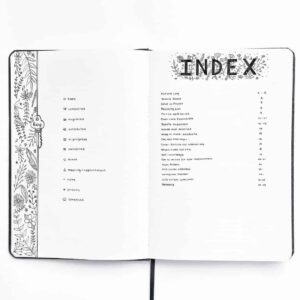
The key is only useful if it is findable. The inside front cover and the last page of the notebook are the two most reliable locations because they do not require an index entry to locate. If the key lives on an interior page, it needs a physical marker — a washi-tape tab, a ribbon, or a folded corner — or it will be scrolled past within a month. Several of the spreads below show how journalers have solved this problem in practice.
Where the key comes from
The original bullet journal system was developed by Ryder Carroll and documented in The Bullet Journal Method. Carroll’s starting point is a small concept called rapid logging, in which each item on the page is reduced to a single symbol that signals the item’s type at a glance — commonly a dot, a dash, an open circle, or an asterisk, though the specific shapes vary by journaler. The key is the legend for those symbols. It is the page that tells the reader what each shape means, and it is referred back to whenever the system’s notation comes up in a future page.
Most journalers begin with Carroll’s default symbols and then adapt the set over a few weeks of use. The default is small on purpose; the system is designed to be extended rather than copied. A reader who is borrowing the method for work will usually add categories for projects and meetings; a reader using it for school will add categories for assignments and reading. The key page is where those additions are recorded.

How a key is typically laid out
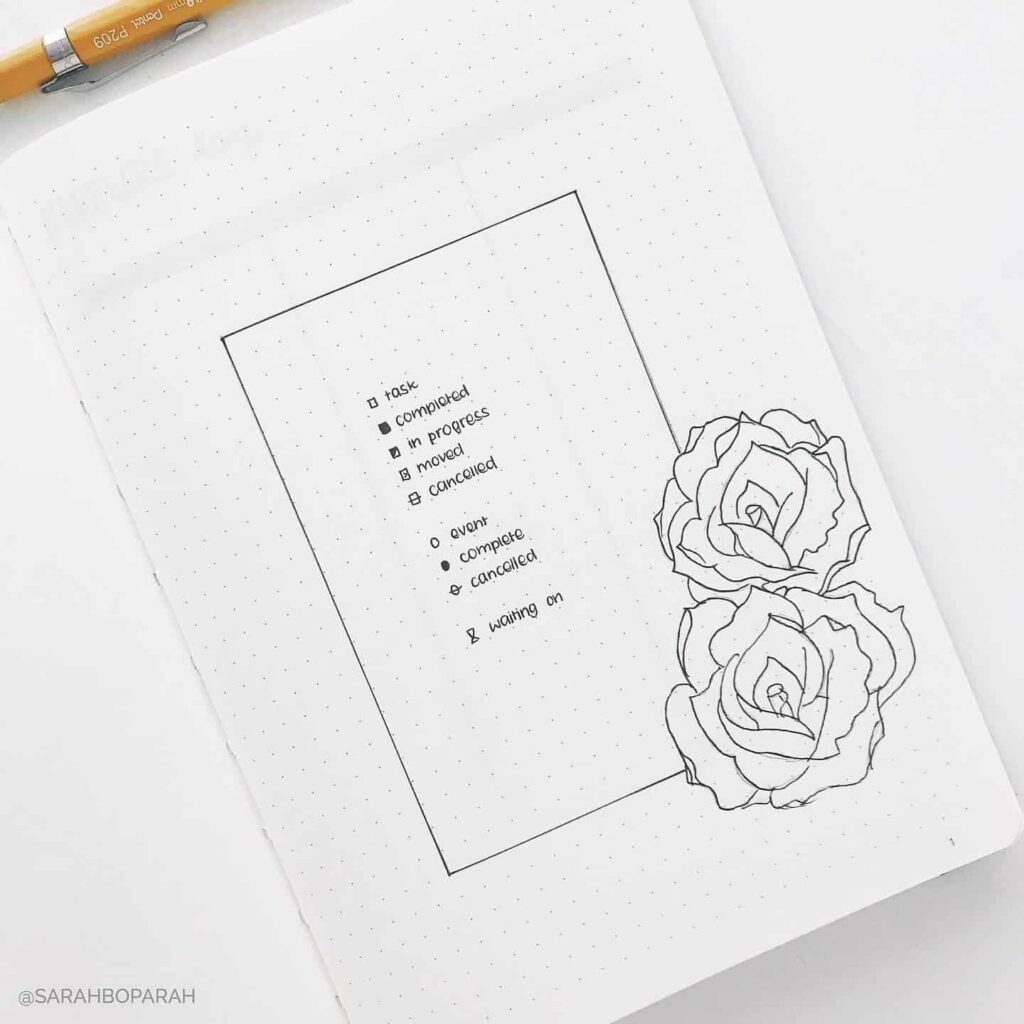
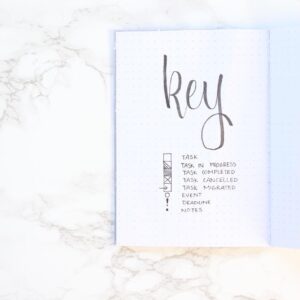
A key is almost always a vertical list: the symbol on the left, the meaning written next to it on the right. The list usually has between five and a dozen entries, though some of the spreads below run longer. The page is placed somewhere it will be easy to find — the inside cover, the first page, the very back, or marked with a bookmark or washi-tape tab on the edge.
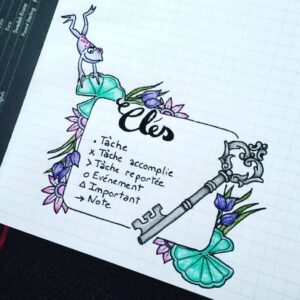
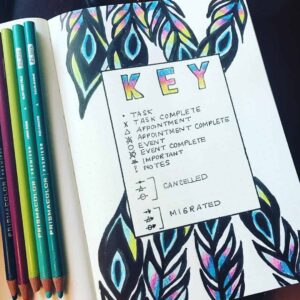
The handwriting and the symbol style are part of the design. A key drawn in plain pen with neat lettering is a different page from a key drawn in three highlighter colours with hand-lettered headers, and the gallery below contains both. The choice tends to follow whatever style the rest of the notebook is in. A minimalist notebook gets a minimalist key; a heavily decorated notebook gets a decorated key.

Common categories a key tracks
Across the spreads below, a small set of categories appears repeatedly. Carroll’s defaults in the original system are roughly:
- A task and its completion state — a dot that becomes a cross or a tick once the task is done.
- An event — an open circle.
- A note or observation — a dash.
- An idea — a small star or asterisk.
- A task that has been moved forward to a later date — a right-pointing arrow.
- A task that has been moved back to a list of someday-maybes — a left-pointing arrow.
- A cancelled task — a strike-through.
- A priority marker — a small dot or star alongside the existing symbol.
Beyond these defaults, journalers add categories that match their own use of the notebook: a separate symbol for things to research, for quotes worth keeping, for items connected to a specific project, or for occasions worth remembering later. The longer the key gets, the more important the placement becomes; a key that is hard to find is a key that gradually stops being used.

Colour, washi tape, and other variations
Several of the spreads below use colour as part of the key rather than only symbols. The pattern is to assign a colour to a category — green for personal, blue for work, red for urgent — and to mark the corresponding item in that colour rather than introducing a new symbol. Colour coding is faster to scan than a long symbol list, but it does require the journaler to be carrying the right pen at the right moment.
Washi tape is another common variation. A strip of patterned tape down the edge of a page can mark the page as belonging to a particular category, so that the notebook flips open to the right section without needing an index. Some journalers use washi tape for monthly dividers; others use it as a more durable version of a coloured highlight. Stickers and small icons sit in the same role — visual shorthand that adds a category without adding a symbol to the key list.
When a key helps and when it does not
Not every journaler uses one. A notebook that is mostly long-form notes, or one where the writer already has a habit of crossing things out and underlining what matters, often does not need a separate symbol legend. The key is a tool for the moments when many small items are being recorded quickly and the journaler needs a way to tell them apart at a glance later. For pages that are mostly running prose, the page itself does the work the key would have done.
A key tends to evolve with the notebook it sits in. The journaler may start with one set of symbols, drop the ones that go unused, and add a category or two as the notebook fills up. In that sense the key is itself a living page rather than a fixed reference, and many of the keys in the gallery below were drawn at a particular point in their journaler’s practice rather than as a final form.
40+ featured bullet journal key examples
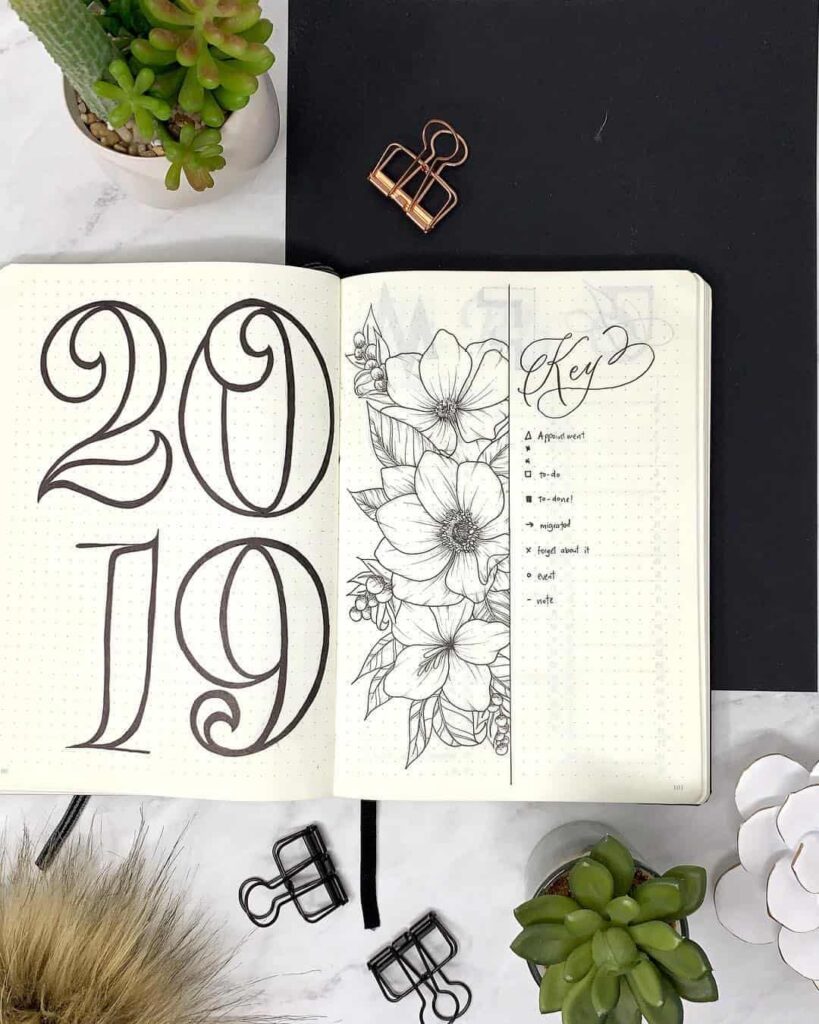
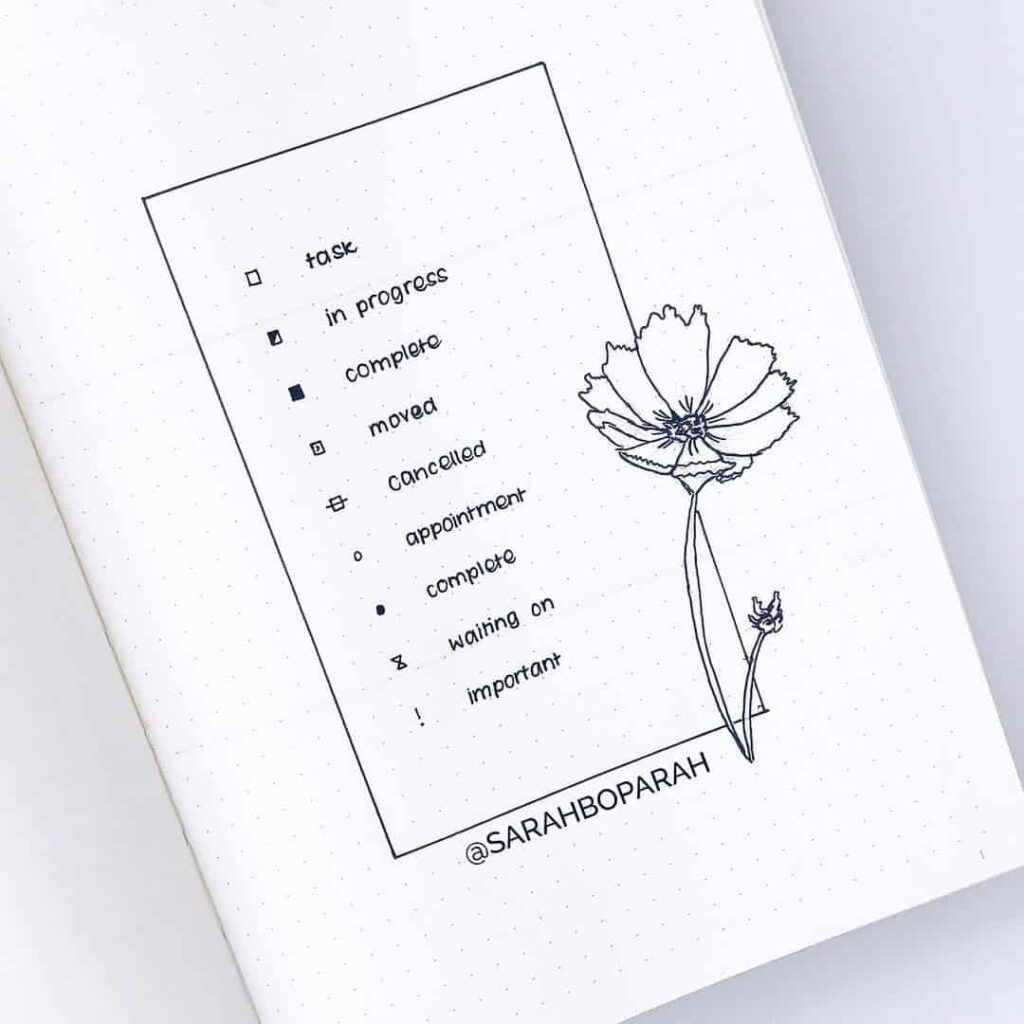
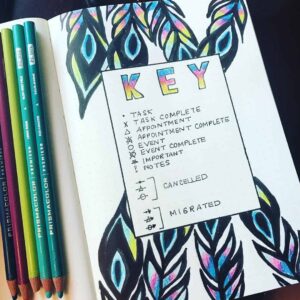
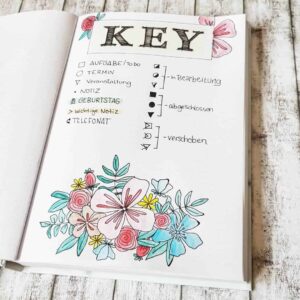
The spreads collected below come from the My Inner Creative community and span minimalist symbol keys, decorated colour-coded keys, washi-tape-tabbed indexes, and hybrid keys that combine more than one approach. They are included as a visual reference; any one of them can be redrawn in a notebook with a pen, and the colour and decoration in each is the journaler’s own preference rather than a requirement of the format.























Building and adjusting your key over time
Signs your key is working
A key that is working gets used without being thought about. You write a dot without deciding to write a dot. You glance at a page from three weeks ago and read it in under a second. The symbols feel like a natural extension of thinking rather than a formatting system to remember. If the key requires mental effort to apply, it usually means it has too many entries, the symbols are too similar to each other, or the categories do not match how you actually use the notebook.
Signs your key needs adjusting
There are four common failure modes. First: entries that never appear. If a symbol has not been used in six weeks, remove it. Second: categories that get written out in full repeatedly. If you keep writing the word “research” in full rather than using its symbol, the symbol is either too hard to draw quickly or too easy to confuse with another symbol. Third: a key that is never consulted. If you stopped checking the key page months ago, the system has either been memorised (which is fine) or abandoned (which usually means it was too complex). Fourth: a single symbol doing too much work. If the dot is standing in for tasks, ideas, questions, and reminders, it is time to split it.
When a key outgrows its original page
A notebook used for six months will often have a different key at the end than it did at the beginning. This is normal. The practical options are: maintaining a running key at the back of the notebook that is updated in place; starting a new key page at the beginning of each new notebook; or keeping a permanent key in a separate reference notebook and using the journal pages themselves for only the variations. Several long-term bullet journalers use a hybrid of the second and third approaches — a core set of symbols that stays constant across notebooks, with a small notebook-specific supplement for that volume’s particular projects.
Adapting the key for different contexts
The same person may keep different keys for different notebooks if they journal separately for work and personal life. A work key is likely to be symbol-heavy and functional; a personal key is more likely to use colour and decoration. Neither approach is more correct, and mixing the two in a single notebook is also common — a practical symbol list on one page, a colour-coded category reference on the facing page. The constraint is only that the key is consistent with itself: the same symbol should not mean two different things anywhere in the same notebook.
A good key gets forgotten about — which is exactly how you know it is working
The journalers whose spreads appear above did not sit down to make a beautiful key. They sat down to track something, and the key grew out of that. Some of the spreads in the gallery are immaculate; others are plainly functional. Both kinds work, because what makes a key useful has nothing to do with how it looks and everything to do with whether it matches how you actually use the pages it belongs to.
If you are starting from scratch, borrow five symbols, put the key somewhere you will find it without thinking, and leave room to add to it. If you have been journaling for a while and the key feels like friction rather than help, that is information — it probably has entries that no longer earn their place, or is missing a category you have been writing out in full for months without noticing.
The best version of a bullet journal key is the one that disappears into the background. When the system is working, you stop seeing the key and start seeing only the thinking it makes visible.